
LG V50 ThinQ 5G vs. Sony Xperia 1: A Deep Dive into Battery, Display, and Performance
| Phones Images | |||||
|---|---|---|---|---|---|
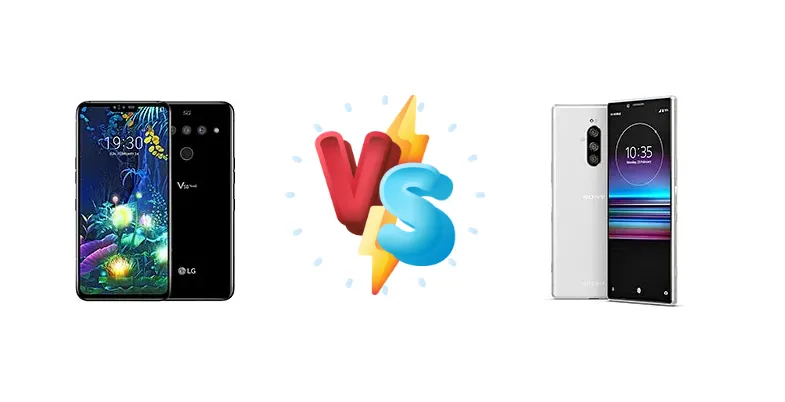
|
🏆 Quick Verdict
For the average user prioritizing all-day battery life and 5G access, the LG V50 ThinQ 5G is the clear winner. While the Sony Xperia 1 boasts a superior display, its shorter battery endurance and similar performance don't justify the price premium, even at current market values.
| PHONES | ||
|---|---|---|
| Phone Names | LG V50 ThinQ 5G | Sony Xperia 1 |
| Network | ||
|---|---|---|
| 2G bands | GSM 850 / 900 / 1800 / 1900 | GSM 850 / 900 / 1800 / 1900 |
| 3G bands | HSDPA 850 / 900 / 1700(AWS) / 1900 / 2100 - USA | HSDPA 800 / 850 / 900 / 1700(AWS) / 1900 / 2100 |
| 4G bands | 1, 2, 3, 4, 5, 7, 8, 12, 13, 17, 20, 25, 26, 28, 40, 41, 46, 66, 71 - USA | 1, 2, 3, 4, 5, 7, 8, 12, 13, 17, 19, 20, 26, 28, 29, 32, 38, 39, 40, 41, 46, 66 |
| 5G bands | 41, 260, 261 NSA | - |
| Speed | HSPA 42.2/5.76 Mbps, LTE (6CA) Cat18 1200/75 Mbps, 5G (2+ Gbps DL) | HSPA 42.2/5.76 Mbps, LTE Cat19 1600/150 Mbps |
| Technology | GSM / CDMA / HSPA / EVDO / LTE / 5G | GSM / HSPA / LTE |
| CDMA2000 1xEV-DO | - | |
| Launch | ||
|---|---|---|
| Announced | 2019, February 24. Released 2019, April 19 | 2019, February 25. Released 2019, May 30 |
| Status | Discontinued | Discontinued |
| Body | ||
|---|---|---|
| Build | Glass front (Gorilla Glass 5), glass back (Gorilla Glass 6), aluminum frame | Glass front (Gorilla Glass 6), glass back (Gorilla Glass 6), aluminum frame |
| Dimensions | 159.2 x 76.1 x 8.3 mm (6.27 x 3.00 x 0.33 in) | 167 x 72 x 8.2 mm (6.57 x 2.83 x 0.32 in) |
| SIM | · Nano-SIM· Nano-SIM + Nano-SIM | · Nano-SIM· Nano-SIM + Nano-SIM |
| Weight | 183 g (6.46 oz) | 178 g (6.28 oz) |
| IP68 dust/water resistant (up to 1.5m for 30 min) MIL-STD-810G compliant* *does not guarantee ruggedness or use in extreme conditions | IP65/IP68 dust/water resistant (up to 1.5m for 30 mins) | |
| Display | ||
|---|---|---|
| Protection | Corning Gorilla Glass 5 | Corning Gorilla Glass 6 |
| Resolution | 1440 x 3120 pixels, 19.5:9 ratio (~538 ppi density) | 1644 x 3840 pixels, 21:9 ratio (~643 ppi density) |
| Size | 6.4 inches, 100.2 cm2 (~82.7% screen-to-body ratio) | 6.5 inches, 98.6 cm2 (~82.0% screen-to-body ratio) |
| Type | P-OLED, HDR10 | OLED, HDR BT.2020 |
| Always-on display | Runs at 1096 x 2560 pixels except for select use cases Triluminos display X-Reality Engine | |
| Platform | ||
|---|---|---|
| CPU | Octa-core (1x2.84 GHz Kryo 485 & 3x2.42 GHz Kryo 485 & 4x1.78 GHz Kryo 485) | Octa-core (1x2.84 GHz Kryo 485 & 3x2.42 GHz Kryo 485 & 4x1.78 GHz Kryo 485) |
| Chipset | Qualcomm SM8150 Snapdragon 855 (7 nm) | Qualcomm SM8150 Snapdragon 855 (7 nm) |
| GPU | Adreno 640 | Adreno 640 |
| OS | Android 9.0 (Pie), upgradable to Android 11 | Android 9.0 (Pie), upgradable to Android 11 |
| Memory | ||
|---|---|---|
| Card slot | microSDXC (dedicated slot) | microSDXC (uses shared SIM slot) - dual SIM model only |
| Internal | 128GB 6GB RAM | 64GB 6GB RAM, 128GB 6GB RAM |
| UFS 2.1 | UFS 2.1 | |
| Main Camera | ||
|---|---|---|
| Features | LED flash, HDR, panorama | Color spectrum sensor, LED flash, panorama, HDR, eye tracking |
| Triple | 12 MP, 27mm (wide), f/1.5, 1/2.55", 1.4µm, dual pixel PDAF, 3-axis OIS 12 MP, 52mm (telephoto), f/2.4, 1/3.4", 1.0µm, 2x optical zoom, PDAF, OIS 16 MP, 16mm (ultrawide), f/1.9, 1/3.1", 1.0µm, no AF | 12 MP, f/1.6, 26mm (wide), 1/2.55", 1.4µm, predictive dual pixel PDAF, 5-axis OIS 12 MP, f/2.4, 52mm (telephoto), 1/3.4", 1.0µm, predictive PDAF, 2x optical zoom, 5-axis OIS 12 MP, f/2.4, 16mm (ultrawide), 1/3.4", 1.0µm |
| Video | 4K@30/60fps, 1080p@30/60/240fps, 24-bit/192kHz stereo sound rec., HDR10 video, gyro-EIS | 4K@24/25/30fps HDR, 1080p@60fps, 1080p@30fps (5-axis gyro-EIS), 1080p@960fps |
| Selfie camera | ||
|---|---|---|
| Dual | 8 MP, f/1.9, 26mm (wide), 1/4.0", 1.12µm 5 MP, 21mm (wide), f/2.2, 1/5.0", 1.12µm | - |
| Features | HDR | HDR |
| Single | - | 8 MP, f/2.0, 24mm (wide), 1/4.0", 1.12µm |
| Video | 1080p@60fps | 1080p@30fps (5-axis gyro-EIS) |
| Sound | ||
|---|---|---|
| 3.5mm jack | Yes | No |
| 35mm jack | Yes | No |
| Loudspeaker | Yes, with stereo speakers | Yes, with stereo speakers |
| 32-bit/192kHz audio 24-bit/192kHz audio recording Tuned with Meridian Audio | 24-bit/192kHz audio Dynamic vibration system | |
| Comms | ||
|---|---|---|
| Bluetooth | 5.0, A2DP, LE, aptX HD | 5.0, A2DP, aptX HD, LE |
| NFC | Yes | Yes |
| Positioning | GPS, GLONASS, GALILEO | GPS, GLONASS, BDS, GALILEO |
| Radio | FM radio | No |
| USB | USB Type-C 3.1 | USB Type-C 3.1, OTG |
| WLAN | Wi-Fi 802.11 a/b/g/n/ac, dual-band, Wi-Fi Direct, DLNA | Wi-Fi 802.11 a/b/g/n/ac, dual-band, Wi-Fi Direct, DLNA |
| Features | ||
|---|---|---|
| Sensors | Fingerprint (rear-mounted), accelerometer, gyro, proximity, compass, barometer | Fingerprint (side-mounted), accelerometer, gyro, proximity, barometer, compass |
| Battery | ||
|---|---|---|
| Charging | 18W wired, PD2.0, QC3, 50% in 36 min 10W wireless (Qi) | 18W wired, PD2.0 |
| Type | Li-Po 4000 mAh, non-removable | Li-Ion 3330 mAh, non-removable |
| Misc | ||
|---|---|---|
| Colors | New Aurora Black | Black, Gray, Purple, White |
| Models | LM-V500, LM-V500N, LM-V500EM, LM-V500XM, LM-V450PM, LM-V450 | J8110, J8170, J9110, J9150, SOV40, SO-03L |
| Price | About 550 EUR | About 500 EUR |
| Tests | ||
|---|---|---|
| Audio quality | Noise -92.5dB / Crosstalk -92.6dB | Noise -93.6dB / Crosstalk -85.2dB |
| Battery life | Endurance rating 96h | Endurance rating 79h |
| Camera | Photo / Video | Photo / Video |
| Display | Contrast ratio: 194000:1 (nominal) | Contrast ratio: Infinite (nominal) |
| Loudspeaker | -25.2 LUFS (Very good) | -26.7 LUFS (Good) |
| Performance | AnTuTu: 343758 (v7), 421934 (v8) GeekBench: 10928 (v4.4), 2672 (v5.1) GFXBench: 22fps (ES 3.1 onscreen) | AnTuTu: 356734 (v7), 418206 (v8) GeekBench: 10985 (v4.4), 2753 (v5.1) GFXBench: 33fps (ES 3.1 onscreen) |
LG V50 ThinQ 5G
- Exceptional battery life (96h endurance)
- 5G connectivity for faster data speeds
- Wireless charging support (Qi)
- Faster charging with Quick Charge 3.0
- Display brightness is lower than Xperia 1
- Less emphasis on cinematic features
Sony Xperia 1
- Unique 21:9 cinematic display
- High contrast ratio for deep blacks
- Premium build quality
- Focus on video recording capabilities
- Significantly shorter battery life (79h endurance)
- No wireless charging support
- Less practical aspect ratio for some apps
Display Comparison
The Sony Xperia 1 distinguishes itself with a 6.5-inch OLED display featuring a unique 21:9 aspect ratio, aiming for a true cinematic experience. However, its measured peak brightness of 665 nits falls short of the LG V50 ThinQ 5G’s 533 nits, though the difference isn't massive. The Xperia 1’s 'Infinite' contrast ratio suggests excellent black levels, typical of OLED technology, while the V50’s 194000:1 nominal contrast ratio is also very strong. The Xperia 1’s taller screen is ideal for multitasking and content consumption, but may present compatibility issues with some apps. The V50’s more conventional aspect ratio offers broader compatibility.
Camera Comparison
Both phones feature capable camera systems, but details beyond 'Photo / Video' are limited. The Xperia 1’s emphasis on a cinematic experience likely translates to a focus on video recording capabilities and color science. The V50, while also capable, likely prioritizes versatility and ease of use. Without specific sensor size or aperture information, it’s difficult to definitively declare a winner. The absence of details regarding image stabilization (OIS) on either device is a significant omission. The lack of information on the camera systems makes a detailed comparison impossible beyond stating both are capable of taking photos and videos.
Performance
Both the LG V50 ThinQ 5G and the Sony Xperia 1 are powered by the Qualcomm SM8150 Snapdragon 855 (7 nm) chipset, featuring an identical octa-core CPU configuration. This means raw processing power will be nearly indistinguishable between the two devices in most tasks. However, the LG V50’s larger battery capacity could potentially allow for sustained peak performance for longer periods, mitigating thermal throttling. Neither device specifies RAM speed, but both likely utilize LPDDR4X, common for the Snapdragon 855 era. The V50’s 5G modem adds a performance dimension the Xperia 1 lacks, offering significantly faster download speeds where 5G infrastructure is available.
Battery Life
The LG V50 ThinQ 5G boasts a significant advantage in battery endurance, achieving a measured 96 hours compared to the Sony Xperia 1’s 79 hours. This translates to a full day of heavy use with more headroom on the V50. Both devices support 18W wired charging with PD2.0, and the V50 adds Quick Charge 3.0 for faster charging with compatible adapters, reaching 50% charge in 36 minutes. The V50 also includes 10W wireless charging (Qi), a feature absent on the Xperia 1. The V50’s larger battery and faster charging options make it the clear winner for users prioritizing battery life.
Buying Guide
Buy the LG V50 ThinQ 5G if you need exceptional battery life, reliable 5G connectivity, and a more practical, everyday smartphone experience. Buy the Sony Xperia 1 if you prioritize a unique, cinematic display experience, and are willing to compromise on battery life and potentially deal with a less mainstream software experience.