
LG V50 ThinQ 5G vs LG V30: Is 5G and a Newer Chipset Worth the Upgrade?
| Phones Images | |||||
|---|---|---|---|---|---|
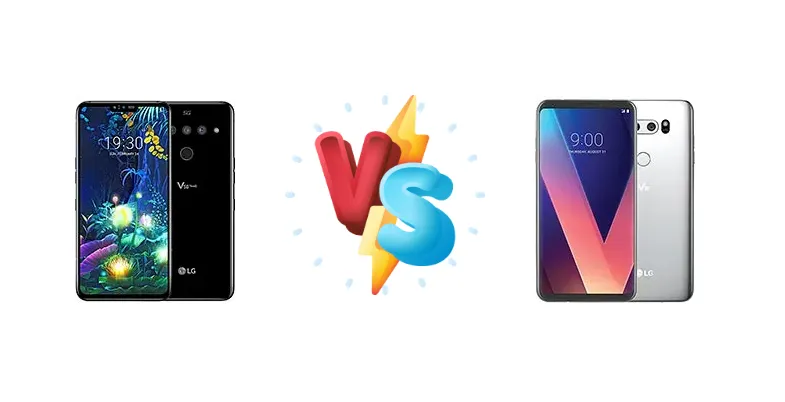
|
🏆 Quick Verdict
For users prioritizing future-proofing and faster data speeds, the LG V50 ThinQ 5G is the clear winner. Its Snapdragon 855 offers a noticeable performance boost, and 5G support provides a tangible benefit in supported areas. However, the V30 remains a strong contender for those seeking excellent value and a refined user experience.
| PHONES | ||
|---|---|---|
| Phone Names | LG V50 ThinQ 5G | LG V30 |
| Network | ||
|---|---|---|
| 2G bands | GSM 850 / 900 / 1800 / 1900 | GSM 850 / 900 / 1800 / 1900 - SIM 1 & SIM 2 (dual-SIM model only) |
| 3G bands | HSDPA 850 / 900 / 1700(AWS) / 1900 / 2100 - USA | HSDPA 850 / 900 / 1700(AWS) / 1800 / 1900 / 2100 |
| 4G bands | 1, 2, 3, 4, 5, 7, 8, 12, 13, 17, 20, 25, 26, 28, 40, 41, 46, 66, 71 - USA | 1, 2, 3, 4, 5, 7, 8, 12, 13, 17, 20, 28, 38, 71 |
| 5G bands | 41, 260, 261 NSA | - |
| Speed | HSPA 42.2/5.76 Mbps, LTE (6CA) Cat18 1200/75 Mbps, 5G (2+ Gbps DL) | HSPA 42.2/5.76 Mbps, LTE (4CA) Cat16 1024/150 Mbps |
| Technology | GSM / CDMA / HSPA / EVDO / LTE / 5G | GSM / HSPA / LTE |
| CDMA2000 1xEV-DO | - | |
| Launch | ||
|---|---|---|
| Announced | 2019, February 24. Released 2019, April 19 | 2017, August 31. Released 2017, December 05 |
| Status | Discontinued | Discontinued |
| Body | ||
|---|---|---|
| Build | Glass front (Gorilla Glass 5), glass back (Gorilla Glass 6), aluminum frame | Glass front (Gorilla Glass 5), glass back (Gorilla Glass 5), aluminum frame |
| Dimensions | 159.2 x 76.1 x 8.3 mm (6.27 x 3.00 x 0.33 in) | 151.7 x 75.4 x 7.3 mm (5.97 x 2.97 x 0.29 in) |
| SIM | · Nano-SIM· Nano-SIM + Nano-SIM | · Nano-SIM· Nano-SIM + Nano-SIM |
| Weight | 183 g (6.46 oz) | 158 g (5.57 oz) |
| IP68 dust/water resistant (up to 1.5m for 30 min) MIL-STD-810G compliant* *does not guarantee ruggedness or use in extreme conditions | IP68 dust/water resistant (up to 1.5m for 30 mins) MIL-STD-810G compliant* *does not guarantee ruggedness or use in extreme conditions | |
| Display | ||
|---|---|---|
| Protection | Corning Gorilla Glass 5 | Corning Gorilla Glass 5 |
| Resolution | 1440 x 3120 pixels, 19.5:9 ratio (~538 ppi density) | 1440 x 2880 pixels, 18:9 ratio (~537 ppi density) |
| Size | 6.4 inches, 100.2 cm2 (~82.7% screen-to-body ratio) | 6.0 inches, 92.9 cm2 (~81.2% screen-to-body ratio) |
| Type | P-OLED, HDR10 | P-OLED, HDR10, Dolby Vision |
| Always-on display | Always-on display | |
| Platform | ||
|---|---|---|
| CPU | Octa-core (1x2.84 GHz Kryo 485 & 3x2.42 GHz Kryo 485 & 4x1.78 GHz Kryo 485) | Octa-core (4x2.45 GHz Kryo & 4x1.9 GHz Kryo) |
| Chipset | Qualcomm SM8150 Snapdragon 855 (7 nm) | Qualcomm MSM8998 Snapdragon 835 (10 nm) |
| GPU | Adreno 640 | Adreno 540 |
| OS | Android 9.0 (Pie), upgradable to Android 11 | Android 7.1.2 (Nougat), upgradable to Android 9.0 (Pie) |
| Memory | ||
|---|---|---|
| Card slot | microSDXC (dedicated slot) | microSDXC (dedicated slot) - single-SIM modelmicroSDXC (uses shared SIM slot) - dual-SIM model |
| Internal | 128GB 6GB RAM | 64GB 4GB RAM, 128GB 4GB RAM |
| UFS 2.1 | UFS 2.1 | |
| Main Camera | ||
|---|---|---|
| Dual | - | 16 MP, f/1.6, 30mm (standard), 1/3.1", 1.0µm, PDAF, 3-axis OIS 13 MP, f/1.9, 12mm (ultrawide), no AF |
| Features | LED flash, HDR, panorama | Laser AF, color spectrum sensor, LED flash, HDR, panorama |
| Triple | 12 MP, 27mm (wide), f/1.5, 1/2.55", 1.4µm, dual pixel PDAF, 3-axis OIS 12 MP, 52mm (telephoto), f/2.4, 1/3.4", 1.0µm, 2x optical zoom, PDAF, OIS 16 MP, 16mm (ultrawide), f/1.9, 1/3.1", 1.0µm, no AF | - |
| Video | 4K@30/60fps, 1080p@30/60/240fps, 24-bit/192kHz stereo sound rec., HDR10 video, gyro-EIS | 4K@30fps, 1080p@30/60fps, 720p@120fps, 24-bit/192kHz stereo sound rec., HDR video |
| Selfie camera | ||
|---|---|---|
| Dual | 8 MP, f/1.9, 26mm (wide), 1/4.0", 1.12µm 5 MP, 21mm (wide), f/2.2, 1/5.0", 1.12µm | - |
| Features | HDR | - |
| Single | - | 5 MP, f/2.2, 22mm (wide), 1/5.0", 1.12µm |
| Video | 1080p@60fps | 1080p@30fps |
| Sound | ||
|---|---|---|
| 3.5mm jack | Yes | Yes |
| 35mm jack | Yes | Yes |
| Loudspeaker | Yes, with stereo speakers | Yes |
| 32-bit/192kHz audio 24-bit/192kHz audio recording Tuned with Meridian Audio | 32-bit/192kHz audio B&O Play certified 24-bit/48kHz audio recording | |
| Comms | ||
|---|---|---|
| Bluetooth | 5.0, A2DP, LE, aptX HD | 5.0, A2DP, LE, aptX HD |
| NFC | Yes | Yes |
| Positioning | GPS, GLONASS, GALILEO | GPS, GLONASS, GALILEO |
| Radio | FM radio | Stereo FM radio with RDS |
| USB | USB Type-C 3.1 | USB Type-C 3.1, OTG |
| WLAN | Wi-Fi 802.11 a/b/g/n/ac, dual-band, Wi-Fi Direct, DLNA | Wi-Fi 802.11 a/b/g/n/ac, dual-band, Wi-Fi Direct, DLNA |
| Features | ||
|---|---|---|
| Sensors | Fingerprint (rear-mounted), accelerometer, gyro, proximity, compass, barometer | Fingerprint (rear-mounted), accelerometer, gyro, proximity, compass, barometer |
| Battery | ||
|---|---|---|
| Charging | 18W wired, PD2.0, QC3, 50% in 36 min 10W wireless (Qi) | 18W wired, PD2.0, QC3, 50% in 36 min 10W wireless |
| Type | Li-Po 4000 mAh, non-removable | Li-Po 3300 mAh, non-removable |
| Misc | ||
|---|---|---|
| Colors | New Aurora Black | Aurora Black, Cloud Silver, Moroccan Blue, Lavender Violet, Raspberry Rose |
| Models | LM-V500, LM-V500N, LM-V500EM, LM-V500XM, LM-V450PM, LM-V450 | H930, H931, H932, H933, VS996, US998, LS998U, LGM-V300L, LGM-V300K, LGM-V300S, LS998, AS998, H932PR, L-01K, H930DS |
| Price | About 550 EUR | About 500 EUR |
| Tests | ||
|---|---|---|
| Audio quality | Noise -92.5dB / Crosstalk -92.6dB | Noise -93.2dB / Crosstalk -94.2dB |
| Battery life | Endurance rating 96h | Endurance rating 93h |
| Camera | Photo / Video | Photo / Video |
| Display | Contrast ratio: 194000:1 (nominal) | Contrast ratio: 207000 (nominal), 4.022 (sunlight) |
| Loudspeaker | -25.2 LUFS (Very good) | Voice 66dB / Noise 72dB / Ring 84dB |
| Performance | AnTuTu: 343758 (v7), 421934 (v8) GeekBench: 10928 (v4.4), 2672 (v5.1) GFXBench: 22fps (ES 3.1 onscreen) | AnTuTu: 182374 (v7) GeekBench: 6365 (v4.4) GFXBench: 13fps (ES 3.1 onscreen) |
LG V50 ThinQ 5G
- 5G Connectivity for faster data speeds
- More powerful Snapdragon 855 processor
- Improved thermal management for sustained performance
- Slightly lower contrast ratio compared to the V30
- Potentially higher price point
LG V30
- Excellent display contrast ratio
- Strong value proposition, especially at lower prices
- Refined and well-regarded user experience
- Older Snapdragon 835 processor
- Lacks 5G connectivity
Display Comparison
Both the V50 and V30 feature high-quality displays, but subtle differences exist. The V50 achieves a measured peak brightness of 533 nits, while the V30 boasts a contrast ratio of 207000:1 compared to the V50’s 194000:1. While the V30’s contrast ratio is nominally higher, the V50’s increased brightness translates to better visibility in direct sunlight. Both phones offer excellent viewing angles and color reproduction, making them suitable for multimedia consumption. The V30’s sunlight readability of 4.022 is a notable advantage for outdoor use.
Camera Comparison
Both devices offer capable photo and video recording, but detailed specifications are limited in the provided data. The V30’s strength lies in its well-regarded image processing and color science. The V50 benefits from the more advanced image signal processor (ISP) within the Snapdragon 855, potentially leading to improved low-light performance and dynamic range. Without specific sensor size or aperture information, it’s difficult to definitively declare a camera winner, but the V50’s newer chipset provides a computational advantage.
Performance
The core difference lies in the chipsets. The V50 ThinQ 5G utilizes the Qualcomm Snapdragon 855 (7nm), a significant leap over the V30’s Snapdragon 835 (10nm). The 855’s smaller fabrication process allows for improved power efficiency and thermal management, resulting in sustained performance during intensive tasks. The V50’s octa-core CPU configuration (1x2.84 GHz Kryo 485, 3x2.42 GHz Kryo 485, 4x1.78 GHz Kryo 485) provides a performance edge over the V30’s (4x2.45 GHz Kryo & 4x1.9 GHz Kryo). This translates to faster app loading times, smoother multitasking, and improved gaming performance on the V50.
Battery Life
Both the V50 and V30 achieve an endurance rating of 93-96 hours, indicating comparable battery life. Both support 18W wired charging with PD2.0 and QC3, reaching 50% charge in 36 minutes. They also both offer 10W wireless charging (Qi). The Snapdragon 855’s improved efficiency in the V50 may slightly offset the similar battery capacity, potentially leading to marginally longer real-world usage, but the difference is likely minimal.
Buying Guide
Buy the LG V50 ThinQ 5G if you need 5G connectivity, demand the latest processor for demanding apps and games, and value the potential for longer software support. Buy the LG V30 if you prioritize a slightly higher contrast display, are on a tighter budget, and don't require the benefits of 5G or the latest processing power. The V30 is ideal for media consumption and everyday tasks.