
LG V60 ThinQ 5G vs. LG V40 ThinQ: Which LG Flagship Reigns Supreme?
| Phones Images | |||||
|---|---|---|---|---|---|
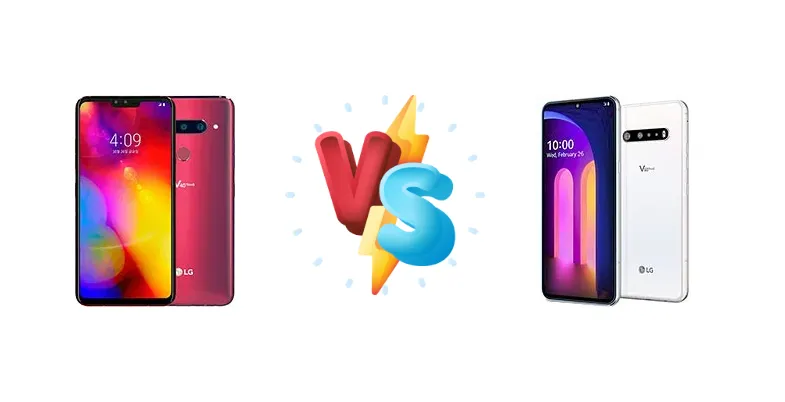
|
🏆 Quick Verdict
For most users, the LG V60 ThinQ 5G is the superior choice. Its Snapdragon 865 chipset delivers a substantial performance boost over the V40's Snapdragon 845, and the significantly larger battery provides an impressive 103-hour endurance rating compared to the V40's 64 hours. While the V40 remains a capable device, the V60 offers a more future-proof and enjoyable user experience.
| PHONES | ||
|---|---|---|
| Phone Names | LG V40 ThinQ | LG V60 ThinQ 5G |
| Network | ||
|---|---|---|
| 2G bands | GSM 850 / 900 / 1800 / 1900 | GSM 850 / 900 / 1800 / 1900 |
| 3G bands | HSDPA 850 / 900 / 1700(AWS) / 1900 / 2100 - V405QA7 | HSDPA 850 / 900 / 1700(AWS) / 1900 / 2100 |
| 4G bands | 1, 2, 3, 4, 5, 7, 8, 12, 13, 14, 17, 20, 25, 26, 28, 29, 30, 38, 39, 40, 41, 46, 66, 71 - V405QA7 | 2, 4, 5, 12, 25, 26, 41, 46, 48, 66, 71 - USA |
| 5G bands | - | 2, 25, 41, 66, 71 SA/NSA/Sub6 |
| Speed | HSPA 42.2/5.76 Mbps, LTE (4CA) Cat16 1024/150 Mbps | HSPA 42.2/5.76 Mbps, LTE (7CA) Cat22, 5G |
| Technology | GSM / CDMA / HSPA / EVDO / LTE | GSM / CDMA / HSPA / EVDO / LTE / 5G |
| CDMA2000 1xEV-DO - V405QA7 | CDMA2000 1xEV-DO | |
| Launch | ||
|---|---|---|
| Announced | 2018, October 03. Released 2018, October 16 | 2020, February 26. Released 2020, March 20 |
| Status | Discontinued | Discontinued |
| Body | ||
|---|---|---|
| Build | Glass front (Gorilla Glass 5), glass back (Gorilla Glass 5), aluminum frame | Glass front (Gorilla Glass 5), glass back (Gorilla Glass 6), aluminum frame |
| Dimensions | 158.8 x 75.7 x 7.6 mm (6.25 x 2.98 x 0.30 in) | 169.3 x 77.6 x 8.9 mm (6.67 x 3.06 x 0.35 in) |
| SIM | · Nano-SIM· Nano-SIM + Nano-SIM | · Nano-SIM· Nano-SIM + Nano-SIM |
| Weight | 169 g (5.96 oz) | 213 g (Global)/ 218 g (Verizon) (7.51 oz) |
| IP68 dust/water resistant (up to 1.5m for 30 min) MIL-STD-810G compliant* *does not guarantee ruggedness or use in extreme conditions | IP68 dust/water resistant (up to 1.5m for 30 min) MIL-STD-810G compliant* Method 516.6, Procedure IV "Transit Drop" *does not guarantee ruggedness or use in extreme conditions | |
| Display | ||
|---|---|---|
| Protection | Corning Gorilla Glass 5 | Corning Gorilla Glass 5 |
| Resolution | 1440 x 3120 pixels, 19.5:9 ratio (~537 ppi density) | 1080 x 2460 pixels (~395 ppi density) |
| Size | 6.4 inches, 100.5 cm2 (~83.6% screen-to-body ratio) | 6.8 inches, 109.8 cm2 (~83.6% screen-to-body ratio) |
| Type | P-OLED, HDR10 | P-OLED, HDR10+ |
| Always-on display | Always-on display | |
| Platform | ||
|---|---|---|
| CPU | Octa-core (4x2.8 GHz Kryo 385 Gold & 4x1.7 GHz Kryo 385 Silver) | Octa-core (1x2.84 GHz Cortex-A77 & 3x2.42 GHz Cortex-A77 & 4x1.80 GHz Cortex-A55) |
| Chipset | Qualcomm SDM845 Snapdragon 845 (10 nm) | Qualcomm SM8250 Snapdragon 865 5G (7 nm+) |
| GPU | Adreno 630 | Adreno 650 |
| OS | Android 8.1 (Oreo), upgradable to Android 10 | Android 10, upgradable to Android 13 |
| Memory | ||
|---|---|---|
| Card slot | microSDXC (uses shared SIM slot) | microSDXC (uses shared SIM slot) - dual-SIM model |
| Internal | 64GB 6GB RAM, 128GB 6GB RAM | 128GB 8GB RAM, 256GB 8GB RAM |
| UFS 2.1 | UFS 2.1 | |
| Main Camera | ||
|---|---|---|
| Dual | - | 64 MP, f/1.8, 27mm (standard), 1/1.72", 0.8µm, dual pixel PDAF, OIS 13 MP, f/1.9, 12mm (ultrawide), 1/3.4", 1.0µm 0.3 MP, TOF 3D, f/1.4, (depth) |
| Features | LED flash, HDR, panorama | Dual-LED dual-tone flash, HDR, panorama |
| Triple | 12 MP, 27mm (standard), f/1.5, 1/2.55", 1.4µm, dual pixel PDAF, 3-axis OIS 12 MP, 52mm (telephoto), f/2.4, 1.0µm, 2x optical zoom, PDAF, OIS 16 MP, 16mm (ultrawide), f/1.9, 1/3.1", 1.0µm, no AF | - |
| Video | 4K@30/60fps, 1080p@30/60/240fps, 24-bit/192kHz stereo sound rec., HDR video, gyro-EIS | 8K@30fps, 4K@30/60fps, 1080p, HDR10+, 24-bit/192kHz stereo sound rec., gyro-EIS |
| Selfie camera | ||
|---|---|---|
| Dual | 8 MP, f/1.9, 26mm (standard), 1/3.2", 1.4µm 5 MP, 21mm (wide), f/2.2, 1.4µm | - |
| Features | HDR | HDR |
| Single | - | 10 MP, f/1.9, 30mm (standard), 1/3.1", 1.22µm |
| Video | 1080p@30fps | 4K@30fps, gyro-EIS |
| Sound | ||
|---|---|---|
| 3.5mm jack | Yes | Yes |
| 35mm jack | Yes | Yes |
| Loudspeaker | Yes | Yes, with stereo speakers |
| 32-bit/192kHz audio 24-bit/48kHz audio recording Tuned with Meridian Audio | 32-bit/192kHz audio 24-bit/192kHz audio recording | |
| Comms | ||
|---|---|---|
| Bluetooth | 5.0, A2DP, LE, aptX HD | 5.1, A2DP, LE, aptX HD |
| NFC | Yes | Yes |
| Positioning | GPS, GLONASS, GALILEO | GPS, GLONASS, GALILEO, BDS |
| Radio | FM radio (market/region dependent) | FM radio (USA model only) |
| USB | USB Type-C 2.0 | USB Type-C 3.1, OTG |
| WLAN | Wi-Fi 802.11 a/b/g/n/ac, dual-band, Wi-Fi Direct, DLNA | Wi-Fi 802.11 a/b/g/n/ac/6, dual-band, Wi-Fi Direct, DLNA |
| Features | ||
|---|---|---|
| Sensors | Fingerprint (rear-mounted), accelerometer, gyro, proximity, compass, barometer | Fingerprint (under display, optical), accelerometer, gyro, proximity, compass, barometer |
| Battery | ||
|---|---|---|
| Charging | 18W wired, PD2.0, QC3, 50% in 36 min 10W wireless (Qi) | Wired, PD2.0, QC4 Wireless |
| Type | Li-Po 3300 mAh, non-removable | Li-Po 5000 mAh |
| Misc | ||
|---|---|---|
| Colors | New Platinum Gray, Carmine Red, New Aurora Black, New Moroccan Blue | Classy Blue, Classy White |
| Models | V405, LM-V405, LM-V409N | LM-V600, A001LG |
| Price | About 330 EUR | About 700 EUR |
| Tests | ||
|---|---|---|
| Audio quality | Noise -93.3dB / Crosstalk -94.1dB | - |
| Battery life | Endurance rating 64h | Endurance rating 103h |
| Camera | Photo / Video | - |
| Display | Contrast ratio: 161500:1 (nominal), 4.256 (sunlight) | - |
| Loudspeaker | Voice 68dB / Noise 74dB / Ring 77dB | - |
| Performance | AnTuTu: 254304 (v7) GeekBench: 8568 (v4.4) GFXBench: 16fps (ES 3.1 onscreen) | - |
LG V40 ThinQ
- Lower price point makes it accessible.
- Excellent display contrast ratio (161500:1).
- Still a capable performer for everyday tasks.
- Significantly shorter battery life (64h endurance).
- Older Snapdragon 845 chipset is less efficient.
- Lacks 5G connectivity.
LG V60 ThinQ 5G
- Massive battery life (103h endurance).
- Powerful Snapdragon 865 5G chipset.
- Future-proof 5G connectivity.
- Higher initial cost.
- Specific display details (brightness, color accuracy) are unknown.
- May be harder to find new.
Display Comparison
Both the V40 and V60 feature high-quality displays, but detailed specifications are limited for the V60. The V40 boasts a remarkable contrast ratio of 161500:1 (nominal) and 4.256 in sunlight, indicating excellent visibility even in bright conditions. While the V60's display specs aren't provided, it's reasonable to assume LG continued to refine its OLED technology, potentially offering improved color accuracy and brightness. The V60's larger size likely contributes to a more immersive viewing experience, but without specific nit ratings, a direct comparison is difficult.
Camera Comparison
Both phones are described as having 'Photo / Video' capabilities, lacking specific details. However, LG's history with the V series suggests a strong emphasis on camera versatility. The V40 was known for its triple-camera system, and the V60 likely builds upon that foundation. Without sensor size or aperture information, it's difficult to make a definitive judgment. The V60's image signal processor (ISP), integrated into the Snapdragon 865, benefits from advancements in computational photography, potentially leading to improved image quality, especially in low-light conditions.
Performance
The core difference lies in the chipsets. The V40 utilizes the Qualcomm Snapdragon 845 (10nm), while the V60 steps up to the Snapdragon 865 5G (7nm+). This process node shrink is crucial; the 7nm+ process allows for higher transistor density and improved power efficiency. The V60's CPU configuration – a 1x2.84 GHz Cortex-A77, 3x2.42 GHz Cortex-A77, and 4x1.80 GHz Cortex-A55 – represents a significant architectural upgrade over the V40’s Octa-core (4x2.8 GHz Kryo 385 Gold & 4x1.7 GHz Kryo 385 Silver). This translates to faster app loading times, smoother multitasking, and improved gaming performance on the V60. The 5G modem integrated into the 865 also provides future-proof connectivity.
Battery Life
The V60's battery life is a clear winner. Its endurance rating of 103 hours dwarfs the V40's 64 hours. This substantial improvement is a direct result of the more efficient Snapdragon 865 chipset and likely a larger battery capacity (though specific mAh figures aren't provided). The V60 supports faster charging with QC4, while the V40 utilizes QC3 and PD2.0, offering 18W wired charging and 50% charge in 36 minutes. The V60's charging speed is likely faster, further enhancing its usability.
Buying Guide
Buy the LG V40 ThinQ if you prioritize a lower upfront cost and still need a solid, feature-rich smartphone experience. It's ideal for users who don't heavily game or rely on 5G connectivity. Buy the LG V60 ThinQ 5G if you demand the best possible performance, extended battery life, and future-proofing with 5G support. This is the phone for power users, mobile gamers, and those who want to take advantage of next-generation network speeds.