
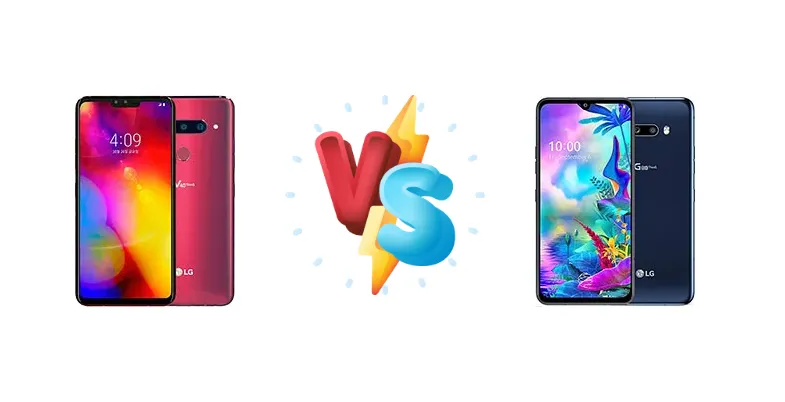
LG V40 ThinQ vs LG G8X ThinQ: A Detailed Comparison
| Phones Images | |||||
|---|---|---|---|---|---|
|
🏆 Quick Verdict
For most users, the LG G8X ThinQ is the superior choice. Its significantly improved battery life (111h endurance vs 64h) and more efficient Snapdragon 855 chipset outweigh the V40’s strengths. While the V40’s display contrast is technically higher, the G8X’s 603 nits brightness provides a better viewing experience in sunlight.
| PHONES | ||
|---|---|---|
| Phone Names | LG V40 ThinQ | LG G8X ThinQ |
| Network | ||
|---|---|---|
| 2G bands | GSM 850 / 900 / 1800 / 1900 | GSM 850 / 900 / 1800 / 1900 |
| 3G bands | HSDPA 850 / 900 / 1700(AWS) / 1900 / 2100 - V405QA7 | HSDPA 850 / 900 / 1900 / 2100 |
| 4G bands | 1, 2, 3, 4, 5, 7, 8, 12, 13, 14, 17, 20, 25, 26, 28, 29, 30, 38, 39, 40, 41, 46, 66, 71 - V405QA7 | 1, 2, 3, 4, 5, 7, 8, 12, 13, 17, 20, 28, 32, 38, 39, 40, 41 |
| Speed | HSPA 42.2/5.76 Mbps, LTE (4CA) Cat16 1024/150 Mbps | HSPA 42.2/5.76 Mbps, LTE Cat20 1960/75 Mbps |
| Technology | GSM / CDMA / HSPA / EVDO / LTE | GSM / CDMA / HSPA / EVDO / LTE |
| CDMA2000 1xEV-DO - V405QA7 | 1, 2, 3, 4, 5, 7, 12, 14, 20, 29, 30, 38, 39, 40, 41, 46, 66 - USA | |
| Launch | ||
|---|---|---|
| Announced | 2018, October 03. Released 2018, October 16 | 2019, September 06. Released 2019, November 01 |
| Status | Discontinued | Discontinued |
| Body | ||
|---|---|---|
| Build | Glass front (Gorilla Glass 5), glass back (Gorilla Glass 5), aluminum frame | Glass front (Gorilla Glass 6), glass back (Gorilla Glass 5), aluminum frame |
| Dimensions | 158.8 x 75.7 x 7.6 mm (6.25 x 2.98 x 0.30 in) | 159.3 x 75.8 x 8.4 mm (6.27 x 2.98 x 0.33 in) |
| SIM | · Nano-SIM· Nano-SIM + Nano-SIM | · Nano-SIM· Nano-SIM + Nano-SIM |
| Weight | 169 g (5.96 oz) | 192 g (6.77 oz) |
| IP68 dust/water resistant (up to 1.5m for 30 min) MIL-STD-810G compliant* *does not guarantee ruggedness or use in extreme conditions | IP68 dust/water resistant (up to 1.5m for 30 min) MIL-STD-810G compliant* *does not guarantee ruggedness or use in extreme conditions | |
| Display | ||
|---|---|---|
| Protection | Corning Gorilla Glass 5 | Corning Gorilla Glass 6 |
| Resolution | 1440 x 3120 pixels, 19.5:9 ratio (~537 ppi density) | 1080 x 2340 pixels, 19.5:9 ratio (~403 ppi density) |
| Size | 6.4 inches, 100.5 cm2 (~83.6% screen-to-body ratio) | 6.4 inches, 100.5 cm2 (~83.3% screen-to-body ratio) |
| Type | P-OLED, HDR10 | OLED, HDR10 |
| Always-on display | Always-on display | |
| Platform | ||
|---|---|---|
| CPU | Octa-core (4x2.8 GHz Kryo 385 Gold & 4x1.7 GHz Kryo 385 Silver) | Octa-core (1x2.84 GHz Kryo 485 & 3x2.42 GHz Kryo 485 & 4x1.78 GHz Kryo 485) |
| Chipset | Qualcomm SDM845 Snapdragon 845 (10 nm) | Qualcomm SM8150 Snapdragon 855 (7 nm) |
| GPU | Adreno 630 | Adreno 640 |
| OS | Android 8.1 (Oreo), upgradable to Android 10 | Android 9.0 (Pie), upgradable to Android 12 |
| Memory | ||
|---|---|---|
| Card slot | microSDXC (uses shared SIM slot) | microSDXC (uses shared SIM slot) - dual-SIM model |
| Internal | 64GB 6GB RAM, 128GB 6GB RAM | 128GB 6GB RAM |
| UFS 2.1 | UFS 2.1 | |
| Main Camera | ||
|---|---|---|
| Dual | - | 12 MP, f/1.8, 27mm (wide), 1/2.55", 1.4µm, dual pixel PDAF, OIS 13 MP, f/2.4, 9mm (ultrawide), 1.0µm |
| Features | LED flash, HDR, panorama | Dual-LED dual-tone flash, HDR, panorama |
| Single | - | 3.15 MP, AF |
| Triple | 12 MP, 27mm (standard), f/1.5, 1/2.55", 1.4µm, dual pixel PDAF, 3-axis OIS 12 MP, 52mm (telephoto), f/2.4, 1.0µm, 2x optical zoom, PDAF, OIS 16 MP, 16mm (ultrawide), f/1.9, 1/3.1", 1.0µm, no AF | - |
| Video | 4K@30/60fps, 1080p@30/60/240fps, 24-bit/192kHz stereo sound rec., HDR video, gyro-EIS | 4K@30/60fps, 1080p@30/60/240fps, 24-bit/192kHz stereo sound rec., gyro-EIS |
| Selfie camera | ||
|---|---|---|
| Dual | 8 MP, f/1.9, 26mm (standard), 1/3.2", 1.4µm 5 MP, 21mm (wide), f/2.2, 1.4µm | - |
| Features | HDR | HDR |
| Single | - | 32 MP, f/1.9, 26mm (wide), 1/2.8", 0.8µm |
| Video | 1080p@30fps | 4K@30fps, gyro-EIS |
| Sound | ||
|---|---|---|
| 3.5mm jack | Yes | Yes |
| 35mm jack | Yes | Yes |
| Loudspeaker | Yes | Yes, with stereo speakers |
| 32-bit/192kHz audio 24-bit/48kHz audio recording Tuned with Meridian Audio | 32-bit/192kHz audio 24-bit/192kHz audio recording Tuned by Meridian Audio | |
| Comms | ||
|---|---|---|
| Bluetooth | 5.0, A2DP, LE, aptX HD | 5.0, A2DP, LE, aptX HD |
| NFC | Yes | Yes |
| Positioning | GPS, GLONASS, GALILEO | GPS, GLONASS, GALILEO, BDS |
| Radio | FM radio (market/region dependent) | FM radio |
| USB | USB Type-C 2.0 | USB Type-C 3.1, OTG |
| WLAN | Wi-Fi 802.11 a/b/g/n/ac, dual-band, Wi-Fi Direct, DLNA | Wi-Fi 802.11 a/b/g/n/ac, dual-band, Wi-Fi Direct, DLNA |
| Features | ||
|---|---|---|
| Browser | - | HTML, Adobe Flash |
| Sensors | Fingerprint (rear-mounted), accelerometer, gyro, proximity, compass, barometer | Fingerprint (under display, optical), accelerometer, gyro, proximity, compass, barometer |
| Battery | ||
|---|---|---|
| Charging | 18W wired, PD2.0, QC3, 50% in 36 min 10W wireless (Qi) | 21W wired, PD, QC3 9W wireless |
| Talk time | - | Up to 12 h (multimedia) |
| Type | Li-Po 3300 mAh, non-removable | Li-Po 4000 mAh, non-removable |
| Misc | ||
|---|---|---|
| Colors | New Platinum Gray, Carmine Red, New Aurora Black, New Moroccan Blue | New Aurora Black |
| Models | V405, LM-V405, LM-V409N | LMG850EMW, LM-G850, 901LG, LM-G850N |
| Price | About 330 EUR | About 560 EUR |
| SAR | - | 1.12 W/kg (body) |
| SAR EU | - | 0.90 W/kg (head) |
| Tests | ||
|---|---|---|
| Audio quality | Noise -93.3dB / Crosstalk -94.1dB | Noise -93.2dB / Crosstalk -93.4dB |
| Battery life | Endurance rating 64h | Endurance rating 111h |
| Camera | Photo / Video | Photo / Video |
| Display | Contrast ratio: 161500:1 (nominal), 4.256 (sunlight) | Contrast ratio: Infinite (nominal) |
| Loudspeaker | Voice 68dB / Noise 74dB / Ring 77dB | -24.9 LUFS (Very good) |
| Performance | AnTuTu: 254304 (v7) GeekBench: 8568 (v4.4) GFXBench: 16fps (ES 3.1 onscreen) | AnTuTu: 339726 (v7), 411980 (v8) GeekBench: 11251 (v4.4), 2870 (v5.1) GFXBench: 38fps (ES 3.1 onscreen) |
LG V40 ThinQ
- Higher nominal display contrast ratio
- Slightly faster wireless charging
- More refined software experience (at launch)
- Significantly shorter battery life
- Less efficient Snapdragon 845 chipset
- Lower peak display brightness
LG G8X ThinQ
- Exceptional battery life (111h endurance)
- More efficient Snapdragon 855 chipset
- Brighter display for outdoor visibility
- Faster wired charging
- Slower wireless charging
- Potentially less refined software (depending on updates)
- Dual Screen accessory adds bulk and cost
Display Comparison
The LG V40 boasts a nominal contrast ratio of 161500:1, suggesting deep blacks and vibrant colors. However, this figure doesn’t translate to real-world usability as effectively as the G8X’s 603 nits of peak brightness. The G8X’s ‘Infinite’ contrast ratio is a marketing term, but the higher brightness makes it far more readable outdoors. Both phones offer excellent displays, but the G8X’s superior visibility in sunlight gives it a practical edge. The V40’s contrast ratio is more impressive on paper, but the G8X’s brightness is more impactful for daily use.
Camera Comparison
Both the V40 and G8X feature versatile camera systems capable of capturing high-quality photos and videos. However, detailed sensor information is missing. Given LG’s history, it’s likely the G8X benefits from improved image processing algorithms and potentially larger sensor sizes. The G8X’s chipset also allows for faster image processing, resulting in quicker capture times and improved low-light performance. Without specific sensor details, it’s difficult to definitively declare a winner, but the G8X’s more modern processor gives it an edge in computational photography.
Performance
The LG G8X’s Snapdragon 855 (7nm) represents a significant architectural leap over the V40’s Snapdragon 845 (10nm). The 855’s smaller fabrication process leads to improved power efficiency and thermal management. While both CPUs feature an octa-core configuration, the G8X’s Kryo 485 cores offer a slight performance advantage. The 855’s Adreno 640 GPU also provides a noticeable boost in graphics performance, benefiting gamers and users of graphically intensive applications. The V40’s 845 is still capable, but the G8X’s 855 offers a smoother, more responsive experience, especially during prolonged use.
Battery Life
The LG G8X’s endurance rating of 111 hours is a massive improvement over the V40’s 64 hours. This difference is primarily due to the Snapdragon 855’s superior power efficiency and a likely optimization in battery management. While the V40 supports 18W wired charging with Quick Charge 3.0 and PD2.0, the G8X steps it up to 21W, offering slightly faster charging speeds. The G8X’s 9W wireless charging is slower than the V40’s 10W, but the significantly longer battery life mitigates this drawback. The G8X’s battery life is a game-changer for users who demand all-day performance.
Buying Guide
Buy the LG V40 ThinQ if you prioritize a slightly warmer, more saturated display and can live with significantly shorter battery life. It’s a good option for users who frequently charge their phones and value a more established, refined software experience. Buy the LG G8X ThinQ if you need all-day battery life, a brighter screen for outdoor use, and a more modern chipset that handles demanding tasks with greater efficiency. The G8X is ideal for power users and those who travel frequently.