
LG V40 ThinQ vs LG G7 ThinQ: A Deep Dive into LG's Flagship Face-Off
| Phones Images | |||||
|---|---|---|---|---|---|
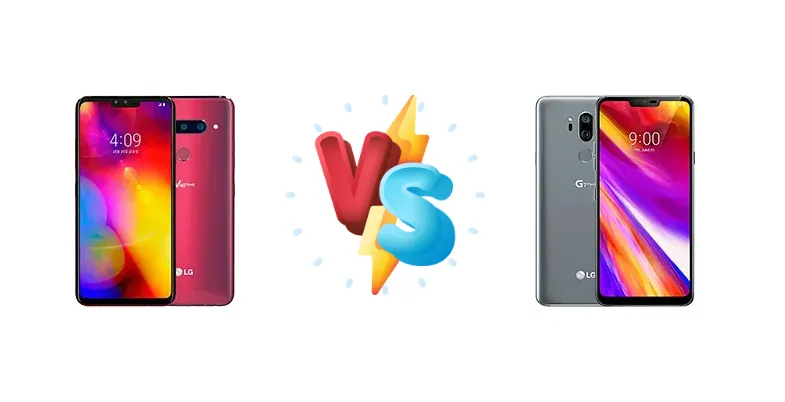
|
🏆 Quick Verdict
For most users, the LG G7 ThinQ emerges as the slightly better choice. Its superior endurance rating of 77 hours, compared to the V40’s 64 hours, provides a tangible benefit in daily use. While the V40 boasts a significantly better display contrast ratio, the G7’s battery life and similar performance make it a more practical all-rounder.
| PHONES | ||
|---|---|---|
| Phone Names | LG V40 ThinQ | LG G7 ThinQ |
| Network | ||
|---|---|---|
| 2G bands | GSM 850 / 900 / 1800 / 1900 | GSM 850 / 900 / 1800 / 1900 |
| 3G bands | HSDPA 850 / 900 / 1700(AWS) / 1900 / 2100 - V405QA7 | HSDPA 850 / 900 / 1900 / 2100 - Global |
| 4G bands | 1, 2, 3, 4, 5, 7, 8, 12, 13, 14, 17, 20, 25, 26, 28, 29, 30, 38, 39, 40, 41, 46, 66, 71 - V405QA7 | 1, 3, 4, 5, 7, 8, 12, 17, 20, 28, 32, 38, 40, 42, 46 - Global |
| Speed | HSPA 42.2/5.76 Mbps, LTE (4CA) Cat16 1024/150 Mbps | HSPA 42.2/5.76 Mbps, LTE (3CA) Cat16 1024/150 Mbps or Cat15 800/150 Mbps (region dependant) |
| Technology | GSM / CDMA / HSPA / EVDO / LTE | GSM / CDMA / HSPA / LTE |
| CDMA2000 1xEV-DO - V405QA7 | 1, 3, 5, 7, 8, 28, 38, 39, 40, 41 - G710EMW, G710EAW1,2,3,4,5,7,8,12,13,17,20,25,29,30,38,41,46,66 - G710AWM | |
| Launch | ||
|---|---|---|
| Announced | 2018, October 03. Released 2018, October 16 | 2018, May 02. Released 2018, June 01 |
| Status | Discontinued | Discontinued |
| Body | ||
|---|---|---|
| Build | Glass front (Gorilla Glass 5), glass back (Gorilla Glass 5), aluminum frame | Glass front (Gorilla Glass 5), glass back (Gorilla Glass 5), aluminum frame |
| Dimensions | 158.8 x 75.7 x 7.6 mm (6.25 x 2.98 x 0.30 in) | 153.2 x 71.9 x 7.9 mm (6.03 x 2.83 x 0.31 in) |
| SIM | · Nano-SIM· Nano-SIM + Nano-SIM | · Nano-SIM· Nano-SIM + Nano-SIM |
| Weight | 169 g (5.96 oz) | 162 g (5.71 oz) |
| IP68 dust/water resistant (up to 1.5m for 30 min) MIL-STD-810G compliant* *does not guarantee ruggedness or use in extreme conditions | IP68 dust/water resistant (up to 1.5m for 30 min) MIL-STD-810G compliant* *does not guarantee ruggedness or use in extreme conditions | |
| Display | ||
|---|---|---|
| Protection | Corning Gorilla Glass 5 | Corning Gorilla Glass 5 |
| Resolution | 1440 x 3120 pixels, 19.5:9 ratio (~537 ppi density) | 1440 x 3120 pixels, 19.5:9 ratio (~564 ppi density) |
| Size | 6.4 inches, 100.5 cm2 (~83.6% screen-to-body ratio) | 6.1 inches, 91.0 cm2 (~82.6% screen-to-body ratio) |
| Type | P-OLED, HDR10 | IPS LCD, HDR10 |
| Always-on display | Always-on display | |
| Platform | ||
|---|---|---|
| CPU | Octa-core (4x2.8 GHz Kryo 385 Gold & 4x1.7 GHz Kryo 385 Silver) | Octa-core (4x2.8 GHz Kryo 385 Gold & 4x1.7 GHz Kryo 385 Silver) |
| Chipset | Qualcomm SDM845 Snapdragon 845 (10 nm) | Qualcomm SDM845 Snapdragon 845 (10 nm) |
| GPU | Adreno 630 | Adreno 630 |
| OS | Android 8.1 (Oreo), upgradable to Android 10 | Android 8.0 (Oreo), upgradable to Android 10 |
| Memory | ||
|---|---|---|
| Card slot | microSDXC (uses shared SIM slot) | microSDXC (dedicated slot) - single-SIM modelmicroSDXC (uses shared SIM slot) - dual-SIM model |
| Internal | 64GB 6GB RAM, 128GB 6GB RAM | 64GB 4GB RAM, 128GB 6GB RAM |
| UFS 2.1 | UFS 2.1 | |
| Main Camera | ||
|---|---|---|
| Dual | - | 16 MP, f/1.6, 30mm (standard), 1/3.1", 1.0µm, PDAF, OIS 16 MP, f/1.9, 16mm (ultrawide), 1/3.1", no AF |
| Features | LED flash, HDR, panorama | Laser AF, LED flash, HDR, panorama |
| Triple | 12 MP, 27mm (standard), f/1.5, 1/2.55", 1.4µm, dual pixel PDAF, 3-axis OIS 12 MP, 52mm (telephoto), f/2.4, 1.0µm, 2x optical zoom, PDAF, OIS 16 MP, 16mm (ultrawide), f/1.9, 1/3.1", 1.0µm, no AF | - |
| Video | 4K@30/60fps, 1080p@30/60/240fps, 24-bit/192kHz stereo sound rec., HDR video, gyro-EIS | 4K@30/60fps, 1080p@30/60fps, 720p@240fps, HDR, 24-bit/192kHz stereo sound rec. |
| Selfie camera | ||
|---|---|---|
| Dual | 8 MP, f/1.9, 26mm (standard), 1/3.2", 1.4µm 5 MP, 21mm (wide), f/2.2, 1.4µm | - |
| Features | HDR | - |
| Single | - | 8 MP, f/1.9, 26mm (wide) |
| Video | 1080p@30fps | 1080p@60fps |
| Sound | ||
|---|---|---|
| 3.5mm jack | Yes | Yes |
| 35mm jack | Yes | Yes |
| Loudspeaker | Yes | Yes |
| 32-bit/192kHz audio 24-bit/48kHz audio recording Tuned with Meridian Audio | 32-bit/192kHz audio | |
| Comms | ||
|---|---|---|
| Bluetooth | 5.0, A2DP, LE, aptX HD | 5.0, A2DP, LE, aptX HD |
| NFC | Yes | Yes |
| Positioning | GPS, GLONASS, GALILEO | GPS, GLONASS, BDS |
| Radio | FM radio (market/region dependent) | FM radio |
| USB | USB Type-C 2.0 | USB Type-C 3.1, OTG |
| WLAN | Wi-Fi 802.11 a/b/g/n/ac, dual-band, Wi-Fi Direct, DLNA | Wi-Fi 802.11 a/b/g/n/ac, dual-band, Wi-Fi Direct, DLNA |
| Features | ||
|---|---|---|
| Sensors | Fingerprint (rear-mounted), accelerometer, gyro, proximity, compass, barometer | Fingerprint (rear-mounted), accelerometer, gyro, proximity, compass, barometer |
| Battery | ||
|---|---|---|
| Charging | 18W wired, PD2.0, QC3, 50% in 36 min 10W wireless (Qi) | 18W wired, QC3 Wireless (USA) |
| Type | Li-Po 3300 mAh, non-removable | Li-Po 3000 mAh, non-removable |
| Misc | ||
|---|---|---|
| Colors | New Platinum Gray, Carmine Red, New Aurora Black, New Moroccan Blue | New Platinum Gray, New Aurora Black, New Moroccan Blue, Raspberry Rose |
| Models | V405, LM-V405, LM-V409N | LM-G710, LM-G710N, LM-G710VM, G710, SM-G710, LM-G710V |
| Price | About 330 EUR | About 370 EUR |
| SAR EU | - | 0.24 W/kg (head) 1.47 W/kg (body) |
| Tests | ||
|---|---|---|
| Audio quality | Noise -93.3dB / Crosstalk -94.1dB | Noise -94.0dB / Crosstalk -93.0dB |
| Battery life | Endurance rating 64h | Endurance rating 77h |
| Camera | Photo / Video | Photo / Video |
| Display | Contrast ratio: 161500:1 (nominal), 4.256 (sunlight) | Contrast ratio: 2044:1 (nominal), 3.978 (sunlight) |
| Loudspeaker | Voice 68dB / Noise 74dB / Ring 77dB | -24.5 LUFS (Very good) |
| Performance | AnTuTu: 254304 (v7) GeekBench: 8568 (v4.4) GFXBench: 16fps (ES 3.1 onscreen) | AnTuTu: 259393 (v7), 297116 (v8) GeekBench: 8865 (v4.4), 2047 (v5.1) GFXBench: 18fps (ES 3.1 onscreen) |
LG V40 ThinQ
- Superior display contrast ratio for vibrant visuals
- Supports wireless charging (Qi)
- Potentially more advanced camera system (based on positioning)
- Lower battery endurance (64h)
- No specific camera details provided
LG G7 ThinQ
- Longer battery life (77h)
- Faster charging offsets smaller battery
- Wireless charging support (USA)
- Inferior display contrast ratio
- No specific camera details provided
Display Comparison
The LG V40 ThinQ’s display stands out with a remarkable contrast ratio of 161500:1 (nominal) and 4.256 under sunlight, significantly exceeding the G7 ThinQ’s 2044:1 and 3.978 respectively. This translates to deeper blacks, more vibrant colors, and improved visibility in bright outdoor conditions. However, both phones share the same resolution and panel technology, meaning the V40’s advantage is purely in contrast. Users sensitive to screen flicker may also appreciate the V40’s potentially higher PWM dimming rate, though this isn’t explicitly stated in the provided data.
Camera Comparison
Both devices are listed as having 'Photo / Video' capabilities, but specific details regarding sensor size, aperture, or image processing are absent. Without this information, a definitive camera comparison is impossible. However, given the V40’s positioning as a more premium device, it’s reasonable to assume it may have a more advanced camera system, potentially with a larger main sensor or more sophisticated image stabilization. The lack of detail necessitates caution when evaluating camera performance based solely on these specs.
Performance
Both the LG V40 and G7 ThinQ are powered by the Qualcomm Snapdragon 845 (10 nm) chipset, featuring an octa-core CPU configuration (4x2.8 GHz Kryo 385 Gold & 4x1.7 GHz Kryo 385 Silver). This means performance in everyday tasks and demanding applications will be virtually identical. The absence of information regarding RAM speed or storage type prevents a deeper analysis of performance nuances. Thermal management will likely be similar, as both devices utilize the same chipset and share a comparable form factor.
Battery Life
The LG G7 ThinQ holds a clear advantage in battery endurance, boasting a rating of 77 hours compared to the V40’s 64 hours. While the V40 supports both 18W wired charging with PD2.0 and QC3, as well as 10W wireless charging (Qi), the G7 ThinQ offers 18W wired charging with QC3 and wireless charging (USA). The G7’s longer endurance suggests more efficient power management, offsetting the V40’s wireless charging capabilities for most users. Both phones achieve a 50% charge in approximately 36 minutes with wired charging.
Buying Guide
Buy the LG V40 ThinQ if you prioritize display quality and are a visual content creator or consumer who demands the best possible contrast and color accuracy. Buy the LG G7 ThinQ if you value battery life above all else and need a phone that can reliably last through a full day of heavy use without needing a recharge. Both phones offer similar processing power, so performance isn't a deciding factor.