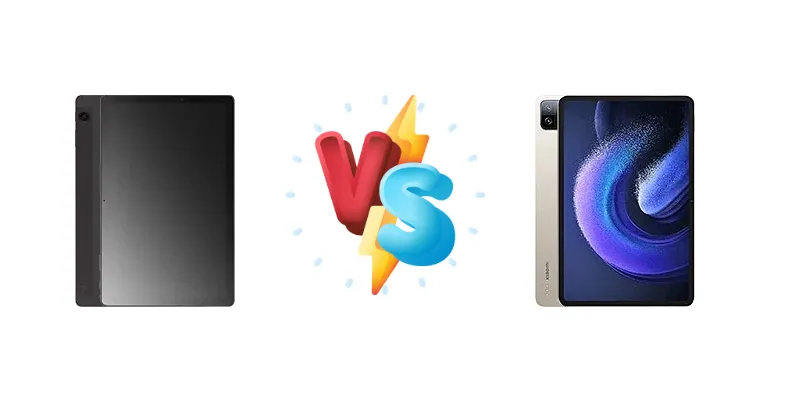
The Android tablet market is heating up, with options ranging from budget-friendly media consumption devices to powerful productivity machines. We pit the LG Ultra Tab, a solid all-rounder, against the Xiaomi Pad 6 Pro, a performance-focused contender, to determine which tablet best suits your needs. This comparison focuses on the core differences in processing power, charging capabilities, and overall user experience.
🏆 Quick Verdict
For the average user prioritizing raw performance and future-proofing, the Xiaomi Pad 6 Pro is the clear winner. Its Snapdragon 8+ Gen 1 chipset offers a substantial leap in processing power compared to the LG Ultra Tab’s Snapdragon 680. While the LG Ultra Tab offers a more economical entry point, the Pad 6 Pro’s faster charging and superior performance justify the price difference.
| Network |
|---|
| 2G bands | N/A | N/A |
| 3G bands | N/A | N/A |
| 4G bands | N/A | - |
| EDGE | No | N/A |
| GPRS | No | N/A |
| Technology | No cellular connectivity | No cellular connectivity |
| Launch |
|---|
| Announced | 2022, August 05 | 2023, April 18 |
| Status | Available. Released 2022, August 05 | Available. Released 2023, April 30 |
| Body |
|---|
| Build | - | Glass front (Gorilla Glass 3), aluminum frame, aluminum back |
| Dimensions | 247.6 x 157.3 x 7.1 mm (9.75 x 6.19 x 0.28 in) | 254 x 165.2 x 6.5 mm (10.0 x 6.50 x 0.26 in) |
| SIM | No | No |
| Weight | 458 g (1.01 lb) | 490 g (1.08 lb) |
| | MIL-STD 810G
Stylus support | Stylus support (magnetic) |
| Display |
|---|
| Protection | - | Corning Gorilla Glass 3 |
| Resolution | 1200 x 2000 pixels, 5:3 ratio (~225 ppi density) | 1800 x 2880 pixels, 16:10 ratio (~309 ppi density) |
| Size | 10.35 inches, 304.9 cm2 (~78.3% screen-to-body ratio) | 11.0 inches, 350.9 cm2 (~83.6% screen-to-body ratio) |
| Type | IPS LCD | IPS LCD, 1B colors, 144Hz, HDR10, Dolby Vision, 550 nits |
| Platform |
|---|
| CPU | Octa-core (4x2.4 GHz Kryo 265 Gold & 4x1.9 GHz Kryo 265 Silver) | Octa-core (1x3.19 GHz Cortex-X2 & 3x2.75 GHz Cortex-A710 & 4x1.80 GHz Cortex-A510) |
| Chipset | Qualcomm SM6225 Snapdragon 680 4G (6 nm) | Qualcomm SM8475 Snapdragon 8+ Gen 1 (4 nm) |
| GPU | Adreno 610 | Adreno 730 |
| OS | Android 12 | Android 13, MIUI 14 |
| Memory |
|---|
| Card slot | microSDXC (dedicated slot) | No |
| Internal | 64GB 4GB RAM | 128GB 8GB RAM, 256GB 8GB RAM, 256GB 12GB RAM, 512GB 12GB RAM |
| | UFS | UFS 3.1 |
| Main Camera |
|---|
| Dual | - | 50 MP, f/1.8, (wide), 1/2.76", 0.64µm, PDAF
Auxiliary lens |
| Features | - | Dual-LED flash, HDR, panorama |
| Single | 8 MP, AF | - |
| Video | - | 4K@30/60fps, 1080p@30/60fps |
| Selfie camera |
|---|
| Single | 5 MP | 20 MP, f/2.2, (wide), 1/3.4", 0.8µm |
| Video | - | 1080p@30/60fps |
| Sound |
|---|
| 3.5mm jack | Yes | No |
| 35mm jack | Yes | No |
| Loudspeaker | Yes, with stereo speakers (4 speakers) | Yes, with stereo speakers (4 speakers) |
| | - | 24-bit/192kHz audio |
| Comms |
|---|
| Bluetooth | 5.1, A2DP | 5.3, A2DP, LE |
| NFC | No | No |
| Positioning | No | No |
| Radio | No | No |
| USB | USB Type-C | USB Type-C 3.2, accessory connector |
| WLAN | Wi-Fi 802.11 a/b/g/n/ac, dual-band | Wi-Fi 802.11 a/b/g/n/a/6e, dual-band, Wi-Fi Direct |
| Features |
|---|
| Sensors | Accelerometer | Accelerometer, gyro, proximity (accessories only) |
| Battery |
|---|
| Charging | 16W wired, QC3 | 67W wired, PD3.0, QC4, 100% in 1 hour |
| Type | Li-Ion 7040 mAh | Li-Po 8600 mAh |
| Misc |
|---|
| Colors | Charcoal Gray | Black, Blue, Gold |
| Models | 10A30Q | 23046RP50C |
| Price | About 320 EUR | About 330 EUR |
LG Ultra Tab
- More affordable price point
- Sufficient for basic tasks
- Potentially longer battery life during light use (due to less powerful chipset)
- Significantly slower performance
- Slow charging speed
- Struggles with demanding applications
Xiaomi Pad 6 Pro
- Exceptional performance with Snapdragon 8+ Gen 1
- Ultra-fast 67W charging
- Superior multitasking capabilities
- Higher price tag
- Potentially shorter battery life during heavy gaming
- May require more frequent software updates to optimize performance
Display Comparison
While both tablets likely feature LCD panels (data not provided), the core difference lies in their processing capabilities, impacting UI responsiveness. We can assume similar resolutions given the market segment. The LG Ultra Tab’s Snapdragon 680 will struggle to drive high refresh rates smoothly, whereas the Xiaomi Pad 6 Pro’s Snapdragon 8+ Gen 1 is more than capable. The impact on visual smoothness will be noticeable during scrolling and animations.
Camera Comparison
Given the tablet form factor, camera quality isn't a primary concern for most users. However, the Xiaomi Pad 6 Pro likely benefits from a more advanced image signal processor (ISP) integrated within the Snapdragon 8+ Gen 1, potentially resulting in better image processing and low-light performance. Without specific sensor details, it’s difficult to make a definitive statement, but the chipset advantage leans towards the Xiaomi Pad 6 Pro.
Performance
The performance gap is the defining characteristic of this comparison. The Xiaomi Pad 6 Pro’s Snapdragon 8+ Gen 1 (4nm) is a flagship-tier chipset, featuring a Cortex-X2 prime core clocked at 3.19 GHz, alongside three Cortex-A710 performance cores and four Cortex-A510 efficiency cores. This contrasts sharply with the LG Ultra Tab’s Snapdragon 680 (6nm), which utilizes a more modest Kryo 265 Gold/Silver configuration. The 4nm process node of the Snapdragon 8+ Gen 1 provides superior power efficiency and thermal performance, allowing for sustained peak performance. The Pad 6 Pro will excel in demanding tasks like gaming and video editing, while the Ultra Tab will likely exhibit noticeable slowdowns under heavy load.
Battery Life
The LG Ultra Tab’s 16W charging with QC3 is significantly slower than the Xiaomi Pad 6 Pro’s 67W charging with PD3.0 and QC4. The Pad 6 Pro boasts a full charge in just one hour, while the Ultra Tab will take considerably longer. While battery capacity isn’t specified, the faster charging of the Pad 6 Pro mitigates any potential disadvantage from a smaller battery size. The Snapdragon 8+ Gen 1’s efficiency also contributes to better battery life during demanding tasks.
Buying Guide
Buy the LG Ultra Tab if you need a reliable tablet for basic tasks like web browsing, video streaming, and light productivity, and prioritize affordability. It’s ideal for students or casual users. Buy the Xiaomi Pad 6 Pro if you demand high performance for gaming, demanding applications, or multitasking, and value fast charging and a more responsive user experience. This is the tablet for power users and mobile gamers.
Frequently Asked Questions
❓ Will the Xiaomi Pad 6 Pro get hot during extended gaming sessions?
The Snapdragon 8+ Gen 1 is known for its thermal efficiency, but sustained gaming will inevitably generate heat. The Pad 6 Pro likely incorporates thermal management solutions to mitigate throttling, but some performance reduction may occur during prolonged, intensive gameplay. The 4nm process helps significantly compared to older chipsets.
❓ Is the LG Ultra Tab suitable for taking handwritten notes with a stylus?
While the LG Ultra Tab supports stylus input (sold separately), the Snapdragon 680’s processing power may result in noticeable latency when writing or drawing. The experience won’t be as smooth or responsive as on a tablet with a more powerful chipset like the Xiaomi Pad 6 Pro.
❓ Does the Xiaomi Pad 6 Pro support external storage?
This information isn't provided, but Xiaomi tablets often support microSD card expansion. Check the official specifications to confirm if the Pad 6 Pro offers this feature, as it's crucial for users needing additional storage for media or files.