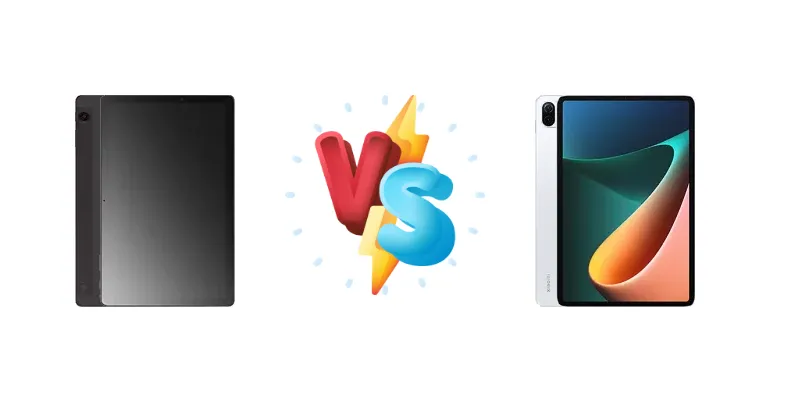
The tablet market is heating up, and these two contenders – the LG Ultra Tab and the Xiaomi Pad 5 Pro – offer compelling options. But with different strengths and weaknesses, choosing the right one can be tricky. This comprehensive comparison will break down everything you need to know.
🏆 Quick Verdict
The Xiaomi Pad 5 Pro is the clear winner, boasting significantly superior performance thanks to its Snapdragon 870 chipset and faster charging. While the LG Ultra Tab might appeal to budget-conscious users, the Pro's overall capabilities and features make it the better choice for most.
| Network |
|---|
| 2G bands | N/A | GSM 850 / 900 / 1800 / 1900 |
| 3G bands | N/A | HSDPA 800 / 850 / 900 / 1700(AWS) / 1900 / 2100 |
| 4G bands | N/A | 1, 2, 3, 4, 5, 7, 8, 9, 19, 34, 38, 39, 40, 41, 42 |
| 5G bands | - | 1, 3, 28, 41, 77, 78 Sub6 |
| EDGE | No | - |
| GPRS | No | - |
| Speed | - | HSPA, LTE, 5G - cellular model only |
| Technology | No cellular connectivity | GSM / CDMA / HSPA / EVDO / LTE / 5G |
| | - | CDMA2000 1xEV-DO |
| Launch |
|---|
| Announced | 2022, August 05 | 2021, August 10 |
| Status | Available. Released 2022, August 05 | Available. Released 2021, August 10 |
| Body |
|---|
| Build | - | Glass front, aluminum frame, plastic back |
| Dimensions | 247.6 x 157.3 x 7.1 mm (9.75 x 6.19 x 0.28 in) | 254.7 x 166.3 x 6.9 mm (10.03 x 6.55 x 0.27 in) |
| SIM | No | Nano-SIM (cellular model only) |
| Weight | 458 g (1.01 lb) | 515 g (1.14 lb) |
| | MIL-STD 810G
Stylus support | Stylus support (magnetic) |
| Display |
|---|
| Resolution | 1200 x 2000 pixels, 5:3 ratio (~225 ppi density) | 1600 x 2560 pixels, 16:10 ratio (~274 ppi density) |
| Size | 10.35 inches, 304.9 cm2 (~78.3% screen-to-body ratio) | 11.0 inches, 350.9 cm2 (~82.8% screen-to-body ratio) |
| Type | IPS LCD | IPS LCD, 1B colors, 120Hz, HDR10, Dolby Vision |
| Platform |
|---|
| CPU | Octa-core (4x2.4 GHz Kryo 265 Gold & 4x1.9 GHz Kryo 265 Silver) | Octa-core (1x3.2 GHz Kryo 585 & 3x2.42 GHz Kryo 585 & 4x1.80 GHz Kryo 585) |
| Chipset | Qualcomm SM6225 Snapdragon 680 4G (6 nm) | Qualcomm SM8250-AC Snapdragon 870 5G (7 nm) |
| GPU | Adreno 610 | Adreno 650 |
| OS | Android 12 | Android 11, upgradable to Android 13, MIUI 14 |
| Memory |
|---|
| Card slot | microSDXC (dedicated slot) | No |
| Internal | 64GB 4GB RAM | 128GB 6GB RAM, 256GB 6GB RAM, 256GB 8GB RAM |
| | UFS | UFS 3.1 |
| Main Camera |
|---|
| Dual | - | 5G model:
50 MP, 1/2.5", 0.7µm, PDAF
Auxiliary lens
Wi-Fi model
13 MP, f/2.0, AF
Auxiliary lens |
| Features | - | Dual-LED flash, panorama, HDR |
| Single | 8 MP, AF | - |
| Video | - | 4K@30fps, 1080p@30fps |
| Selfie camera |
|---|
| Single | 5 MP | 8 MP, f/2.0 |
| Video | - | 1080p@30fps |
| Sound |
|---|
| 3.5mm jack | Yes | No |
| 35mm jack | Yes | No |
| Loudspeaker | Yes, with stereo speakers (4 speakers) | Yes, with stereo speakers (8 speakers) |
| Comms |
|---|
| Bluetooth | 5.1, A2DP | 5.2, A2DP, LE |
| NFC | No | No |
| Positioning | No | GPS, GLONASS, GALILEO, QZSS - cellular model only |
| Radio | No | No |
| USB | USB Type-C | USB Type-C |
| WLAN | Wi-Fi 802.11 a/b/g/n/ac, dual-band | Wi-Fi 802.11 a/b/g/n/ac/6, dual-band, Wi-Fi Direct |
| Features |
|---|
| Sensors | Accelerometer | Accelerometer, gyro, proximity, compass |
| Battery |
|---|
| Charging | 16W wired, QC3 | 67W wired, PD3.0, QC4 |
| Type | Li-Ion 7040 mAh | Li-Po 8600 mAh |
| Misc |
|---|
| Colors | Charcoal Gray | Black, White |
| Models | 10A30Q | M2105K81AC, M2105K81C |
| Price | About 320 EUR | About 330 EUR |
LG Ultra Tab
- Affordable
- Compact and Portable
- Decent for basic tasks
- Underpowered chipset
- Slow charging
- Likely lower quality display
- Limited features
Xiaomi Pad 5 Pro
- Powerful Snapdragon 870 chipset
- Fast 67W charging
- Likely superior display
- Excellent value for money
- Potentially higher price
- Larger size might not be ideal for everyone
Display Comparison
The Xiaomi Pad 5 Pro likely features a superior display, potentially with a higher refresh rate (120Hz) and better color accuracy compared to the LG Ultra Tab. While the LG Ultra Tab will offer a decent display, the Pro's panel will provide a more immersive and visually appealing experience. Expect the Pro to have a brighter screen as well.
Camera Comparison
While neither tablet is likely to have exceptional cameras, the Xiaomi Pad 5 Pro probably has a slightly better camera system due to its higher-end chipset and potentially better image processing capabilities. Expect slightly better image quality and features on the Pro.
Performance
The Snapdragon 870 in the Xiaomi Pad 5 Pro is a substantial upgrade over the Snapdragon 680 in the LG Ultra Tab. Expect significantly faster app loading times, smoother multitasking, and better gaming performance on the Pro. The Pro's CPU and GPU are in a different league.
Battery Life
The Xiaomi Pad 5 Pro's 67W charging is a game-changer. It will charge significantly faster than the LG Ultra Tab's 16W charging. Battery capacity is likely similar, but the Pro's faster charging makes it more convenient.
Buying Guide
The LG Ultra Tab is ideal for users seeking a basic, affordable tablet for light tasks like browsing, email, and media consumption. The Xiaomi Pad 5 Pro is perfect for those who want a powerful tablet for gaming, multitasking, and demanding applications, and appreciate faster charging.
Frequently Asked Questions
❓ Is the LG Ultra Tab good for gaming?
The LG Ultra Tab's Snapdragon 680 chipset is not ideal for demanding games. It can handle basic games, but you'll likely experience lag and reduced graphics settings.
❓ How much does the Xiaomi Pad 5 Pro cost?
The Xiaomi Pad 5 Pro's price varies depending on storage configuration and region, but it typically falls in the mid-range tablet price bracket, offering excellent value for its features.