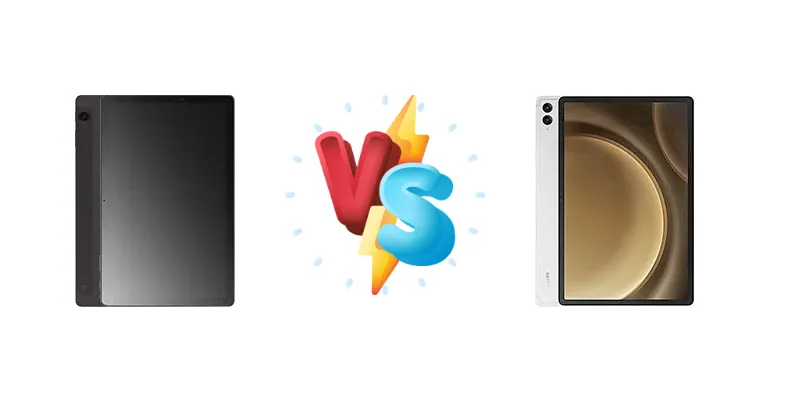
The mid-range Android tablet space is heating up. The LG Ultra Tab offers a compelling value proposition with its Snapdragon 680 chipset, while the Samsung Galaxy Tab S9 FE+ aims for a more balanced experience with the Exynos 1380 and faster charging. This comparison dissects the key differences to help you choose the right tablet for your workflow.
🏆 Quick Verdict
For the average user prioritizing sustained performance and faster charging, the Samsung Galaxy Tab S9 FE+ is the better choice. Its Exynos 1380, built on a 5nm process, delivers a noticeable performance edge over the LG Ultra Tab’s Snapdragon 680, despite the similar CPU clock speeds. However, the LG Ultra Tab remains a viable option for budget-conscious users.
| Network |
|---|
| 2G bands | N/A | GSM 850 / 900 / 1800 / 1900 |
| 3G bands | N/A | HSDPA 850 / 900 / 1700(AWS) / 1900 / 2100 |
| 4G bands | N/A | 1, 2, 3, 4, 5, 7, 8, 12, 13, 17, 20, 26, 28, 32, 38, 40, 41, 66 |
| 5G bands | - | 1, 3, 5, 7, 8, 20, 28, 38, 40, 41, 66, 77, 78 SA/NSA/Sub6 |
| EDGE | No | - |
| GPRS | No | - |
| Speed | - | HSPA, LTE, 5G - cellular model only |
| Technology | No cellular connectivity | GSM / HSPA / LTE / 5G |
| Launch |
|---|
| Announced | 2022, August 05 | 2023, October 04 |
| Status | Available. Released 2022, August 05 | Available. Released 2023, October 16 |
| Body |
|---|
| Build | - | Glass front, aluminum back, aluminum frame |
| Dimensions | 247.6 x 157.3 x 7.1 mm (9.75 x 6.19 x 0.28 in) | 285.4 x 185.4 x 6.5 mm (11.24 x 7.30 x 0.26 in) |
| SIM | No | Nano-SIM + eSIM (cellular model only) |
| Weight | 458 g (1.01 lb) | 627 g or 628 g (1.38 lb) |
| | MIL-STD 810G
Stylus support | - |
| Display |
|---|
| Resolution | 1200 x 2000 pixels, 5:3 ratio (~225 ppi density) | 1600 x 2560 pixels, 16:10 ratio (~243 ppi density) |
| Size | 10.35 inches, 304.9 cm2 (~78.3% screen-to-body ratio) | 12.4 inches, 445.8 cm2 (~84.3% screen-to-body ratio) |
| Type | IPS LCD | IPS LCD, 90Hz |
| Platform |
|---|
| CPU | Octa-core (4x2.4 GHz Kryo 265 Gold & 4x1.9 GHz Kryo 265 Silver) | Octa-core (4x2.4 GHz Cortex-A78 & 4x2.0 GHz Cortex-A55) |
| Chipset | Qualcomm SM6225 Snapdragon 680 4G (6 nm) | Exynos 1380 (5 nm) |
| GPU | Adreno 610 | Mali-G68 MP5 |
| OS | Android 12 | Android 13, up to 4 major Android upgrades, One UI 6 |
| Memory |
|---|
| Card slot | microSDXC (dedicated slot) | microSDXC (dedicated slot) |
| Internal | 64GB 4GB RAM | 128GB 6GB RAM, 128GB 8GB RAM, 256GB 8GB RAM, 256GB 12GB RAM |
| | UFS | - |
| Main Camera |
|---|
| Dual | - | 8 MP, (wide)
8 MP, (ultrawide) |
| Single | 8 MP, AF | - |
| Video | - | 4K@30fps, 1080p@30fps |
| Selfie camera |
|---|
| Single | 5 MP | 12 MP, (ultrawide) |
| Video | - | Yes |
| Sound |
|---|
| 3.5mm jack | Yes | - |
| 35mm jack | Yes | No |
| Loudspeaker | Yes, with stereo speakers (4 speakers) | Yes, with stereo speakers |
| Comms |
|---|
| Bluetooth | 5.1, A2DP | 5.3, A2DP, LE |
| NFC | No | No |
| Positioning | No | GPS, GALILEO, GLONASS, BDS, QZSS - cellular model only |
| Radio | No | No |
| USB | USB Type-C | USB Type-C 2.0, magnetic connector |
| WLAN | Wi-Fi 802.11 a/b/g/n/ac, dual-band | Wi-Fi 802.11 a/b/g/n/ac/6, dual-band, Wi-Fi Direct |
| Features |
|---|
| Sensors | Accelerometer | Fingerprint (side-mounted), accelerometer, gyro, compass, proximity (accessories only) |
| Battery |
|---|
| Charging | 16W wired, QC3 | 45W wired, QC2.0 |
| Type | Li-Ion 7040 mAh | Li-Po 10090 mAh |
| Misc |
|---|
| Colors | Charcoal Gray | Mint, Silver, Gray, Lavender |
| Models | 10A30Q | SM-X610, SM-X616B |
| Price | About 320 EUR | About 770 EUR |
| SAR | - | 0.77 W/kg (body) |
| SAR EU | - | 0.50 W/kg (body) |
LG Ultra Tab
- More affordable price point
- Sufficient performance for basic tasks
- Qualcomm chipset generally offers good software support
- Slower charging speed (16W)
- Less powerful processor for demanding tasks
- Likely lower quality display
Samsung Galaxy Tab S9 FE+
- Faster charging (45W)
- More powerful Exynos 1380 processor
- Potentially better display quality
- Superior multitasking capabilities
- Higher price tag
- Exynos chips can sometimes exhibit thermal throttling
Display Comparison
Neither device's display specifications are provided, so we must infer. Given the market positioning, the LG Ultra Tab likely features an IPS LCD panel, prioritizing cost savings. The Samsung Galaxy Tab S9 FE+ likely utilizes a higher-quality LCD or potentially an AMOLED panel, offering better color accuracy and contrast. The S9 FE+’s larger screen size (12.4 inches vs. the Ultra Tab’s likely 10.3-10.9 inch) will also contribute to a more immersive viewing experience. The absence of LTPO technology on either device suggests standard refresh rates, impacting smoothness during scrolling and animations.
Camera Comparison
Without specific camera specs, a detailed comparison is limited. However, Samsung generally prioritizes camera quality even in its FE series. It’s reasonable to assume the Tab S9 FE+ has a more capable main sensor and potentially better image processing algorithms. The LG Ultra Tab likely features a basic camera setup suitable for casual snapshots. The presence or absence of Optical Image Stabilization (OIS) on the S9 FE+ would be a significant advantage, improving image clarity in low-light conditions.
Performance
The core difference lies in the chipsets. The Samsung Galaxy Tab S9 FE+’s Exynos 1380 (5nm) benefits from a more advanced fabrication process compared to the LG Ultra Tab’s Snapdragon 680 (6nm). While both CPUs feature a similar core configuration – octa-core with 4x2.4 GHz performance cores – the Exynos 1380’s architecture (Cortex-A78 vs Kryo 265 Gold) offers superior single-core performance. This translates to snappier app launches and smoother multitasking. The 5nm process also contributes to better thermal efficiency, potentially reducing throttling during prolonged intensive tasks. The LG Ultra Tab will handle everyday tasks adequately, but will struggle with demanding games or resource-intensive applications.
Battery Life
Battery capacity is not specified for either device. However, the charging capabilities reveal a key difference. The Samsung Galaxy Tab S9 FE+ supports 45W wired charging with QC2.0, allowing for significantly faster charging times compared to the LG Ultra Tab’s 16W charging with QC3. This means less time tethered to an outlet. While the LG Ultra Tab might have a slightly larger battery, the faster charging of the S9 FE+ effectively mitigates any potential endurance gap. A full charge on the S9 FE+ is likely to take under 90 minutes, while the Ultra Tab could require over 2 hours.
Buying Guide
Buy the LG Ultra Tab if you need a highly affordable tablet for basic tasks like web browsing, video streaming, and light productivity. Its Snapdragon 680 is sufficient for these workloads, and the lower price point makes it ideal for students or families on a tight budget. Buy the Samsung Galaxy Tab S9 FE+ if you prioritize smoother multitasking, more demanding games, and faster charging. The Exynos 1380 provides a more responsive experience, and the 45W charging significantly reduces downtime.
Frequently Asked Questions
❓ Does the Exynos 1380 in the Samsung Galaxy Tab S9 FE+ tend to overheat during extended gaming sessions?
While the Exynos 1380 is a capable chip, it's known to sometimes exhibit thermal throttling under sustained load. However, the larger chassis of the Tab S9 FE+ provides more surface area for heat dissipation compared to a smartphone, mitigating this issue. Expect some performance reduction after prolonged gaming, but it shouldn't be severe enough to render the experience unplayable.
❓ Is the 16W charging on the LG Ultra Tab slow enough to be a significant inconvenience?
Yes, 16W charging is considerably slower than the 45W charging on the Samsung Galaxy Tab S9 FE+. A full charge will take significantly longer, potentially over two hours. This is a major drawback for users who need to quickly top up their tablet's battery.
❓ How will the Snapdragon 680 handle multitasking with several apps open simultaneously?
The Snapdragon 680 is adequate for light multitasking, such as switching between web browsing, email, and a music app. However, it will struggle with more demanding scenarios, like running multiple resource-intensive apps (e.g., video editing, gaming) concurrently. Expect noticeable slowdowns and app reloading.
❓ What type of storage does each tablet use, and is expandable storage available?
Neither device's storage type or expandability is specified. However, Samsung tablets often utilize UFS storage for faster read/write speeds. Expandable storage via microSD card is a common feature in this price range, and it's likely available on both devices, though confirmation is needed.