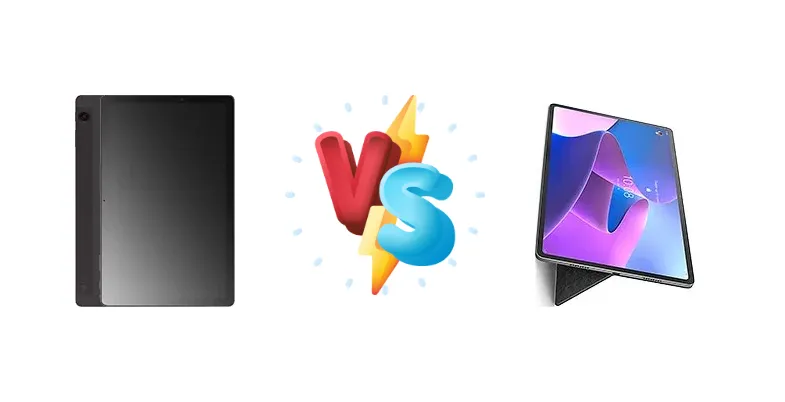
The Android tablet market is heating up, with options ranging from budget-friendly media consumption devices to powerful productivity powerhouses. The LG Ultra Tab and Lenovo Tab P12 Pro represent distinct approaches: the LG prioritizing efficiency and affordability, while the Lenovo aims for a premium experience with flagship-level performance. This comparison dissects their key differences to help you choose the right tablet for your needs.
🏆 Quick Verdict
For the average user prioritizing performance and future-proofing, the Lenovo Tab P12 Pro is the clear winner. Its Snapdragon 870 chipset delivers a significantly faster experience than the LG Ultra Tab’s Snapdragon 680. However, the LG Ultra Tab offers a compelling value proposition for those on a tighter budget.
| Network |
|---|
| 2G bands | N/A | GSM 850 / 900 / 1800 / 1900 |
| 3G bands | N/A | HSDPA 850 / 900 / 1900 / 2100 |
| 4G bands | N/A | 1, 2, 3, 4, 5, 7, 8, 19, 20, 26, 28, 34, 38, 39, 40, 41 |
| 5G bands | - | 1, 3, 7, 8, 20, 28, 38, 41, 77, 78 SA/NSA/Sub6 |
| EDGE | No | - |
| GPRS | No | - |
| Speed | - | HSPA, LTE, 5G - cellular model only |
| Technology | No cellular connectivity | GSM / HSPA / LTE / 5G |
| Launch |
|---|
| Announced | 2022, August 05 | 2021, September 08 |
| Status | Available. Released 2022, August 05 | Available. Released 2021, November 19 |
| Body |
|---|
| Dimensions | 247.6 x 157.3 x 7.1 mm (9.75 x 6.19 x 0.28 in) | 285.6 x 184.5 x 5.6 mm (11.24 x 7.26 x 0.22 in) |
| SIM | No | Nano-SIM (cellular model only) |
| Weight | 458 g (1.01 lb) | 565 g (1.25 lb) |
| | MIL-STD 810G
Stylus support | Stylus support |
| Display |
|---|
| Resolution | 1200 x 2000 pixels, 5:3 ratio (~225 ppi density) | 1600 x 2560 pixels, 16:10 ratio (~240 ppi density) |
| Size | 10.35 inches, 304.9 cm2 (~78.3% screen-to-body ratio) | 12.6 inches, 460.3 cm2 (~87.4% screen-to-body ratio) |
| Type | IPS LCD | AMOLED, 120Hz, HDR10+, Dolby Vision, 600 nits (HBM) |
| Platform |
|---|
| CPU | Octa-core (4x2.4 GHz Kryo 265 Gold & 4x1.9 GHz Kryo 265 Silver) | Octa-core (1x3.2 GHz Kryo 585 & 3x2.42 GHz Kryo 585 & 4x1.80 GHz Kryo 585) |
| Chipset | Qualcomm SM6225 Snapdragon 680 4G (6 nm) | Qualcomm SM8250-AC Snapdragon 870 5G (7 nm) |
| GPU | Adreno 610 | Adreno 650 |
| OS | Android 12 | Android 11 |
| Memory |
|---|
| Card slot | microSDXC (dedicated slot) | microSDXC (dedicated slot) |
| Internal | 64GB 4GB RAM | 128GB 6GB RAM, 256GB 8GB RAM |
| | UFS | - |
| Main Camera |
|---|
| Dual | - | 13 MP, (wide), AF
5 MP, (ultrawide) |
| Single | 8 MP, AF | - |
| Video | - | 4K@30fps, 1080p@30fps |
| Selfie camera |
|---|
| Single | 5 MP | 8 MP, (wide)
8 MP, IR TOF 3D, (biometrics sensor only) |
| Video | - | 1080p@30fps |
| Sound |
|---|
| 3.5mm jack | Yes | No |
| 35mm jack | Yes | No |
| Loudspeaker | Yes, with stereo speakers (4 speakers) | Yes, with stereo speakers (4 speakers) |
| | - | JBL speakers |
| Comms |
|---|
| Bluetooth | 5.1, A2DP | 5.2, A2DP, LE |
| NFC | No | Yes (wireless charging and data transfer only) |
| Positioning | No | GPS, GLONASS, BDS - cellular model only |
| Radio | No | Unspecified |
| USB | USB Type-C | USB Type-C 3.1 |
| WLAN | Wi-Fi 802.11 a/b/g/n/ac, dual-band | Wi-Fi 802.11 a/b/g/n/ac/6, dual-band, Wi-Fi Direct |
| Features |
|---|
| Sensors | Accelerometer | Fingerprint (side-mounted), accelerometer, gyro, proximity |
| Battery |
|---|
| Charging | 16W wired, QC3 | 45W wired, QC4 |
| Type | Li-Ion 7040 mAh | Li-Po 10200 mAh |
| Misc |
|---|
| Colors | Charcoal Gray | Storm Grey |
| Models | 10A30Q | TB-Q706Z, TB-Q706F |
| Price | About 320 EUR | About 520 EUR |
LG Ultra Tab
- More affordable price point
- Sufficient for basic tasks
- Potentially longer battery life during light use
- Significantly slower performance
- Slower charging speeds
- Less future-proof
Lenovo Tab P12 Pro
- Much faster performance with Snapdragon 870
- 45W fast charging with QC4
- Better multitasking and gaming capabilities
- Higher price tag
- Potentially shorter battery life under heavy load
- May be overkill for basic users
Display Comparison
While both tablets likely feature LCD panels (data not provided), the core difference lies in their processing power, impacting UI responsiveness. The LG Ultra Tab’s Snapdragon 680 will struggle with demanding graphical tasks, potentially leading to stuttering during scrolling or video playback. The Lenovo Tab P12 Pro, with its Snapdragon 870, will handle these tasks with ease. We anticipate the P12 Pro will have a higher peak brightness and potentially better color accuracy due to its higher-end positioning, though specific nit ratings are unavailable.
Camera Comparison
Given the tablet form factor, camera quality isn't a primary concern for most users. However, the Lenovo Tab P12 Pro is likely to have a more capable camera system, benefiting from the more powerful ISP (Image Signal Processor) within the Snapdragon 870. While specific sensor details are missing, the P12 Pro’s chipset allows for better image processing, resulting in sharper images and improved low-light performance. We expect both tablets to include basic rear and front-facing cameras, but the P12 Pro will likely offer more features and better overall quality.
Performance
The performance gap is the most significant differentiator. The Lenovo Tab P12 Pro’s Snapdragon 870 5G (7nm) is a substantial upgrade over the LG Ultra Tab’s Snapdragon 680 4G (6nm). The 870 features a Kryo 585 core clocked at 3.2 GHz, compared to the 680’s Kryo 265 Gold core at 2.4 GHz. This translates to a roughly 30-40% performance increase in CPU-intensive tasks and a much larger leap in GPU performance. The 7nm process node of the 870 also allows for more efficient thermal management, reducing throttling during sustained workloads. The LG Ultra Tab is suitable for casual use, but the P12 Pro is built for demanding applications.
Battery Life
The LG Ultra Tab’s 16W charging with QC3 is significantly slower than the Lenovo Tab P12 Pro’s 45W charging with QC4. This means the P12 Pro will charge from 0-100% much faster, a crucial advantage for users who need to quickly top up their battery. While battery capacity isn’t specified, the faster charging of the P12 Pro mitigates any potential disadvantage from a slightly smaller battery size. The Snapdragon 870’s improved efficiency also contributes to better battery life under heavy load.
Buying Guide
Buy the LG Ultra Tab if you need a reliable tablet for basic tasks like web browsing, video streaming, and light productivity, and value affordability above all else. Its Snapdragon 680 is sufficient for everyday use. Buy the Lenovo Tab P12 Pro if you demand smooth multitasking, demanding gaming, and a premium experience. The Snapdragon 870 provides a substantial performance boost, justifying the higher price tag for power users and creative professionals.
Frequently Asked Questions
❓ Will the LG Ultra Tab struggle with graphically intensive games like Genshin Impact or Call of Duty Mobile?
Yes, the Snapdragon 680 is not designed for demanding gaming. While you might be able to run these games at low settings, expect significant frame drops and stuttering. The Lenovo Tab P12 Pro’s Snapdragon 870 will provide a much smoother and more enjoyable gaming experience.
❓ How long will it take to fully charge each tablet from 0%?
The LG Ultra Tab with its 16W charging will likely take over 3 hours to fully charge. The Lenovo Tab P12 Pro, with 45W fast charging, should be able to reach 100% in around 1.5 to 2 hours, offering a substantial time saving.
❓ Is the 4G connectivity on the LG Ultra Tab sufficient, or is the 5G on the Lenovo Tab P12 Pro a significant advantage?
For most tablet users, 4G is sufficient. However, if you frequently travel to areas with limited 4G coverage or require the fastest possible download speeds, the 5G connectivity on the Lenovo Tab P12 Pro is a notable benefit. It also future-proofs the device for evolving network infrastructure.