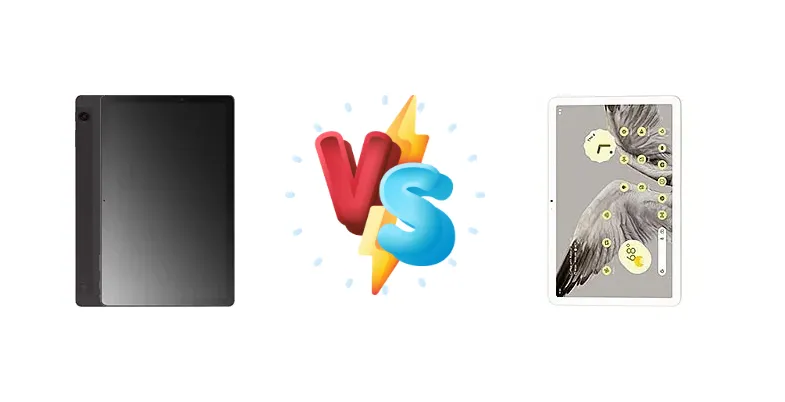
The Android tablet market is heating up, with Google re-entering the fray with the Pixel Tablet and LG offering a more budget-conscious option in the Ultra Tab. This comparison dissects the core differences between these two devices, focusing on how their contrasting chipsets – Google’s Tensor G2 and Qualcomm’s Snapdragon 680 – impact real-world performance and user experience.
🏆 Quick Verdict
For most users, the Google Pixel Tablet emerges as the superior choice. While the LG Ultra Tab offers a more affordable entry point, the Pixel Tablet’s Tensor G2 chipset delivers significantly faster performance, ensuring smoother multitasking and a more responsive experience. The slight charging speed difference is a worthwhile trade-off for the performance gains.
| Network |
|---|
| 2G bands | N/A | N/A |
| 3G bands | N/A | N/A |
| 4G bands | N/A | N/A |
| EDGE | No | No |
| GPRS | No | No |
| Technology | No cellular connectivity | No cellular connectivity |
| Launch |
|---|
| Announced | 2022, August 05 | 2023, May 10 |
| Status | Available. Released 2022, August 05 | Available. Released 2023, June 20 |
| Body |
|---|
| Build | - | Glass front, aluminum frame, aluminum back |
| Dimensions | 247.6 x 157.3 x 7.1 mm (9.75 x 6.19 x 0.28 in) | 258 x 169 x 8.1 mm (10.16 x 6.65 x 0.32 in) |
| SIM | No | No |
| Weight | 458 g (1.01 lb) | 493 g (1.09 lb) |
| | MIL-STD 810G
Stylus support | Stylus support |
| Display |
|---|
| Resolution | 1200 x 2000 pixels, 5:3 ratio (~225 ppi density) | 1600 x 2560 pixels, 16:10 ratio (~276 ppi density) |
| Size | 10.35 inches, 304.9 cm2 (~78.3% screen-to-body ratio) | 10.95 inches, 347.7 cm2 (~79.7% screen-to-body ratio) |
| Type | IPS LCD | IPS LCD |
| Platform |
|---|
| CPU | Octa-core (4x2.4 GHz Kryo 265 Gold & 4x1.9 GHz Kryo 265 Silver) | Octa-core (2x2.85 GHz Cortex-X1 & 2x2.35 GHz Cortex-A78 & 4x1.80 GHz Cortex-A55) |
| Chipset | Qualcomm SM6225 Snapdragon 680 4G (6 nm) | Google Tensor G2 (5 nm) |
| GPU | Adreno 610 | Mali-G710 MP7 |
| OS | Android 12 | Android 13, upgradable to Android 15 |
| Memory |
|---|
| Card slot | microSDXC (dedicated slot) | No |
| Internal | 64GB 4GB RAM | 128GB 8GB RAM, 256GB 8GB RAM |
| | UFS | UFS 3.1 |
| Main Camera |
|---|
| Features | - | HDR, panorama |
| Single | 8 MP, AF | 8 MP, f/2.0, 24mm (wide), 1/4.0", 1.12µm |
| Video | - | 1080p@30fps |
| Selfie camera |
|---|
| Features | - | HDR, panorama |
| Single | 5 MP | 8 MP, f/2.0, 24mm (wide), 1/4.0", 1.12µm |
| Video | - | 1080p@30fps |
| Sound |
|---|
| 3.5mm jack | Yes | No |
| 35mm jack | Yes | No |
| Loudspeaker | Yes, with stereo speakers (4 speakers) | Yes, with stereo speakers (4 speakers) |
| Comms |
|---|
| Bluetooth | 5.1, A2DP | 5.2, A2DP, LE |
| NFC | No | No |
| Positioning | No | No |
| Radio | No | No |
| USB | USB Type-C | USB Type-C 3.2 (Gen 1), magnetic connector |
| WLAN | Wi-Fi 802.11 a/b/g/n/ac, dual-band | Wi-Fi 802.11 a/b/g/n/ac/6, dual-band |
| Features |
|---|
| Sensors | Accelerometer | Accelerometer, gyro, compass, proximity (accessories only) |
| | - | Ultra Wideband (UWB) support |
| Battery |
|---|
| Charging | 16W wired, QC3 | 15W wired |
| Type | Li-Ion 7040 mAh | Li-Po 7020 mAh (27 Wh) |
| Misc |
|---|
| Colors | Charcoal Gray | Porcelain, Hazel, Rose |
| Models | 10A30Q | GA06156-EU, GA06157-EU, GA06158-EU |
| Price | About 320 EUR | About 670 EUR |
LG Ultra Tab
- More powerful Tensor G2 processor for smoother performance.
- Likely superior camera image processing.
- Benefit from Google’s software updates and ecosystem integration.
- Slower charging speed (15W).
- Potentially higher price point.
Google Pixel Tablet
- More affordable price.
- Slightly faster charging speed (16W).
- Decent performance for basic tasks.
- Significantly less powerful Snapdragon 680 processor.
- Likely inferior camera performance.
- May receive fewer software updates.
Display Comparison
Neither device's display specifications are provided, so we must infer. Given the Pixel Tablet's positioning, it likely features an LCD panel with a resolution around 2000x1200 and a refresh rate of 60Hz. The LG Ultra Tab, targeting a lower price point, likely uses a similar LCD panel, potentially with slightly lower brightness. The key difference will likely be color accuracy and viewing angles, where the Pixel Tablet, benefiting from Google’s software calibration, will likely have an edge. Bezels are expected to be comparable, reflecting the mid-range nature of both devices.
Camera Comparison
Without specific camera specs, a direct comparison is difficult. However, given the Pixel Tablet’s focus on software processing, it’s reasonable to assume it will deliver superior image quality despite potentially similar sensor resolutions. Google’s computational photography algorithms are renowned for their ability to enhance dynamic range and reduce noise. The LG Ultra Tab will likely offer a more basic camera experience, suitable for casual snapshots but lacking the refinement of the Pixel Tablet.
Performance
The performance gap is the most significant differentiator. The Google Pixel Tablet’s Tensor G2, built on a 5nm process, boasts a powerful octa-core configuration with 2x2.85 GHz Cortex-X1 cores for peak performance and 2x2.35 GHz Cortex-A78 cores for sustained workloads. This is a substantial upgrade over the LG Ultra Tab’s Snapdragon 680 (6nm), which relies on 4x2.4 GHz Kryo 265 Gold and 4x1.9 GHz Kryo 265 Silver cores. The Tensor G2’s architecture, including the Cortex-X1 prime cores, translates to significantly faster app launch times, smoother multitasking, and a more responsive user interface. The 5nm process also contributes to better thermal efficiency, potentially reducing throttling during extended use. The Snapdragon 680 is adequate for basic tasks, but will struggle with demanding games or resource-intensive applications.
Battery Life
Battery capacity is not specified for either device. However, the charging speeds – 15W for the Pixel Tablet and 16W for the LG Ultra Tab – are relatively slow by modern standards. The slight advantage in charging wattage for the LG Ultra Tab won’t translate to a significant difference in 0-100% charge times. The Tensor G2’s 5nm efficiency *could* offset a potentially smaller battery capacity in the Pixel Tablet, but real-world battery life will depend heavily on usage patterns. The Snapdragon 680, being a more power-efficient chip, may offer slightly longer battery life during light use.
Buying Guide
Buy the LG Ultra Tab if you prioritize affordability and primarily need a tablet for basic tasks like web browsing, video streaming, and light reading. It’s ideal for users who don’t demand high performance or plan on heavy multitasking. Buy the Google Pixel Tablet if you value performance, future-proofing, and a more polished software experience. It’s the better choice for users who want a tablet capable of handling demanding apps, gaming, and seamless multitasking, and who appreciate Google’s software ecosystem.
Frequently Asked Questions
❓ Will the Google Tensor G2 in the Pixel Tablet struggle with graphically intensive games?
While the Tensor G2 isn't a flagship gaming chip, it's significantly more capable than the Snapdragon 680. It should handle most Android games at medium to high settings, though demanding titles may require some graphical compromises. The 5nm process also aids in thermal management, reducing the likelihood of significant throttling during gaming sessions.
❓ Is the Snapdragon 680 in the LG Ultra Tab sufficient for everyday tasks like browsing and streaming?
Yes, the Snapdragon 680 is perfectly adequate for everyday tasks such as web browsing, video streaming, email, and social media. It won’t provide a blazing-fast experience, but it will handle these tasks smoothly without significant lag. However, multitasking with several apps open simultaneously may reveal its limitations.
❓ How does the software experience differ between the Pixel Tablet and the LG Ultra Tab?
The Pixel Tablet benefits from Google’s pure Android experience, guaranteeing timely software updates and access to the latest features. It also integrates seamlessly with other Google services. The LG Ultra Tab likely runs a customized version of Android, which may include bloatware and slower update cycles. The Pixel Tablet also has the advantage of Google’s optimized tablet UI.