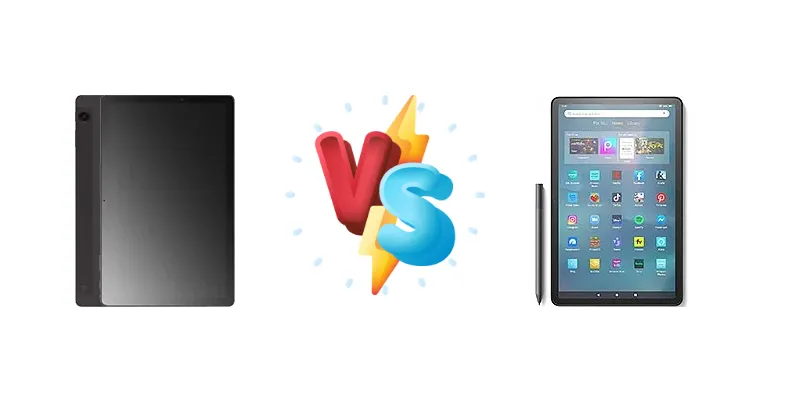
The tablet market offers a diverse range of options, but narrowing down the choices can be challenging. We pit the LG Ultra Tab, powered by Qualcomm’s Snapdragon 680, against the Amazon Fire Max 11, utilizing a Mediatek MT8188J chipset. This comparison focuses on real-world performance implications, battery life, and value, helping you determine which tablet best suits your needs.
🏆 Quick Verdict
For users prioritizing a smoother, more versatile Android experience and slightly better performance, the LG Ultra Tab emerges as the winner. While the Fire Max 11 offers a compelling price point, its Mediatek chipset and Fire OS limitations hold it back from matching the LG’s overall capabilities.
| Network |
|---|
| 2G bands | N/A | N/A |
| 3G bands | N/A | - |
| 4G bands | N/A | - |
| EDGE | No | No |
| GPRS | No | No |
| Technology | No cellular connectivity | No cellular connectivity |
| Launch |
|---|
| Announced | 2022, August 05 | 2023, May 23 |
| Status | Available. Released 2022, August 05 | Available. Released 2023, May 23 |
| Body |
|---|
| Dimensions | 247.6 x 157.3 x 7.1 mm (9.75 x 6.19 x 0.28 in) | 259.1 x 163.7 x 7.5 mm (10.20 x 6.44 x 0.30 in) |
| SIM | No | No |
| Weight | 458 g (1.01 lb) | 490 g (1.08 lb) |
| | MIL-STD 810G
Stylus support | - |
| Display |
|---|
| Resolution | 1200 x 2000 pixels, 5:3 ratio (~225 ppi density) | 2000 x 1200 pixels, 5:3 ratio (~212 ppi density) |
| Size | 10.35 inches, 304.9 cm2 (~78.3% screen-to-body ratio) | 11.0 inches, 344.4 cm2 (~81.2% screen-to-body ratio) |
| Type | IPS LCD | IPS LCD |
| Platform |
|---|
| CPU | Octa-core (4x2.4 GHz Kryo 265 Gold & 4x1.9 GHz Kryo 265 Silver) | Octa-core (2x2.2 GHz Cortex-A78 & 6x2.0 GHz Cortex-A55) |
| Chipset | Qualcomm SM6225 Snapdragon 680 4G (6 nm) | Mediatek MT8188J |
| GPU | Adreno 610 | Mali-G57 MC2 |
| OS | Android 12 | Android 11, Fire OS 8 |
| Memory |
|---|
| Card slot | microSDXC (dedicated slot) | microSDXC (dedicated slot) |
| Internal | 64GB 4GB RAM | 64GB 4GB RAM, 128GB 4GB RAM |
| | UFS | - |
| Main Camera |
|---|
| Single | 8 MP, AF | 8 MP, AF |
| Video | - | 1080p |
| Selfie camera |
|---|
| Single | 5 MP | 8 MP |
| Video | - | 1080p |
| Sound |
|---|
| 3.5mm jack | Yes | - |
| 35mm jack | Yes | No |
| Loudspeaker | Yes, with stereo speakers (4 speakers) | Yes, with stereo speakers |
| Comms |
|---|
| Bluetooth | 5.1, A2DP | 5.3, A2DP, LE |
| NFC | No | No |
| Positioning | No | No |
| Radio | No | No |
| USB | USB Type-C | USB Type-C 2.0, OTG, magnetic accessory connector |
| WLAN | Wi-Fi 802.11 a/b/g/n/ac, dual-band | Wi-Fi 802.11 a/b/g/n/ac/6, dual-band |
| Features |
|---|
| Sensors | Accelerometer | Fingerprint (side-mounted), accelerometer, proximity (accessories only) |
| Battery |
|---|
| Charging | 16W wired, QC3 | 15W wired |
| Type | Li-Ion 7040 mAh | Li-Ion |
| Misc |
|---|
| Colors | Charcoal Gray | Gray |
| Models | 10A30Q | KFSNWI |
| Price | About 320 EUR | About 270 EUR |
LG Ultra Tab
- More powerful Snapdragon 680 processor
- Standard Android experience for wider app compatibility
- Potentially better battery life due to 6nm process
- May be slightly more expensive than the Fire Max 11
- Charging speed is only marginally faster
Amazon Fire Max 11
- Lower price point makes it very accessible
- Tight integration with Amazon’s ecosystem
- Decent performance for basic tasks like streaming
- Fire OS is restrictive and lacks Google Play Store access without sideloading
- Mediatek MT8188J chipset is less powerful than the Snapdragon 680
Display Comparison
Neither device boasts a particularly standout display. Both likely utilize IPS LCD panels, given their price points. However, the core difference lies in processing power impacting UI smoothness. While specific display specs (resolution, brightness) are missing, the Snapdragon 680’s superior GPU in the LG Ultra Tab will contribute to a more responsive and fluid visual experience, especially during scrolling and video playback. The Fire Max 11’s Mediatek chipset may exhibit slight stuttering in demanding UI transitions.
Camera Comparison
Camera performance is unlikely to be a deciding factor for either tablet. Given the context, both likely feature modest camera setups. Without specific sensor details, it’s safe to assume image quality will be adequate for casual snapshots and video calls. The LG Ultra Tab’s stronger ISP (Image Signal Processor) within the Snapdragon 680 may offer slightly better image processing, particularly in low-light conditions, but the difference will be minimal. We can expect both to struggle with detailed photography.
Performance
The LG Ultra Tab’s Qualcomm Snapdragon 680, built on a 6nm process, offers a significant architectural advantage over the Amazon Fire Max 11’s Mediatek MT8188J. The Snapdragon 680’s octa-core configuration, with 4x2.4 GHz Kryo 265 Gold cores, provides a performance edge in single-core tasks, crucial for app responsiveness. The Fire Max 11’s MT8188J, featuring 2x2.2 GHz Cortex-A78 and 6x2.0 GHz Cortex-A55 cores, focuses on efficiency but lacks the raw processing power of the Snapdragon. This translates to faster app loading times and smoother multitasking on the LG Ultra Tab. The 6nm node of the Snapdragon also implies better thermal efficiency, reducing the likelihood of performance throttling during extended use.
Battery Life
Both tablets offer similar charging speeds – 16W for the LG Ultra Tab and 15W for the Fire Max 11. The LG Ultra Tab’s Snapdragon 680, being more power-efficient, may offer slightly longer battery life despite potentially having a similar battery capacity (spec not provided). The 6nm process contributes to reduced power consumption during both active use and standby. While the Fire Max 11’s Mediatek chipset prioritizes efficiency, the Snapdragon’s overall optimization gives the LG a slight edge in real-world endurance.
Buying Guide
Buy the LG Ultra Tab if you need a tablet capable of handling multitasking, light gaming, and a wider range of Android applications without significant slowdowns. It’s ideal for users who value a standard Android experience and appreciate Qualcomm’s optimized power efficiency. Buy the Amazon Fire Max 11 if you primarily consume media, rely heavily on Amazon’s ecosystem, and are seeking the most affordable 10-inch tablet option, accepting the trade-offs in performance and software flexibility.
Frequently Asked Questions
❓ Will the Amazon Fire Max 11’s Fire OS limit my app choices?
Yes, Fire OS is based on Android but lacks full Google Play Store support. While you can access a limited app store and sideload apps, the process is less convenient and some apps may not function correctly. The LG Ultra Tab, with standard Android, offers access to the full Google Play Store ecosystem.
❓ Is the Snapdragon 680 in the LG Ultra Tab powerful enough for gaming?
The Snapdragon 680 is capable of handling casual gaming, but it’s not a high-end gaming chipset. Expect to play less demanding titles smoothly, but graphically intensive games may require lower settings to maintain playable frame rates. The Fire Max 11’s Mediatek MT8188J will likely struggle even more with demanding games.
❓ How does the charging speed compare in real-world usage?
While the LG Ultra Tab supports 16W charging and the Fire Max 11 supports 15W, the difference in charging time will be minimal. Both tablets will likely take around 2-3 hours to fully charge from 0%. The Snapdragon 680’s power efficiency may allow for slightly faster charging overall due to optimized power draw.
❓ Can I easily watch Amazon Prime Video on the LG Ultra Tab?
Yes, you can easily watch Amazon Prime Video on the LG Ultra Tab by downloading the Prime Video app from the Google Play Store. The LG Ultra Tab’s standard Android experience doesn’t restrict access to Amazon’s services.