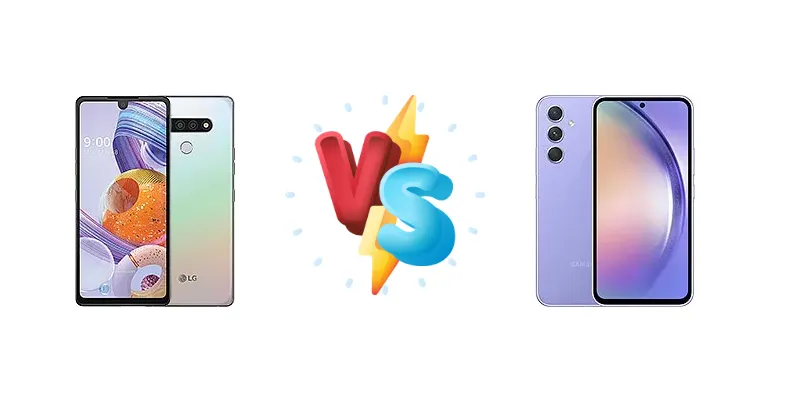
The LG Stylo 6 represents a dwindling breed of ultra-affordable smartphones, while the Samsung Galaxy A54 aims to deliver a polished mid-range experience. This comparison dissects the core differences between these two devices, helping you determine if the A54’s added features and performance justify its higher price tag, or if the Stylo 6 still holds value for basic smartphone needs.
🏆 Quick Verdict
For the average user, the Samsung Galaxy A54 is the superior choice. Its significantly more powerful Exynos 1380 chipset, brighter display, and longer software support outweigh the Stylo 6’s lower cost. However, the Stylo 6 remains a viable option for those prioritizing absolute affordability and minimal feature requirements.
| Network |
|---|
| 2G bands | GSM 850 / 900 / 1800 / 1900 | GSM 850 / 900 / 1800 / 1900 |
| 3G bands | HSDPA 850 / 900 / 1900 / 2100 | HSDPA 850 / 900 / 1700(AWS) / 1900 / 2100 |
| 4G bands | LTE | 1, 2, 3, 4, 5, 7, 8, 12, 17, 20, 26, 28, 32, 38, 40, 41, 66 - International |
| 5G bands | - | 1, 3, 7, 8, 20, 28, 38, 40, 41, 77, 78 SA/NSA/Sub6 - International |
| Speed | HSPA 42.2/5.76 Mbps, LTE (2CA) Cat6 300/50 Mbps | HSPA, LTE, 5G |
| Technology | GSM / HSPA / LTE | GSM / HSPA / LTE / 5G |
| | - | 25, 41, 66, 71 SA/NSA/Sub6/mmWave - USA |
| Launch |
|---|
| Announced | 2020, May 20. Released 2020, May 20 | 2023, March 15 |
| Status | Discontinued | Available. Released 2023, March 24 |
| Body |
|---|
| Build | - | Glass front (Gorilla Glass 5), glass back (Gorilla Glass 5), plastic frame |
| Dimensions | 171.2 x 77.7 x 8.6 mm (6.74 x 3.06 x 0.34 in) | 158.2 x 76.7 x 8.2 mm (6.23 x 3.02 x 0.32 in) |
| SIM | Nano-SIM | · Nano-SIM + eSIM· Nano-SIM + Nano-SIM |
| Weight | 219 g (7.72 oz) | 202 g (7.13 oz) |
| | Stylus | IP67 dust/water resistant (up to 1m for 30 min) |
| Display |
|---|
| Protection | - | Corning Gorilla Glass 5 |
| Resolution | 1080 x 2460 pixels (~395 ppi density) | 1080 x 2340 pixels, 19.5:9 ratio (~403 ppi density) |
| Size | 6.8 inches, 109.8 cm2 (~82.5% screen-to-body ratio) | 6.4 inches, 100.5 cm2 (~82.9% screen-to-body ratio) |
| Type | IPS LCD | Super AMOLED, 120Hz, HDR10+, 1000 nits (HBM) |
| Platform |
|---|
| CPU | Octa-core (4x2.3 GHz Cortex-A53 & 4x1.8 GHz Cortex-A53) | Octa-core (4x2.4 GHz Cortex-A78 & 4x2.0 GHz Cortex-A55) |
| Chipset | Mediatek MT6765 Helio P35 (12 nm) | Exynos 1380 (5 nm) |
| GPU | PowerVR GE8320 | Mali-G68 MP5 |
| OS | Android 10 | Android 13, up to 4 major Android upgrades, One UI 7 |
| Memory |
|---|
| Card slot | microSDXC (dedicated slot) | microSDXC (uses shared SIM slot) |
| Internal | 64GB 3GB RAM | 128GB 4GB RAM, 128GB 6GB RAM, 128GB 8GB RAM, 256GB 6GB RAM, 256GB 8GB RAM |
| | eMMC 5.1 | - |
| Main Camera |
|---|
| Features | LED flash, panorama, HDR | LED flash, panorama, HDR |
| Single | - | 32 MP, f/2.2, 26mm (wide), 1/2.8", 0.8µm |
| Triple | 13 MP, (wide), PDAF
5 MP, 120˚, (ultrawide)
Auxiliary lens | 50 MP, f/1.8, 23mm (wide), 1/1.56", 1.0µm, PDAF, OIS
12 MP, f/2.2, 13mm, 123˚ (ultrawide), 1/3.X", 1.12µm
5 MP (macro) |
| Video | 1080p@30fps | 4K@30fps, 1080p@30/60fps, 720p@480fps, gyro-EIS |
| Selfie camera |
|---|
| Single | 13 MP, 1/3.1", 1.12µm | 32 MP, f/2.2, 26mm (wide), 1/2.8", 0.8µm |
| Video | 1080p@30fps | 4K@30fps, 1080p@30/60fps |
| Sound |
|---|
| 3.5mm jack | Yes | No |
| 35mm jack | Yes | No |
| Loudspeaker | Yes | Yes, with stereo speakers |
| Comms |
|---|
| Bluetooth | 5.0, A2DP, LE | 5.3, A2DP, LE |
| NFC | No | Yes (market/region dependent) |
| Positioning | GPS | GPS, GLONASS, GALILEO, BDS |
| Radio | No | No |
| USB | USB Type-C 2.0 | USB Type-C 2.0, OTG |
| WLAN | Wi-Fi 802.11 b/g/n, Wi-Fi Direct | Wi-Fi 802.11 a/b/g/n/ac/6, dual-band, Wi-Fi Direct |
| Features |
|---|
| Sensors | Fingerprint (rear-mounted), accelerometer, proximity | Fingerprint (under display, optical), accelerometer, gyro, compass, barometer (USA only) |
| | - | Virtual proximity sensing |
| Battery |
|---|
| Charging | - | 25W wired |
| Type | Li-Po 4000 mAh | 5000 mAh |
| Misc |
|---|
| Colors | White | Lime, Graphite, Violet, White |
| Models | LMQ730TM, LM-Q730TM | SM-A546V, SM-A546U, SM-A546U1, SM-A546B, SM-A546B/DS, SM-A546E, SM-A546E/DS, SM-A5460, SM-A546M, SM-A546M/DS, SM-A546W |
| Price | About 200 EUR | € 210.00 / $ 119.11 / £ 169.95 / ₹ 28,999 |
| SAR | - | 0.81 W/kg (head) 0.67 W/kg (body) |
| SAR EU | - | 0.69 W/kg (head) 1.34 W/kg (body) |
| Tests |
|---|
| Battery life | - |
Endurance rating 119h
|
| Camera | - |
Photo / Video |
| Display | - |
Contrast ratio: Infinite (nominal) |
| Loudspeaker | - |
-26.6 LUFS (Good)
|
| Performance | - |
AnTuTu: 506678 (v9)
GeekBench: 2703 (v5.1), 2797 (v6)
GFXBench: 25fps (ES 3.1 onscreen) |
LG Stylo 6
- Extremely affordable price point
- Functional for basic smartphone tasks
- Acceptable for calls and texts
- Outdated and slow processor
- Poor camera performance
- Limited software support
Samsung Galaxy A54
- Powerful Exynos 1380 chipset
- Bright and vibrant display
- Excellent battery life and fast charging
- Higher price tag
- May be overkill for basic users
- Software bloatware (typical of Samsung)
Display Comparison
The Samsung Galaxy A54 boasts a significantly brighter display, reaching a measured 980 nits, compared to the LG Stylo 6’s unspecified brightness. This difference is crucial for outdoor visibility. While the Stylo 6’s display resolution isn’t specified, the A54’s likely higher resolution contributes to a sharper image. The A54’s 'Infinite' contrast ratio (nominal) suggests a superior panel technology, likely AMOLED, offering deeper blacks and more vibrant colors, a stark contrast to the Stylo 6’s likely IPS LCD. The A54’s display is geared towards immersive media consumption, while the Stylo 6’s is likely adequate for basic viewing.
Camera Comparison
Both devices feature photo and video capabilities, but the A54 is expected to deliver significantly better image quality. While specific sensor details are missing for both, Samsung typically employs larger sensors and more sophisticated image processing algorithms in its A-series phones. The A54 likely benefits from Optical Image Stabilization (OIS), reducing blur in photos and videos, a feature likely absent on the Stylo 6. The Stylo 6’s camera is likely adequate for casual snapshots, but the A54 will excel in low-light conditions and offer more detail and dynamic range.
Performance
The performance gap between these devices is substantial. The Samsung Galaxy A54’s Exynos 1380 (5nm) is built on a far more efficient process node than the LG Stylo 6’s Mediatek Helio P35 (12nm). The Exynos 1380’s octa-core configuration, featuring four Cortex-A78 cores clocked at 2.4 GHz, provides a significant performance boost over the Stylo 6’s four Cortex-A53 cores at 2.3 GHz. This translates to faster app loading times, smoother multitasking, and a more responsive user interface on the A54. The A54 is capable of handling demanding games and applications, while the Stylo 6 will struggle with anything beyond basic tasks. The 5nm process also implies better thermal management, reducing throttling during sustained workloads.
Battery Life
The Samsung Galaxy A54 achieves an impressive endurance rating of 119 hours and 11:15 hours of active use, indicating excellent battery life. While the Stylo 6’s battery capacity isn’t specified, its less efficient chipset and likely lower capacity will result in shorter runtimes. The A54 also supports 25W wired charging, allowing for faster top-ups compared to the Stylo 6’s likely slower charging speed. The A54’s combination of efficient hardware and fast charging provides a more convenient and reliable battery experience.
Buying Guide
Buy the LG Stylo 6 if you need a functional smartphone for basic tasks like calls, texts, and light social media, and your budget is extremely limited. You’re willing to compromise on performance, camera quality, and long-term software updates. Buy the Samsung Galaxy A54 if you prioritize a smooth user experience, a vibrant display for media consumption, a capable camera system, and a phone that will receive software updates for years to come, even if it means spending more upfront.
Frequently Asked Questions
❓ Does the Exynos 1380 in the Galaxy A54 tend to overheat during prolonged gaming sessions?
The Exynos 1380, built on a 5nm process, is generally efficient and manages heat well. While it can get warm during extended gaming, it's unlikely to experience significant throttling, providing a consistently smooth gaming experience. The Stylo 6's Helio P35 will likely throttle much more aggressively under similar load.
❓ Is the camera on the LG Stylo 6 sufficient for casual social media posting?
The LG Stylo 6's camera is adequate for basic social media sharing in good lighting conditions. However, expect limited detail, poor low-light performance, and a lack of advanced features. The Samsung Galaxy A54 offers a far superior camera experience for more demanding users.
❓ How long will Samsung provide software updates for the Galaxy A54?
Samsung typically provides four years of major Android OS updates and five years of security updates for its A-series devices. This means the Galaxy A54 will remain secure and up-to-date for a considerable period, unlike the LG Stylo 6, which is unlikely to receive further software support.