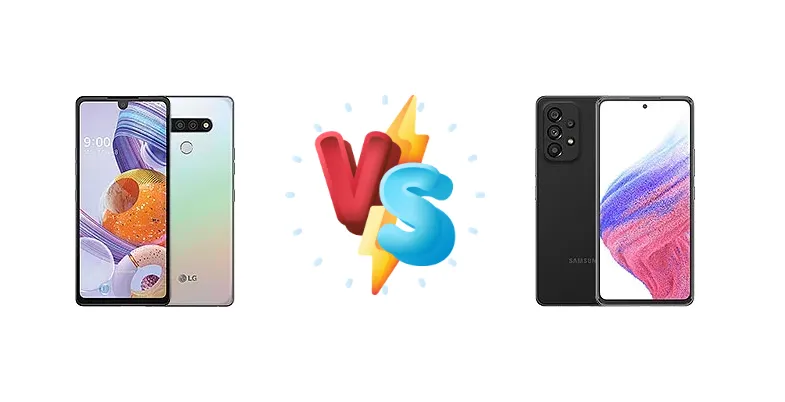
The LG Stylo 6 and Samsung Galaxy A53 5G represent different ends of the budget smartphone spectrum. The Stylo 6, a holdover from LG’s smartphone days, focuses on affordability, while the A53 5G aims to deliver a more modern experience with 5G connectivity and a more powerful processor. This comparison dissects their key differences to help you determine which device best suits your needs.
🏆 Quick Verdict
For most users, the Samsung Galaxy A53 5G is the superior choice. Its Exynos 1280 chipset provides significantly better performance, and the 830 nit display offers a far more vibrant viewing experience. While the Stylo 6 offers a lower price point, the A53’s improvements in key areas justify the cost for all but the most budget-constrained buyers.
| Network |
|---|
| 2G bands | GSM 850 / 900 / 1800 / 1900 | GSM 850 / 900 / 1800 / 1900 |
| 3G bands | HSDPA 850 / 900 / 1900 / 2100 | HSDPA 850 / 900 / 1700(AWS) / 1900 / 2100 |
| 4G bands | LTE | 1, 2, 3, 4, 5, 7, 12, 14, 20, 29, 30, 38, 39, 40, 41, 46, 48, 66 - SM-A536U |
| 5G bands | - | 2, 5, 41, 66, 77, 78 SA/NSA/Sub6/mmWave - SM-A536U |
| Speed | HSPA 42.2/5.76 Mbps, LTE (2CA) Cat6 300/50 Mbps | HSPA, LTE, 5G |
| Technology | GSM / HSPA / LTE | GSM / HSPA / LTE / 5G |
| | - | 2, 5, 48, 66, 77, 78, 260, 261 SA/NSA/Sub6/mmWave - SM-A536V |
| Launch |
|---|
| Announced | 2020, May 20. Released 2020, May 20 | 2022, March 17 |
| Status | Discontinued | Available. Released 2022, March 24 |
| Body |
|---|
| Build | - | Glass front (Gorilla Glass 5), plastic frame, plastic back |
| Dimensions | 171.2 x 77.7 x 8.6 mm (6.74 x 3.06 x 0.34 in) | 159.6 x 74.8 x 8.1 mm (6.28 x 2.94 x 0.32 in) |
| SIM | Nano-SIM | · Nano-SIM· Nano-SIM + Nano-SIM |
| Weight | 219 g (7.72 oz) | 189 g (6.67 oz) |
| | Stylus | IP67 dust/water resistant (up to 1m for 30 min) |
| Display |
|---|
| Protection | - | Corning Gorilla Glass 5 |
| Resolution | 1080 x 2460 pixels (~395 ppi density) | 1080 x 2400 pixels, 20:9 ratio (~405 ppi density) |
| Size | 6.8 inches, 109.8 cm2 (~82.5% screen-to-body ratio) | 6.5 inches, 102.0 cm2 (~85.4% screen-to-body ratio) |
| Type | IPS LCD | Super AMOLED, 120Hz, 800 nits (HBM) |
| Platform |
|---|
| CPU | Octa-core (4x2.3 GHz Cortex-A53 & 4x1.8 GHz Cortex-A53) | Octa-core (2x2.4 GHz Cortex-A78 & 6x2.0 GHz Cortex-A55) |
| Chipset | Mediatek MT6765 Helio P35 (12 nm) | Exynos 1280 (5 nm) |
| GPU | PowerVR GE8320 | Mali-G68 |
| OS | Android 10 | Android 12, up to 4 major Android upgrades, One UI 8 |
| Memory |
|---|
| Card slot | microSDXC (dedicated slot) | microSDXC (uses shared SIM slot) |
| Internal | 64GB 3GB RAM | 128GB 4GB RAM, 128GB 6GB RAM, 128GB 8GB RAM, 256GB 6GB RAM, 256GB 8GB RAM |
| | eMMC 5.1 | - |
| Main Camera |
|---|
| Features | LED flash, panorama, HDR | LED flash, panorama, HDR |
| Quad | - | 64 MP, f/1.8, 26mm (wide), 1/1.7X", 0.8µm, PDAF, OIS
12 MP, f/2.2, 123˚ (ultrawide), 1.12µm
5 MP (macro)
Auxiliary lens |
| Single | - | 32 MP, f/2.2, 26mm (wide), 1/2.8", 0.8µm |
| Triple | 13 MP, (wide), PDAF
5 MP, 120˚, (ultrawide)
Auxiliary lens | - |
| Video | 1080p@30fps | 4K@30fps, 1080p@30/60fps; gyro-EIS |
| Selfie camera |
|---|
| Features | - | HDR |
| Single | 13 MP, 1/3.1", 1.12µm | 32 MP, f/2.2, 26mm (wide), 1/2.8", 0.8µm |
| Video | 1080p@30fps | 4K@30fps, 1080p@30fps |
| Sound |
|---|
| 3.5mm jack | Yes | No |
| 35mm jack | Yes | No |
| Loudspeaker | Yes | Yes, with stereo speakers |
| Comms |
|---|
| Bluetooth | 5.0, A2DP, LE | 5.1, A2DP, LE |
| NFC | No | Yes (market/region dependent) |
| Positioning | GPS | GPS, GLONASS, GALILEO, BDS |
| Radio | No | No |
| USB | USB Type-C 2.0 | USB Type-C 2.0, OTG |
| WLAN | Wi-Fi 802.11 b/g/n, Wi-Fi Direct | Wi-Fi 802.11 a/b/g/n/ac, dual-band, Wi-Fi Direct |
| Features |
|---|
| Sensors | Fingerprint (rear-mounted), accelerometer, proximity | Fingerprint (under display, optical), accelerometer, gyro, compass, barometer (market/region dependent) |
| | - | Virtual proximity sensing |
| Battery |
|---|
| Charging | - | 25W wired |
| Type | Li-Po 4000 mAh | Li-Po 5000 mAh |
| Misc |
|---|
| Colors | White | Black, White, Blue, Peach |
| Models | LMQ730TM, LM-Q730TM | SM-A536B, SM-A536B/DS, SM-A536U, SM-A536U1, SM-A5360, SM-A536E, SM-A536E/DS, SM-A536V, SM-A536W, SM-A536N, SM-S536DL |
| Price | About 200 EUR | $ 151.42 / £ 185.00 / € 169.14 |
| SAR | - | 0.75 W/kg (head) 1.58 W/kg (body) |
| SAR EU | - | 0.89 W/kg (head) 1.60 W/kg (body) |
| Tests |
|---|
| Battery life | - |
Endurance rating 113h
|
| Camera | - |
Photo / Video |
| Display | - |
Contrast ratio: Infinite (nominal) |
| Loudspeaker | - |
-26.5 LUFS (Good)
|
| Performance | - |
AnTuTu: 329802 (v8), 379313 (v9)
GeekBench: 1891 (v5.1)
GFXBench: 19fps (ES 3.1 onscreen) |
LG Stylo 6
- Significantly lower price point
- Potentially longer battery life due to less demanding hardware
- Stylus support for note-taking and drawing
- Outdated and slow processor
- Poor gaming performance
- Lower quality display
Samsung Galaxy A53 5G
- Powerful Exynos 1280 processor
- Bright and vibrant display
- 5G connectivity for faster data speeds
- Higher price tag
- May experience some software bloat
- Charging brick not included
Display Comparison
The Samsung Galaxy A53 5G boasts a significantly brighter display, reaching a measured 830 nits, compared to the LG Stylo 6’s unspecified brightness. This difference translates to much better visibility outdoors. While the Stylo 6’s display resolution is likely 720p+, the A53’s higher resolution (likely 1080p+) results in a sharper image. The A53’s 'Infinite' contrast ratio, while a marketing term, suggests a superior panel technology, likely AMOLED, offering deeper blacks and more vibrant colors than the Stylo 6’s likely IPS LCD. This makes the A53 a better choice for media consumption and gaming.
Camera Comparison
Both devices offer photo and video capabilities, but the A53 5G is expected to deliver significantly better results. While specific sensor details are missing for both, Samsung typically equips its A-series phones with capable cameras. The A53 likely features a larger main sensor with optical image stabilization (OIS), resulting in sharper images and better low-light performance. The Stylo 6’s camera system is likely more basic, and while adequate for casual snapshots, it won’t match the A53’s image quality or versatility. The inclusion of a 2MP macro camera on the Stylo 6 is largely a marketing gimmick, offering limited practical benefit.
Performance
The performance gap between these two devices is substantial. The Samsung Galaxy A53 5G’s Exynos 1280 (5nm) is built on a far more advanced manufacturing process than the LG Stylo 6’s Mediatek Helio P35 (12nm). The Exynos 1280’s octa-core configuration, featuring 2x2.4 GHz Cortex-A78 and 6x2.0 GHz Cortex-A55 cores, is architecturally superior to the Stylo 6’s 4x2.3 GHz Cortex-A53 & 4x1.8 GHz Cortex-A53 setup. This translates to faster app loading times, smoother multitasking, and a more responsive user experience. The A53 will handle demanding games and applications with ease, while the Stylo 6 will struggle with anything beyond basic tasks. The 5nm process also contributes to better thermal efficiency, reducing the likelihood of performance throttling under sustained load.
Battery Life
Both phones share an endurance rating of 113 hours, suggesting comparable battery life under similar usage conditions. However, the A53 5G’s 25W wired charging is a significant advantage over the Stylo 6’s likely slower charging speed. This means the A53 can be topped up much faster, minimizing downtime. While the A53’s battery capacity is not specified, the more efficient Exynos 1280 chipset likely contributes to similar real-world battery performance despite potentially having a smaller battery capacity than the Stylo 6.
Buying Guide
Buy the LG Stylo 6 if you prioritize absolute affordability and basic smartphone functionality, needing only calls, texts, and light social media use. You're willing to compromise on performance and future-proofing. Buy the Samsung Galaxy A53 5G if you want a smoother, more responsive experience, 5G connectivity, a brighter and more enjoyable display, and a camera system capable of capturing better photos and videos, even in challenging conditions.
Frequently Asked Questions
❓ Does the Exynos 1280 in the A53 5G tend to overheat during prolonged gaming sessions?
The Exynos 1280 is generally well-managed in terms of thermals. While it can get warm during extended gaming, the 5nm manufacturing process helps to mitigate overheating and prevent significant performance throttling. It's unlikely to reach uncomfortable temperatures under normal usage.
❓ Is the stylus on the LG Stylo 6 actually useful for everyday tasks?
The stylus is a key differentiator for the Stylo 6. It's useful for taking quick notes, sketching, and navigating the interface, especially on the larger screen. However, it's not as precise or feature-rich as the S Pen found on Samsung's Note series.
❓ What kind of 5G bands does the Samsung Galaxy A53 5G support?
The Samsung Galaxy A53 5G supports a wide range of 5G bands, including n2, n5, n41, n66, n71, and n78, ensuring compatibility with most 5G networks in North America and Europe. Check with your carrier to confirm specific band support in your region.
❓ How does the LG Stylo 6 perform with multitasking and running multiple apps simultaneously?
The LG Stylo 6's Mediatek Helio P35 processor and limited RAM will struggle with heavy multitasking. Running multiple apps simultaneously can lead to noticeable slowdowns and app crashes. It's best suited for running one app at a time.