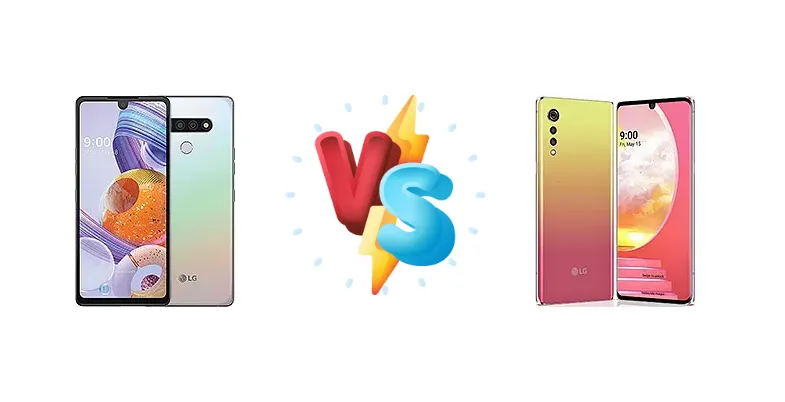
The LG Stylo 6 and LG Velvet 5G represent distinct approaches within LG’s smartphone lineup. The Stylo 6 focuses on affordability and essential features, while the Velvet 5G aims for a more premium experience with 5G connectivity and a more powerful processor. This comparison dissects the key differences to determine which device best suits your needs and budget.
🏆 Quick Verdict
For most users, the LG Velvet 5G is the superior choice. Its Snapdragon 765G chipset delivers significantly faster performance, enabling smoother multitasking and a more responsive user experience. While the Stylo 6 offers a lower price point, the Velvet 5G’s 5G capabilities and improved features justify the price difference.
| Network |
|---|
| 2G bands | GSM 850 / 900 / 1800 / 1900 | GSM 850 / 900 / 1800 / 1900 |
| 3G bands | HSDPA 850 / 900 / 1900 / 2100 | HSDPA 850 / 900 / 1900 / 2100 |
| 4G bands | LTE | 1, 2, 3, 4, 5, 7, 8, 12, 17, 20, 28, 32, 38, 39, 40, 41 |
| 5G bands | - | 1, 3, 28, 78 SA/NSA |
| Speed | HSPA 42.2/5.76 Mbps, LTE (2CA) Cat6 300/50 Mbps | HSPA 42.2/5.76 Mbps, LTE (5CA) Cat16 1000/75 Mbps, 5G 2Gbps |
| Technology | GSM / HSPA / LTE | GSM / HSPA / LTE / 5G |
| Launch |
|---|
| Announced | 2020, May 20. Released 2020, May 20 | 2020, May 07. Released 2020, May 15 |
| Status | Discontinued | Discontinued |
| Body |
|---|
| Build | - | Glass front, glass back, aluminum frame |
| Dimensions | 171.2 x 77.7 x 8.6 mm (6.74 x 3.06 x 0.34 in) | 167.2 x 74.1 x 7.9 mm (6.58 x 2.92 x 0.31 in) |
| SIM | Nano-SIM | Nano-SIM + Nano-SIM |
| Weight | 219 g (7.72 oz) | 180 g (6.35 oz) |
| | Stylus | IP68 dust/water resistant (up to 1.5m for 30 mins)
MIL-STD-810G compliant*
*does not guarantee ruggedness or use in extreme conditions |
| Display |
|---|
| Resolution | 1080 x 2460 pixels (~395 ppi density) | 1080 x 2460 pixels (~395 ppi density) |
| Size | 6.8 inches, 109.8 cm2 (~82.5% screen-to-body ratio) | 6.8 inches, 109.8 cm2 (~88.6% screen-to-body ratio) |
| Type | IPS LCD | P-OLED |
| Platform |
|---|
| CPU | Octa-core (4x2.3 GHz Cortex-A53 & 4x1.8 GHz Cortex-A53) | Octa-core (1x2.4 GHz Kryo 475 Prime & 1x2.2 GHz Kryo 475 Gold & 6x1.8 GHz Kryo 475 Silver) |
| Chipset | Mediatek MT6765 Helio P35 (12 nm) | Qualcomm SM7250 Snapdragon 765G 5G (7 nm) |
| GPU | PowerVR GE8320 | Adreno 620 |
| OS | Android 10 | Android 10, upgradable to Android 13, LG UX |
| Memory |
|---|
| Card slot | microSDXC (dedicated slot) | microSDXC (uses shared SIM slot) |
| Internal | 64GB 3GB RAM | 128GB 6GB RAM, 128GB 8GB RAM |
| | eMMC 5.1 | UFS 2.1 |
| Main Camera |
|---|
| Features | LED flash, panorama, HDR | LED flash, panorama, HDR |
| Triple | 13 MP, (wide), PDAF
5 MP, 120˚, (ultrawide)
Auxiliary lens | 48 MP, f/1.8, 26mm (wide), 1/2.0", 0.8µm, PDAF
8 MP, f/2.2, 120˚, 15mm (ultrawide), 1/4.0", 1.12µm
Auxiliary lens |
| Video | 1080p@30fps | 4K@30fps, 1080p@30/60fps, gyro-EIS |
| Selfie camera |
|---|
| Features | - | HDR |
| Single | 13 MP, 1/3.1", 1.12µm | 16 MP, f/1.9, 29mm (standard), 1/3.06, 1.0µm |
| Video | 1080p@30fps | 1080p@30fps |
| Sound |
|---|
| 3.5mm jack | Yes | Yes |
| 35mm jack | Yes | Yes |
| Loudspeaker | Yes | Yes, with stereo speakers |
| Comms |
|---|
| Bluetooth | 5.0, A2DP, LE | 5.1, A2DP, LE, aptX HD |
| NFC | No | Yes |
| Positioning | GPS | GPS (L1+L5), GLONASS, BDS, GALILEO, QZSS |
| Radio | No | FM radio (market/region dependent) |
| USB | USB Type-C 2.0 | USB Type-C, OTG |
| WLAN | Wi-Fi 802.11 b/g/n, Wi-Fi Direct | Wi-Fi 802.11 a/b/g/n/ac, dual-band, Wi-Fi Direct, DLNA |
| Features |
|---|
| Sensors | Fingerprint (rear-mounted), accelerometer, proximity | Fingerprint (under display, optical), accelerometer, gyro, proximity, compass, barometer |
| Battery |
|---|
| Charging | - | 25W wired, PD3.0, QC4
9W wireless |
| Type | Li-Po 4000 mAh | Li-Po 4300 mAh |
| Misc |
|---|
| Colors | White | Aurora White, Aurora Green, Aurora Gray, Illusion Sunset, Red, Pink |
| Models | LMQ730TM, LM-Q730TM | LM-G900N, LM-G900EM, LM-G900, LM-G900TM |
| Price | About 200 EUR | About 470 EUR |
| SAR | - | 0.23 W/kg (head) 1.02 W/kg (body) |
| Tests |
|---|
| Battery life | - | Endurance rating 79h |
| Camera | - |
Photo / Video |
| Display | - |
Contrast ratio: Infinite (nominal) |
| Loudspeaker | - |
-23.5 LUFS (Very good) |
| Performance | - |
AnTuTu: 297372 (v8)
GeekBench: 1905 (v5.1)
GFXBench: 16fps (ES 3.1 onscreen) |
LG Stylo 6
- Significantly lower price point
- Acceptable battery life for basic use
- Large display for media consumption
- Slow processor and limited performance
- Outdated chipset architecture
- Likely inferior camera quality
LG Velvet 5G
- 5G connectivity for faster data speeds
- Powerful Snapdragon 765G processor
- Faster charging with 25W wired and 9W wireless
- Higher price compared to the Stylo 6
- May be overkill for basic smartphone users
- No detailed display specifications available
Display Comparison
The LG Velvet 5G boasts a significantly more capable display experience. While both phones lack detailed display specifications beyond the Velvet’s measured 617 nits of peak brightness, this figure alone indicates a much more visible screen in outdoor conditions compared to the Stylo 6. The Velvet’s ‘Infinite’ contrast ratio (nominal) suggests a superior panel capable of deeper blacks, enhancing video consumption. The Stylo 6, likely utilizing a standard LCD panel, will struggle in direct sunlight and offer less vibrant colors.
Camera Comparison
Both phones are listed as having Photo/Video capabilities, but the underlying hardware likely differs significantly. While specific sensor details are missing, the Velvet 5G, being a higher-tier device, likely features a larger main sensor and more sophisticated image processing algorithms. The Stylo 6, targeting a budget market, likely utilizes a simpler camera system. The absence of details regarding OIS (Optical Image Stabilization) on either device suggests limited low-light performance. It’s reasonable to assume the Velvet 5G will produce sharper, more detailed images with better dynamic range, especially in challenging lighting conditions.
Performance
The performance disparity between these two devices is substantial. The LG Velvet 5G’s Qualcomm Snapdragon 765G (7nm) is a far more advanced chipset than the Stylo 6’s MediaTek Helio P35 (12nm). The 765G features a Kryo 475 CPU with a prime core clocked at 2.4 GHz, alongside Gold and Silver cores, offering a more efficient and powerful architecture. The Stylo 6’s Cortex-A53 cores, while octa-core, are less efficient and deliver lower peak performance. This translates to noticeably slower app loading times, lag during multitasking, and a less enjoyable gaming experience on the Stylo 6. The 7nm process node of the Snapdragon 765G also contributes to better thermal management, reducing the likelihood of performance throttling under sustained load.
Battery Life
Both devices share an endurance rating of 79 hours, suggesting comparable battery life under similar usage patterns. However, the Velvet 5G’s 25W wired charging with PD3.0 and QC4 support offers a significant advantage over the Stylo 6’s unspecified charging speed. The Velvet 5G can rapidly replenish its battery, minimizing downtime, while the Stylo 6 will likely require a much longer charging period. The inclusion of 9W wireless charging on the Velvet 5G further enhances its convenience.
Buying Guide
Buy the LG Stylo 6 if you prioritize extreme affordability and only need a smartphone for basic tasks like calls, texts, and light social media use. You’ll appreciate its lower cost and acceptable battery life for minimal usage. Buy the LG Velvet 5G if you want a more future-proof device with 5G connectivity, a noticeably faster processor for gaming and demanding apps, and a brighter, more vibrant display. The Velvet 5G is ideal for users who value performance and want to take advantage of next-generation network speeds.
Frequently Asked Questions
❓ Is the Snapdragon 765G in the Velvet 5G capable of handling demanding games like PUBG or Call of Duty?
Yes, the Snapdragon 765G is a capable mid-range processor that can handle PUBG and Call of Duty at medium to high settings. While it won't deliver the same performance as flagship chipsets, it provides a smooth and enjoyable gaming experience, especially considering the phone's thermal management capabilities.
❓ Does the LG Velvet 5G support carrier aggregation for improved 5G speeds?
The Snapdragon 765G modem supports carrier aggregation, which allows the phone to combine multiple 5G channels for faster and more reliable data speeds. However, the actual speeds you experience will depend on your carrier's network infrastructure and coverage.
❓ How does the Helio P35 in the Stylo 6 perform with multitasking and app switching?
The Helio P35 struggles with intensive multitasking. Expect noticeable lag when switching between multiple apps, especially larger applications. It's best suited for running one app at a time and is not ideal for power users.
❓ What type of storage does the LG Velvet 5G use, and is it expandable?
While not specified in the provided data, LG Velvet 5G typically uses UFS 2.1 storage for faster read/write speeds. Expandability via microSD card is not a standard feature on the Velvet 5G, so users should carefully consider their storage needs before purchasing.