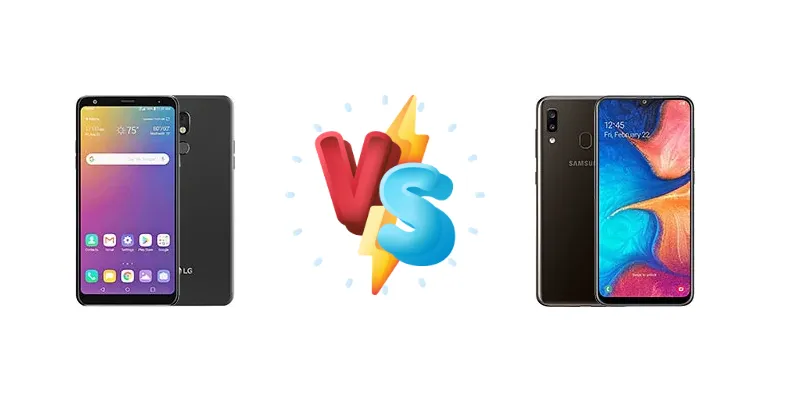
The LG Stylo 5 and Samsung Galaxy A20 represent a shrinking segment of the smartphone market: truly affordable devices. Both phones aim to deliver essential smartphone functionality without breaking the bank, but they take different approaches to achieving this. This comparison dissects their key specifications to determine which offers the best value for budget-conscious consumers.
🏆 Quick Verdict
For most users, the LG Stylo 5 emerges as the slightly better choice. Its superior endurance rating of 79 hours, coupled with faster 20W charging, provides a more reliable and convenient experience. While the Galaxy A20’s Exynos chip has a more complex CPU architecture, the real-world performance difference is minimal for everyday tasks.
| Network |
|---|
| 2G bands | GSM 850 / 900 / 1800 / 1900 | GSM 850 / 900 / 1800 / 1900 |
| 3G bands | HSDPA 850 / 1700(AWS) / 1900 | HSDPA 850 / 900 / 1900 / 2100 |
| 4G bands | 2, 4, 5, 12, 14, 29, 30, 66 | 1, 3, 5, 7, 8, 20, 38, 40, 41 |
| Speed | HSPA, LTE | HSPA 42.2/5.76 Mbps, LTE Cat4 150/50 Mbps |
| Technology | GSM / HSPA / LTE | GSM / HSPA / LTE |
| | - | 1, 2, 3, 4, 5, 7, 8, 12, 13, 20, 25, 26, 28, 38, 39, 40, 41, 66, 71 - SM-A205U |
| Launch |
|---|
| Announced | 2019, June. Released 2019, June | 2019, March 19. Released 2019, April 05 |
| Status | Discontinued | Discontinued |
| Body |
|---|
| Build | Glass front (Gorilla Glass 5), aluminum back, aluminum frame | Glass front (Gorilla Glass 3), plastic back, plastic frame |
| Dimensions | 160 x 77.7 x 8.4 mm (6.30 x 3.06 x 0.33 in) | 158.4 x 74.7 x 7.8 mm (6.24 x 2.94 x 0.31 in) |
| SIM | Nano-SIM | · Nano-SIM· Nano-SIM + Nano-SIM |
| Weight | 179 g (6.31 oz) | 169 g (5.96 oz) |
| | Stylus | - |
| Display |
|---|
| Protection | Corning Gorilla Glass 5 | Corning Gorilla Glass 3 |
| Resolution | 1080 x 2160 pixels, 18:9 ratio (~390 ppi density) | 720 x 1560 pixels, 19.5:9 ratio (~268 ppi density) |
| Size | 6.2 inches, 99.2 cm2 (~79.8% screen-to-body ratio) | 6.4 inches, 100.5 cm2 (~85.0% screen-to-body ratio) |
| Type | IPS LCD | Super AMOLED |
| Platform |
|---|
| CPU | Octa-core 1.8 GHz Cortex-A53 | Octa-core (2x1.6 GHz Cortex-A73 & 6x1.35 GHz Cortex-A53) |
| Chipset | Qualcomm SDM450 Snapdragon 450 (14 nm) | Exynos 7884 (14 nm) |
| GPU | Adreno 506 | Mali-G71 MP2 |
| OS | Android 9.0 (Pie) | Android 9.0 (Pie), upgradable to Android 11, One UI 3.1 |
| Memory |
|---|
| Card slot | microSDXC (dedicated slot) | microSDXC (dedicated slot) |
| Internal | 32GB 3GB RAM | 32GB 3GB RAM |
| | eMMC 5.1 | eMMC 5.1 |
| Main Camera |
|---|
| Dual | - | 13 MP, f/1.9, 28mm (wide), AF
5 MP, f/2.2, 12mm (ultrawide) |
| Features | LED flash, panorama, HDR | LED flash, panorama, HDR |
| Single | 13 MP, PDAF | - |
| Video | 1080p@30fps | 1080p@30fps |
| Selfie camera |
|---|
| Dual | 16 MP, f/2.0, 26mm (wide), 1/3.06", 1.0µm
8 MP | - |
| Single | 5 MP | 8 MP, f/2.0 |
| Video | 1080p@30fps | 1080p@30fps |
| Sound |
|---|
| 3.5mm jack | Yes | Yes |
| 35mm jack | Yes | Yes |
| Loudspeaker | Yes | Yes |
| Comms |
|---|
| Bluetooth | 4.2, A2DP, LE | 5.0, A2DP, LE |
| NFC | No | Yes (market/region dependent) |
| Positioning | GPS | GPS, GLONASS, BDS |
| Radio | No | FM radio |
| USB | USB Type-C 2.0 | USB Type-C 2.0, OTG |
| WLAN | Wi-Fi 802.11 a/b/g/n/ac, dual-band, Wi-Fi Direct | Wi-Fi 802.11 b/g/n, Wi-Fi Direct |
| Features |
|---|
| Sensors | Fingerprint (rear-mounted), accelerometer, proximity | Fingerprint (rear-mounted), accelerometer, gyro, proximity, compass |
| Battery |
|---|
| Charging | 20W wired | 15W wired |
| Type | Li-Ion 3500 mAh, non-removable | Li-Po 4000 mAh, non-removable |
| Misc |
|---|
| Colors | Blonde Rose, Platinum Gray | Black, Deep Blue, Red, Coral Orange, Gold |
| Models | LM-Q720 | SM-A205F, SM-A205FN, SM-A205GN, SM-A205YN, SM-A205G, SM-A205W, SM-A205U, SM-A205S, SM-S205DL, SM-A205U1 |
| Price | About 200 EUR | About 100 EUR |
| SAR | - | 1.09 W/kg (head) 0.60 W/kg (body) |
| SAR EU | - | 0.23 W/kg (head) 1.38 W/kg (body) |
| Tests |
|---|
| Audio quality |
Noise-93.5dB / Crosstalk -92.0dB | - |
| Battery life |
Endurance rating 79h
| - |
| Camera |
Photo / Video | - |
| Display |
Contrast ratio: 1485 (nominal), 3.218 (sunlight) | - |
| Loudspeaker |
Voice 62dB / Noise 69dB / Ring 70dB
| - |
| Performance |
GeekBench: 4695 (v4.4)
GFXBench: 6fps (ES 3.1 onscreen) | - |
LG Stylo 5
- Exceptional 79-hour endurance rating
- Faster 20W wired charging
- Potentially better outdoor display visibility due to higher contrast ratio
- Simpler CPU architecture compared to the A20
- Camera specifications are not detailed
Samsung Galaxy A20
- More complex CPU architecture with Cortex-A73 cores
- Samsung’s typically vibrant image processing
- Familiar Samsung One UI software experience
- Slower 15W charging
- Likely lower battery endurance compared to the Stylo 5
Display Comparison
Both the LG Stylo 5 and Samsung Galaxy A20 feature displays geared towards affordability, but differ in contrast. The Stylo 5 boasts a nominal contrast ratio of 1485, improving to 3.218 in sunlight, suggesting better outdoor visibility. While specific panel technology isn't specified, the contrast ratios indicate a potentially more vibrant and readable display in bright conditions compared to the A20, which lacks published contrast data. Bezels are expected to be substantial on both devices, typical of this price point, and color accuracy is likely to be standard for budget LCDs.
Camera Comparison
Both devices offer basic camera capabilities, but detailed sensor information is limited. Without specific megapixel counts or sensor sizes, it’s difficult to make a definitive judgment. However, the inclusion of 'Photo / Video' as a feature for the Stylo 5 suggests a standard camera experience. The A20 likely features a similar setup, and the presence of a 2MP macro camera on many A-series phones suggests it's present here, though its utility is questionable due to the low resolution. Image processing will likely be the differentiating factor, with Samsung typically offering more saturated and vibrant images.
Performance
The Samsung Galaxy A20’s Exynos 7884 utilizes a more complex octa-core configuration – two Cortex-A73 cores clocked at 1.6 GHz and six Cortex-A53 cores at 1.35 GHz – compared to the LG Stylo 5’s homogenous octa-core Cortex-A53 setup running at 1.8 GHz. While the A73 cores offer higher individual performance, the A20’s overall performance advantage is likely to be subtle in everyday tasks. Both chipsets are built on a 14nm process, suggesting similar thermal characteristics. The Stylo 5’s higher clock speed on its A53 cores may provide a slight edge in sustained performance, but the A20’s architecture could handle multi-threaded tasks more efficiently. Neither phone is designed for demanding gaming.
Battery Life
The LG Stylo 5’s endurance rating of 79 hours is a significant advantage over the Samsung Galaxy A20, which lacks a published endurance rating. This suggests the Stylo 5 can last considerably longer on a single charge. Furthermore, the Stylo 5 supports 20W wired charging, while the A20 is limited to 15W. This faster charging speed translates to quicker top-ups, reducing downtime. While battery capacity isn’t specified for either device, the combination of endurance and charging speed makes the Stylo 5 the clear winner in this category.
Buying Guide
Buy the LG Stylo 5 if you prioritize long battery life and quick charging, making it ideal for users who are frequently on the go or have limited access to power outlets. Buy the Samsung Galaxy A20 if you prefer a slightly more sophisticated CPU architecture, potentially offering a marginal performance boost in specific, demanding applications, and are comfortable with slower charging speeds.
Frequently Asked Questions
❓ Does the Exynos 7884 in the Galaxy A20 tend to overheat during prolonged use, like video recording or gaming?
The Exynos 7884 is a relatively low-power chip built on a 14nm process. While it can handle basic tasks, prolonged intensive use *could* lead to some thermal throttling, reducing performance slightly. However, neither phone is designed for extended gaming sessions, and overheating is unlikely to be a major issue for typical usage.
❓ Is the 2MP macro camera on the Samsung Galaxy A20 actually useful for taking detailed close-up photos?
Generally, 2MP macro cameras on budget phones are limited in their usefulness. The low resolution results in images lacking detail and sharpness. While it can capture a close-up perspective, don't expect professional-quality macro photography. It's more of a marketing feature than a genuinely impactful camera component.
❓ Can either the LG Stylo 5 or Samsung Galaxy A20 reliably run PUBG Mobile at 60fps?
Running PUBG Mobile at 60fps on either of these devices is unlikely to be a smooth experience. Both the Snapdragon 450 and Exynos 7884 are entry-level chipsets. You'll likely need to play at lower graphics settings and potentially accept frame rate drops, even at 30fps. They are better suited for less demanding mobile games.
❓ Which phone is better for streaming videos for extended periods, considering battery life?
The LG Stylo 5 is the clear winner for video streaming. Its 79-hour endurance rating indicates significantly longer battery life compared to the Samsung Galaxy A20. You'll be able to watch more videos on a single charge with the Stylo 5, making it the better choice for media consumption.