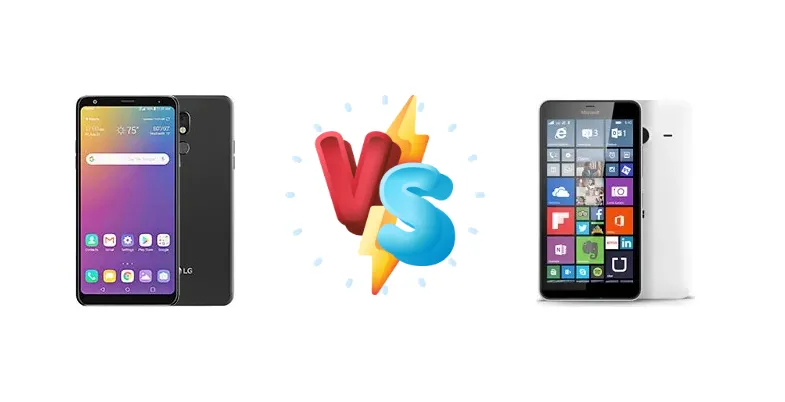
The LG Stylo 5 and Microsoft Lumia 640 XL represent distinct eras of the budget smartphone market. The Stylo 5, running Android, arrived in a landscape dominated by evolving software, while the Lumia 640 XL was a late-stage offering from Microsoft’s Windows Phone platform. This comparison dissects their core specifications to determine which device offers the most value, particularly considering the current software support landscape.
🏆 Quick Verdict
For the average user in 2024, the LG Stylo 5 is the superior choice. Its more modern Snapdragon 450 chipset delivers significantly better performance, and the Android ecosystem provides ongoing software updates and app compatibility, unlike the discontinued Windows Phone OS of the Lumia 640 XL.
| Network |
|---|
| 2G bands | GSM 850 / 900 / 1800 / 1900 | GSM 850 / 900 / 1800 / 1900 |
| 3G bands | HSDPA 850 / 1700(AWS) / 1900 | HSDPA 850 / 900 / 1900 / 2100 |
| 4G bands | 2, 4, 5, 12, 14, 29, 30, 66 | - |
| Speed | HSPA, LTE | HSPA 42.2/5.76 Mbps |
| Technology | GSM / HSPA / LTE | GSM / HSPA |
| Launch |
|---|
| Announced | 2019, June. Released 2019, June | 2015, March. Released 2015, April |
| Status | Discontinued | Discontinued |
| Body |
|---|
| Build | Glass front (Gorilla Glass 5), aluminum back, aluminum frame | - |
| Dimensions | 160 x 77.7 x 8.4 mm (6.30 x 3.06 x 0.33 in) | 157.9 x 81.5 x 9 mm (6.22 x 3.21 x 0.35 in) |
| SIM | Nano-SIM | Micro-SIM |
| Weight | 179 g (6.31 oz) | 171 g (6.03 oz) |
| | Stylus | - |
| Display |
|---|
| Protection | Corning Gorilla Glass 5 | Corning Gorilla Glass 3 |
| Resolution | 1080 x 2160 pixels, 18:9 ratio (~390 ppi density) | 720 x 1280 pixels, 16:9 ratio (~259 ppi density) |
| Size | 6.2 inches, 99.2 cm2 (~79.8% screen-to-body ratio) | 5.7 inches, 88.9 cm2 (~69.1% screen-to-body ratio) |
| Type | IPS LCD | IPS LCD |
| | - | ClearBlack display |
| Platform |
|---|
| CPU | Octa-core 1.8 GHz Cortex-A53 | Quad-core 1.2 GHz Cortex-A7 |
| Chipset | Qualcomm SDM450 Snapdragon 450 (14 nm) | Qualcomm MSM8226 Snapdragon 400 (28 nm) |
| GPU | Adreno 506 | Adreno 305 |
| OS | Android 9.0 (Pie) | Microsoft Windows Phone 8.1, upgradable to Microsoft Windows 10 |
| Memory |
|---|
| Card slot | microSDXC (dedicated slot) | microSDXC (dedicated slot) |
| Internal | 32GB 3GB RAM | 8GB 1GB RAM |
| | eMMC 5.1 | eMMC 4.5 |
| Main Camera |
|---|
| Features | LED flash, panorama, HDR | Zeiss optics, LED flash |
| Single | 13 MP, PDAF | 13 MP, f/2.0, 28mm (wide), 1/3.0", AF |
| Video | 1080p@30fps | 1080p@30fps |
| Selfie camera |
|---|
| Dual | 16 MP, f/2.0, 26mm (wide), 1/3.06", 1.0µm
8 MP | - |
| Single | 5 MP | 5 MP |
| Video | 1080p@30fps | 1080p@30fps |
| Sound |
|---|
| 3.5mm jack | Yes | Yes |
| 35mm jack | Yes | Yes |
| Loudspeaker | Yes | Yes |
| Comms |
|---|
| Bluetooth | 4.2, A2DP, LE | 4.0, A2DP |
| NFC | No | Yes |
| Positioning | GPS | GPS, GLONASS, BDS |
| Radio | No | FM radio |
| USB | USB Type-C 2.0 | microUSB 2.0 |
| WLAN | Wi-Fi 802.11 a/b/g/n/ac, dual-band, Wi-Fi Direct | Wi-Fi 802.11 b/g/n, DLNA, hotspot |
| Features |
|---|
| Sensors | Fingerprint (rear-mounted), accelerometer, proximity | Accelerometer, proximity, compass, sensor core |
| Battery |
|---|
| Charging | 20W wired | - |
| Stand-by | - | Up to 936 h (2G) / Up to 936 h (3G) |
| Talk time | - | Up to 31 h 20 min (2G) / Up to 23 h 40 min (3G) |
| Type | Li-Ion 3500 mAh, non-removable | Li-Ion 3000 mAh, removable |
| Misc |
|---|
| Colors | Blonde Rose, Platinum Gray | Matte cyan, Orange, Black, Matte white, Glossy white |
| Models | LM-Q720 | - |
| Price | About 200 EUR | About 170 EUR |
| Tests |
|---|
| Audio quality |
Noise-93.5dB / Crosstalk -92.0dB |
Noise -93.0dB / Crosstalk -94.4dB |
| Battery life |
Endurance rating 79h
|
Endurance rating 74h
|
| Camera |
Photo / Video | - |
| Display |
Contrast ratio: 1485 (nominal), 3.218 (sunlight) |
Contrast ratio: 1119:1 (nominal), 3.065 (sunlight) |
| Loudspeaker |
Voice 62dB / Noise 69dB / Ring 70dB
| - |
| Performance |
GeekBench: 4695 (v4.4)
GFXBench: 6fps (ES 3.1 onscreen) | - |
LG Stylo 5
- Significantly faster processor (Snapdragon 450)
- More efficient 14nm process
- Faster 20W charging
- Ongoing Android software support
- Likely lower build quality compared to the Lumia
- Camera performance likely similar to Lumia
Microsoft Lumia 640 XL
- Potentially more durable build quality
- Larger display size (typically)
- Lower initial purchase price (when new)
- Dedicated camera button (common on Lumia devices)
- Outdated Windows Phone OS – no updates
- Slow processor (Snapdragon 400)
- Less efficient 28nm process
- Limited app availability
Display Comparison
Both the LG Stylo 5 and Microsoft Lumia 640 XL feature displays with similar sunlight contrast ratios around 3.065, suggesting comparable outdoor visibility. However, the LG Stylo 5 boasts a higher nominal contrast ratio of 1485:1 compared to the Lumia 640 XL’s 1119:1, indicating potentially deeper blacks and a more vibrant image. While neither display is expected to be particularly high-resolution, the Stylo 5’s superior contrast provides a slight edge in visual quality. The absence of information regarding panel technology (IPS, TFT) prevents a deeper analysis of color accuracy and viewing angles.
Camera Comparison
Detailed camera analysis is limited by the provided data. Both devices are listed as having 'Photo / Video' capabilities, lacking specifics on sensor size, aperture, or image stabilization. Given the market positioning, it’s safe to assume both cameras are entry-level. The absence of details prevents a meaningful comparison beyond acknowledging that both likely struggle in low-light conditions. The focus should be on the software processing capabilities, which are inherently tied to the operating system – a significant advantage for the Stylo 5 due to ongoing Android updates.
Performance
The performance gap between these two devices is substantial. The LG Stylo 5’s Qualcomm SDM450 Snapdragon 450, built on a 14nm process, features an octa-core 1.8 GHz Cortex-A53 CPU. This contrasts sharply with the Microsoft Lumia 640 XL’s Qualcomm MSM8226 Snapdragon 400, fabricated on a less efficient 28nm node, and equipped with a quad-core 1.2 GHz Cortex-A7 CPU. The 14nm process of the Snapdragon 450 translates to better power efficiency and reduced thermal throttling, while the eight cores provide a significant advantage in multi-tasking and app responsiveness. The architectural difference between Cortex-A53 and A7 cores further favors the Stylo 5, with A53 offering improved performance per clock cycle.
Battery Life
Both the LG Stylo 5 and Microsoft Lumia 640 XL achieve endurance ratings of approximately 74-79 hours, indicating similar overall battery life. However, the Stylo 5’s 20W wired charging capability offers a significant advantage over the Lumia 640 XL, which lacks specific charging information but was typically slower. This faster charging allows the Stylo 5 to replenish its battery more quickly, minimizing downtime. The Snapdragon 450’s 14nm process also contributes to better power efficiency, potentially extending real-world usage despite similar battery capacities.
Buying Guide
Buy the LG Stylo 5 if you need a functional, affordable smartphone with access to a vast app ecosystem and reasonable performance for everyday tasks. It’s ideal for users who prioritize current software support and basic multimedia consumption. Buy the Microsoft Lumia 640 XL only if you have a specific need for the Windows Phone ecosystem (highly unlikely in 2024) or are seeking a very inexpensive device for extremely limited use, accepting the risks of no further software updates.
Frequently Asked Questions
❓ Is the LG Stylo 5 still receiving software updates in 2024?
While the Stylo 5 is no longer receiving major Android version updates, it likely still receives security patches, offering a level of protection against vulnerabilities that the Lumia 640 XL, with its discontinued Windows Phone OS, completely lacks. This continued (albeit limited) support is a significant advantage.
❓ Can I still download apps on the Microsoft Lumia 640 XL?
The Microsoft Store for Windows Phone has been discontinued. While some existing apps may still function, you will be unable to download new applications, severely limiting the functionality of the device. This is a critical drawback compared to the LG Stylo 5, which has access to the vast Google Play Store.
❓ Will the Snapdragon 400 in the Lumia 640 XL struggle with modern apps?
Yes, the Snapdragon 400 is a significantly underpowered processor for modern applications. Expect slow loading times, lag, and potential crashes when running even basic apps. The Stylo 5’s Snapdragon 450 offers a much smoother and more responsive experience.
❓ How does the battery life compare for typical daily use?
While both phones have similar endurance ratings, the Stylo 5’s more efficient processor and faster charging mean you’ll likely spend less time tethered to a charger. The Lumia 640 XL’s battery life will be impacted by the strain of its older processor.