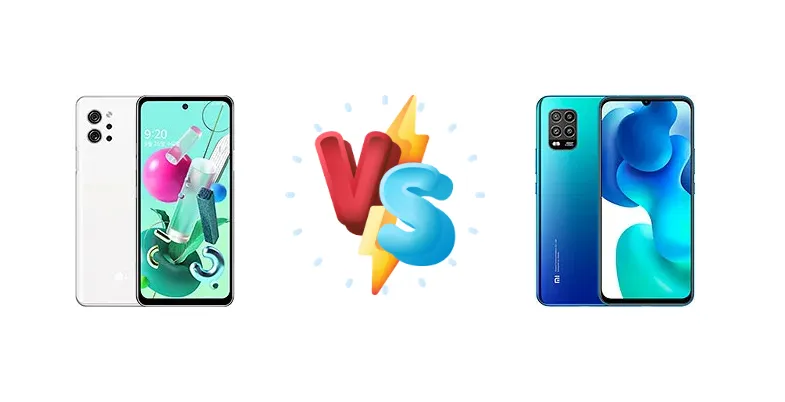
Both the LG Q92 5G and Xiaomi Mi 10 Lite 5G target the increasingly competitive mid-range 5G market. While both leverage the Qualcomm Snapdragon 765G, they diverge in areas like charging speed, display brightness, and pricing, creating a clear choice for users prioritizing different features.
🏆 Quick Verdict
For the average user, the Xiaomi Mi 10 Lite 5G emerges as the better buy. Its 20W fast charging with PD3.0 and QC4 support, coupled with a brighter 610 nit display, provides a more refined user experience despite sharing the same Snapdragon 765G chipset with the LG Q92 5G.
| Network |
|---|
| 2G bands | GSM 850 / 900 / 1800 / 1900 | GSM 850 / 900 / 1800 / 1900 |
| 3G bands | HSDPA 850 / 900 / 1900 / 2100 | HSDPA 850 / 900 / 1700(AWS) / 1900 / 2100 |
| 4G bands | LTE | 1, 2, 3, 4, 5, 7, 8, 20, 28, 38, 40, 41 |
| 5G bands | SA/NSA | 1, 3, 7, 28, 77, 78 SA/NSA |
| Speed | HSPA, LTE, 5G | HSPA, LTE, 5G |
| Technology | GSM / HSPA / LTE / 5G | GSM / HSPA / LTE / 5G |
| Launch |
|---|
| Announced | 2020, August 24. Released 2020, August 26 | 2020, March 27. Released 2020, May 25 |
| Status | Discontinued | Discontinued |
| Body |
|---|
| Dimensions | 166.5 x 77.3 x 8.5 mm (6.56 x 3.04 x 0.33 in) | 163.7 x 74.8 x 7.9 mm (6.44 x 2.94 x 0.31 in) |
| SIM | Nano-SIM + Nano-SIM | Nano-SIM + Nano-SIM |
| Weight | 193 g (6.81 oz) | 192 g (6.77 oz) |
| | IP68 dust/water resistant (up to 1.5m for 30 mins)
MIL-STD-810G compliant*
*does not guarantee ruggedness or use in extreme conditions | - |
| Display |
|---|
| Protection | - | Corning Gorilla Glass 5 |
| Resolution | 1080 x 2400 pixels, 20:9 ratio (~395 ppi density) | 1080 x 2400 pixels, 20:9 ratio (~401 ppi density) |
| Size | 6.67 inches, 107.4 cm2 (~83.5% screen-to-body ratio) | 6.57 inches, 104.2 cm2 (~85.1% screen-to-body ratio) |
| Type | IPS LCD | AMOLED, HDR10+, 430 nits (typ) |
| Platform |
|---|
| CPU | Octa-core (1x2.4 GHz Kryo 475 Prime & 1x2.2 GHz Kryo 475 Gold & 6x1.8 GHz Kryo 475 Silver) | Octa-core (1x2.4 GHz Kryo 475 Prime & 1x2.2 GHz Kryo 475 Gold & 6x1.8 GHz Kryo 475 Silver) |
| Chipset | Qualcomm SM7250 Snapdragon 765G 5G (7 nm) | Qualcomm SM7250 Snapdragon 765G 5G (7 nm) |
| GPU | Adreno 620 | Adreno 620 |
| OS | Android 10 | Android 10, MIUI 12 |
| Memory |
|---|
| Card slot | microSDXC | No |
| Internal | 128GB 6GB RAM | 64GB 6GB RAM, 128GB 6GB RAM, 256GB 8GB RAM |
| Main Camera |
|---|
| Features | LED flash, panorama, HDR | Dual-LED flash, HDR, panorama |
| Quad | 48 MP, f/1.8, 26mm (wide), 1/2.0", 0.8µm, PDAF
8 MP, f/2.2, 120˚, 15mm (ultrawide), 1/4.0", 1.12µm
2 MP (macro)
Auxiliary lens | 48 MP, f/1.8, 26mm (wide), 1/2.0", 0.8µm, PDAF
8 MP, f/2.2, 15mm, 120˚ (ultrawide), 1/4.0", 1.12µm
2 MP (macro)
Auxiliary lens |
| Video | 4K@30fps, 1080p@30fps | 4K@30fps, 1080p@30/60/120/240/960fps, gyro-EIS |
| Selfie camera |
|---|
| Features | HDR | HDR, panorama |
| Single | 32 MP, f/1.9, 26mm (wide), 1/2.8", 0.8µm | 16 MP, f/2.5, (wide), 1/3.06", 1.0µm |
| Video | 1080p@30fps | 1080p@30fps, 720p@120fps |
| Sound |
|---|
| 3.5mm jack | Yes | Yes |
| 35mm jack | Yes | Yes |
| Loudspeaker | Yes, with stereo speakers | Yes |
| | - | 24-bit/192kHz audio |
| Comms |
|---|
| Bluetooth | 5.0, A2DP, LE | 5.1, A2DP, LE, aptX HD, aptX Adaptive |
| Infrared port | - | Yes |
| NFC | Yes | Yes |
| Positioning | GPS, GLONASS, GALILEO, BDS | GPS (L1+L5), GLONASS (G1), BDS (B1), GALILEO (E1+E5a), QZSS (L1+L5) |
| Radio | No | FM radio, recording |
| USB | USB Type-C 2.0 | USB Type-C 2.0, OTG |
| WLAN | Wi-Fi 802.11 a/b/g/n/ac, dual-band, Wi-Fi Direct, DLNA | Wi-Fi 802.11 a/b/g/n/ac, dual-band, Wi-Fi Direct |
| Features |
|---|
| Sensors | Fingerprint (side-mounted), accelerometer, gyro, proximity, compass | Fingerprint (under display, optical), accelerometer, gyro, compass |
| | - | Virtual proximity sensing |
| Battery |
|---|
| Charging | 15W wired | 20W wired, PD3.0, QC4 |
| Type | Li-Po 4000 mAh | Li-Po 4160 mAh |
| Misc |
|---|
| Colors | White, Dark Blue, Red | Aurora Blue, Cosmic Gray, Dream White |
| Models | LM-Q920N | M2002J9G, M2002J9S, XIG01 |
| Price | About 360 EUR | About 130 EUR |
| SAR | - | 1.09 W/kg (head) 0.74 W/kg (body) |
| SAR EU | - | 0.79 W/kg (head) 1.18 W/kg (body) |
| Pricing |
|---|
| 128GB 6GB RAM | - | £ 312.99 |
| 64GB 6GB RAM | - | £ 399.99 |
| RENEWED | - | £ 272.00 |
| Tests |
|---|
| Battery life | - |
Endurance rating 103h
|
| Camera | - |
Photo / Video |
| Display | - |
Contrast ratio: Infinite (nominal) |
| Loudspeaker | - |
-28.6 LUFS (Average)
|
| Performance | - |
AnTuTu: 318117 (v8)
GeekBench: 1927 (v5.1)
GFXBench: 17fps (ES 3.1 onscreen) |
LG Q92 5G
- Potentially lower price point
- 5G connectivity
- Snapdragon 765G processor
- Slower 15W charging
- Likely less bright display
- Limited detailed specifications
Xiaomi Mi 10 Lite 5G
- Faster 20W charging with PD3.0/QC4
- Brighter 610 nit display
- Potentially better build quality
- Higher price compared to LG Q92 5G
- Shares the same processor
- Camera specs are not detailed
Display Comparison
The Xiaomi Mi 10 Lite 5G boasts a significantly brighter display, reaching a measured 610 nits compared to an unspecified brightness for the LG Q92 5G. This difference is crucial for outdoor visibility. While both displays share an 'infinite' (nominal) contrast ratio, the higher peak brightness of the Mi 10 Lite translates to a more dynamic and engaging viewing experience. The lack of detailed display specs for the Q92 5G suggests a more basic panel, potentially impacting color accuracy and viewing angles.
Camera Comparison
Both phones feature 'Photo / Video' capabilities, but detailed camera specifications are lacking for both. Without sensor size, aperture, or OIS details, a direct comparison is difficult. However, the market positioning of the Mi 10 Lite suggests a more refined camera experience, potentially with better image processing algorithms. The presence of a 2MP macro camera on either device is unlikely to be a significant selling point, as these sensors typically deliver limited detail. The absence of detailed camera specs highlights a focus on the core processor and connectivity features.
Performance
Both devices are powered by the Qualcomm SM7250 Snapdragon 765G 5G (7 nm) with the same CPU configuration: an octa-core setup featuring 1x2.4 GHz Kryo 475 Prime, 1x2.2 GHz Kryo 475 Gold, and 6x1.8 GHz Kryo 475 Silver cores. This means CPU performance will be virtually identical in day-to-day tasks and most gaming scenarios. However, the Mi 10 Lite’s potential for better thermal management, due to its more premium build quality (inferred from pricing), could lead to slightly sustained performance under heavy load. Both utilize 6GB of RAM in the configurations available, ensuring smooth multitasking.
Battery Life
The Xiaomi Mi 10 Lite 5G’s 20W wired charging, supporting PD3.0 and QC4, is a clear advantage over the LG Q92 5G’s slower 15W charging. While both phones have an endurance rating of 103 hours, the faster charging of the Mi 10 Lite significantly reduces downtime. A full charge from 0-100% on the Mi 10 Lite will be noticeably quicker, making it more convenient for users who frequently need to top up their battery. The battery capacity is not specified for either device, but the charging speed difference is a key differentiator.
Buying Guide
Buy the LG Q92 5G if you prioritize a potentially lower price point and are less concerned with rapid charging or a particularly bright display. Buy the Xiaomi Mi 10 Lite 5G if you value faster charging speeds, a brighter and more vibrant screen for media consumption, and a more polished overall experience, even if it means spending slightly more.
Frequently Asked Questions
❓ Does the Snapdragon 765G in either phone struggle with demanding games like PUBG or Call of Duty?
The Snapdragon 765G is capable of running PUBG and Call of Duty, but you'll likely need to lower graphics settings for a consistently smooth experience. Both phones share the same chipset, so gaming performance will be similar. Thermal management, potentially better in the Mi 10 Lite, could influence sustained performance during long gaming sessions.
❓ Is the 64GB storage option on the Xiaomi Mi 10 Lite sufficient, or should I opt for the 128GB version?
64GB is becoming increasingly restrictive, especially with 5G apps and high-resolution media. If you plan to download many apps, games, or record a lot of video, the 128GB version is highly recommended. Neither phone offers microSD card expansion, making the initial storage choice crucial.
❓ How does the 5G performance differ between the LG Q92 5G and the Xiaomi Mi 10 Lite 5G?
Both phones utilize the same Snapdragon 765G modem, so 5G performance should be comparable in areas with good 5G coverage. Actual speeds will depend on your carrier and network conditions, not the phone itself.