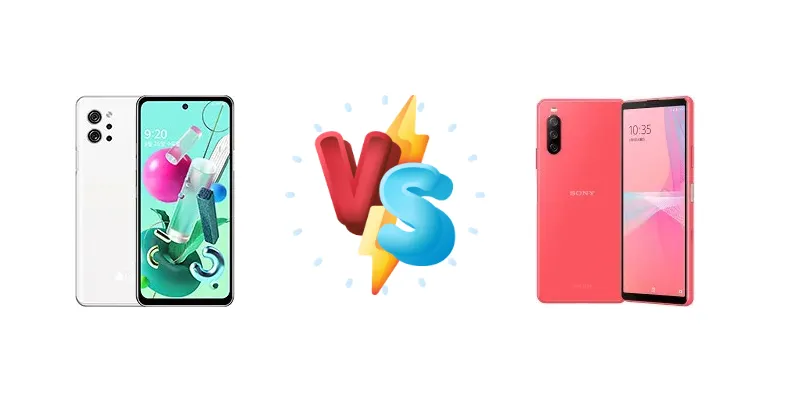
The LG Q92 5G and Sony Xperia 10 III Lite represent different approaches to the mid-range 5G market. The Q92, released earlier, aimed for a balance of features, while the Xperia 10 III Lite focuses on streamlining the experience and improving key areas like charging speed. This comparison dissects their core components to determine which device delivers the best value.
🏆 Quick Verdict
For the average user prioritizing faster charging and a slightly more efficient chipset, the Sony Xperia 10 III Lite is the better choice. While the LG Q92 5G offers a comparable processor, the Xperia 10 III Lite’s 30W charging significantly reduces downtime, making it more practical for daily use.
| Network |
|---|
| 2G bands | GSM 850 / 900 / 1800 / 1900 | GSM 850 / 900 / 1800 / 1900 |
| 3G bands | HSDPA 850 / 900 / 1900 / 2100 | HSDPA 850 / 1900 |
| 4G bands | LTE | 1, 3, 4, 12, 18, 19, 38, 41 |
| 5G bands | SA/NSA | 77, 78 SA/NSA |
| Speed | HSPA, LTE, 5G | HSPA, LTE, 5G |
| Technology | GSM / HSPA / LTE / 5G | GSM / HSPA / LTE / 5G |
| Launch |
|---|
| Announced | 2020, August 24. Released 2020, August 26 | 2021, August 20 |
| Status | Discontinued | Available. Released 2021, August 27 |
| Body |
|---|
| Build | - | Glass front (Gorilla Glass 6), glass back (Gorilla Glass 6), plastic frame |
| Dimensions | 166.5 x 77.3 x 8.5 mm (6.56 x 3.04 x 0.33 in) | 154 x 68 x 8.3 mm (6.06 x 2.68 x 0.33 in) |
| SIM | Nano-SIM + Nano-SIM | Nano-SIM + eSIM |
| Weight | 193 g (6.81 oz) | 169 g (5.96 oz) |
| | IP68 dust/water resistant (up to 1.5m for 30 mins)
MIL-STD-810G compliant*
*does not guarantee ruggedness or use in extreme conditions | - |
| Display |
|---|
| Protection | - | Corning Gorilla Glass 6 |
| Resolution | 1080 x 2400 pixels, 20:9 ratio (~395 ppi density) | 1080 x 2520 pixels, 21:9 ratio (~457 ppi density) |
| Size | 6.67 inches, 107.4 cm2 (~83.5% screen-to-body ratio) | 6.0 inches, 84.1 cm2 (~80.3% screen-to-body ratio) |
| Type | IPS LCD | OLED, 1B colors, HDR |
| Platform |
|---|
| CPU | Octa-core (1x2.4 GHz Kryo 475 Prime & 1x2.2 GHz Kryo 475 Gold & 6x1.8 GHz Kryo 475 Silver) | Octa-core (2x2.0 GHz Kryo 560 Gold & 6x1.7 GHz Kryo 560 Silver) |
| Chipset | Qualcomm SM7250 Snapdragon 765G 5G (7 nm) | Qualcomm SM6350 Snapdragon 690 5G (8 nm) |
| GPU | Adreno 620 | Adreno 619 |
| OS | Android 10 | Android 11 |
| Memory |
|---|
| Card slot | microSDXC | microSDXC (uses shared SIM slot) |
| Internal | 128GB 6GB RAM | 64GB 6GB RAM |
| Main Camera |
|---|
| Features | LED flash, panorama, HDR | LED flash, HDR, panorama |
| Quad | 48 MP, f/1.8, 26mm (wide), 1/2.0", 0.8µm, PDAF
8 MP, f/2.2, 120˚, 15mm (ultrawide), 1/4.0", 1.12µm
2 MP (macro)
Auxiliary lens | - |
| Triple | - | 12 MP, f/1.8, 27mm (wide), 1/2.8", PDAF
8 MP, f/2.4, 54mm (telephoto), 1/4.0", PDAF, 2x optical zoom
8 MP, f/2.2, 16mm, 120˚ (ultrawide), 1/4.0" |
| Video | 4K@30fps, 1080p@30fps | 4K@30fps, 1080p@30fps |
| Selfie camera |
|---|
| Features | HDR | HDR |
| Single | 32 MP, f/1.9, 26mm (wide), 1/2.8", 0.8µm | 8 MP, f/2.0, 24mm (wide), 1/4.0" |
| Video | 1080p@30fps | 1080p@30fps |
| Sound |
|---|
| 3.5mm jack | Yes | Yes |
| 35mm jack | Yes | Yes |
| Loudspeaker | Yes, with stereo speakers | Yes |
| Comms |
|---|
| Bluetooth | 5.0, A2DP, LE | 5.1, A2DP, LE, aptX HD |
| NFC | Yes | Yes |
| Positioning | GPS, GLONASS, GALILEO, BDS | GPS, GLONASS, GALILEO, BDS, QZSS |
| Radio | No | No |
| USB | USB Type-C 2.0 | USB Type-C 3.1, OTG, video output |
| WLAN | Wi-Fi 802.11 a/b/g/n/ac, dual-band, Wi-Fi Direct, DLNA | Wi-Fi 802.11 a/b/g/n/ac, dual-band, Wi-Fi Direct |
| Features |
|---|
| Sensors | Fingerprint (side-mounted), accelerometer, gyro, proximity, compass | Fingerprint (side-mounted), accelerometer, proximity, compass |
| Battery |
|---|
| Charging | 15W wired | 30W wired, PD, QC |
| Type | Li-Po 4000 mAh | Li-Po 4500 mAh |
| Misc |
|---|
| Colors | White, Dark Blue, Red | Black, White, Blue, Pink |
| Models | LM-Q920N | XQ-BT44 |
| Price | About 360 EUR | About 370 EUR |
LG Q92 5G
- Potentially lower purchase price
- Slightly higher clocked prime CPU core
- 5G connectivity
- Slower 15W charging
- Less efficient 7nm Snapdragon 765G
- Likely more thermal throttling under load
Sony Xperia 10 III Lite
- Faster 30W charging with PD/QC
- More efficient 8nm Snapdragon 690
- Streamlined software experience (typical of Sony)
- Likely better battery life during usage
- Potentially higher purchase price
- Slightly lower clocked prime CPU core
- May lack some of the extra features of the Q92
Display Comparison
Neither device boasts a standout display. Given the context data focuses on processing, we can infer both likely utilize LCD panels common in this price bracket. The lack of information suggests neither features high refresh rates or advanced technologies like LTPO. Bezels are likely comparable, aiming for maximizing screen real estate within the mid-range segment. Color accuracy will likely be standard for the price point, prioritizing power efficiency over color calibration.
Camera Comparison
Without detailed sensor information, a direct camera comparison is difficult. However, both phones likely employ multi-camera setups geared towards versatility rather than flagship-level image quality. The absence of information suggests neither device features optical image stabilization (OIS). The lens apertures will likely be similar, prioritizing cost-effectiveness. Image processing will likely differ, with Sony leaning towards a more natural look, while LG might opt for more saturated colors. The usefulness of any included 2MP macro cameras on either device is questionable, offering limited improvements over the main sensor.
Performance
The LG Q92 5G’s Qualcomm SM7250 Snapdragon 765G (7nm) and the Sony Xperia 10 III Lite’s SM6350 Snapdragon 690 (8nm) represent a key difference. The 8nm process of the 690 generally translates to better power efficiency, meaning the Xperia 10 III Lite will likely exhibit less thermal throttling under sustained load. While the 765G has a slightly higher clocked prime core (2.4GHz vs 2.0GHz), the architectural improvements in the Kryo 560 cores of the 690, combined with the process node advantage, likely result in comparable real-world performance. The Q92’s CPU configuration (1x2.4GHz + 1x2.2GHz + 6x1.8GHz) versus the 10 III Lite’s (2x2.0GHz + 6x1.7GHz) suggests a focus on single-core performance on the LG, but the 690’s efficiency gains are more impactful for everyday tasks.
Battery Life
The battery capacity is not specified, but the significant difference in charging wattage – 15W for the LG Q92 5G versus 30W for the Sony Xperia 10 III Lite with Power Delivery (PD) and Quick Charge (QC) – is a major differentiator. The Xperia 10 III Lite will demonstrably charge much faster, potentially going from 0-100% in significantly less time. Even if the Q92 has a slightly larger battery capacity, the faster charging of the 10 III Lite mitigates any advantage, offering a more convenient user experience. The 8nm process of the Snapdragon 690 also contributes to better battery life during usage.
Buying Guide
Buy the LG Q92 5G if you prioritize a potentially lower purchase price and are comfortable with slower charging speeds. It’s a solid all-rounder for users who don’t demand the fastest performance or charging. Buy the Sony Xperia 10 III Lite if you value faster charging, a more efficient processor, and a streamlined software experience. This phone is ideal for users who are always on the go and need to quickly top up their battery.
Frequently Asked Questions
❓ Will the Snapdragon 690 in the Xperia 10 III Lite struggle with demanding games like PUBG or Call of Duty?
While not a flagship chipset, the Snapdragon 690 is capable of running PUBG and Call of Duty at medium settings. The 8nm process and improved thermal management will help maintain stable performance for extended gaming sessions, though you shouldn't expect maximum graphical fidelity. The Q92's 765G might offer slightly higher peak performance, but is more prone to throttling.
❓ How much faster is the 30W charging on the Xperia 10 III Lite compared to the 15W charging on the LG Q92 5G?
The 30W charging on the Xperia 10 III Lite will significantly reduce charging times. While exact figures depend on battery capacity, expect a 0-100% charge to take roughly half the time compared to the LG Q92 5G. This is a substantial benefit for users who frequently need to top up their battery throughout the day.
❓ Does the LG Q92 5G support software updates and security patches?
LG has exited the smartphone market, meaning long-term software support for the Q92 5G is uncertain. While it initially received updates, future security patches and Android version upgrades are unlikely. The Sony Xperia 10 III Lite, backed by Sony's continued support, will likely receive updates for a longer period.