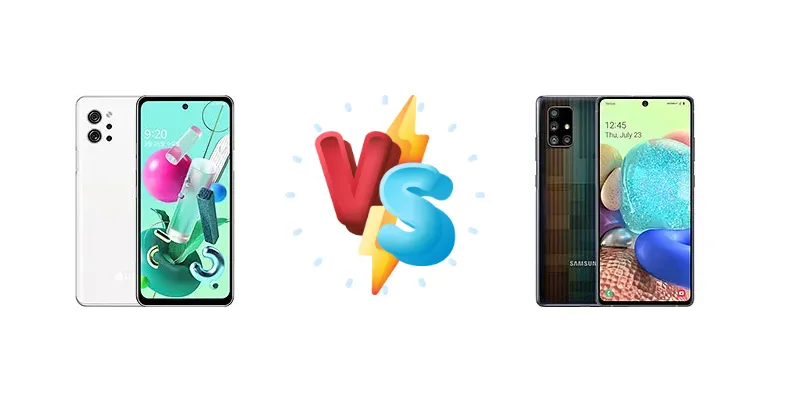
The LG Q92 5G and Samsung Galaxy A71 5G UW represent a fascinating intersection in the mid-range 5G market. Both devices leverage the Qualcomm Snapdragon 765G chipset, promising similar performance. However, subtle differences in charging speeds and potentially software optimization create a compelling case for one over the other, especially for users prioritizing convenience and minimizing downtime.
🏆 Quick Verdict
For the average user, the Samsung Galaxy A71 5G UW emerges as the slightly better choice. While both phones share the same Snapdragon 765G processor, Samsung’s 25W fast charging significantly reduces recharge times, offering a tangible benefit in daily use. The LG Q92 5G remains a viable option, but the charging disparity is a key differentiator.
| Network |
|---|
| 2G bands | GSM 850 / 900 / 1800 / 1900 | GSM 850 / 900 / 1800 / 1900 |
| 3G bands | HSDPA 850 / 900 / 1900 / 2100 | HSDPA 850 / 900 / 1900 / 2100 |
| 4G bands | LTE | 2, 3, 4, 5, 7, 12, 13, 20, 28, 66 |
| 5G bands | SA/NSA | 260, 261 SA/NSA/mmWave |
| Speed | HSPA, LTE, 5G | HSPA, LTE, 5G |
| Technology | GSM / HSPA / LTE / 5G | GSM / HSPA / LTE / 5G |
| Launch |
|---|
| Announced | 2020, August 24. Released 2020, August 26 | 2020, July 07 |
| Status | Discontinued | Available. Released 2020, July 16 |
| Body |
|---|
| Build | - | Glass front (Gorilla Glass 3), plastic back, aluminum frame |
| Dimensions | 166.5 x 77.3 x 8.5 mm (6.56 x 3.04 x 0.33 in) | 162.8 x 75.7 x 8.4 mm (6.41 x 2.98 x 0.33 in) |
| SIM | Nano-SIM + Nano-SIM | Nano-SIM (pre-installed) |
| Weight | 193 g (6.81 oz) | 188 g (6.63 oz) |
| | IP68 dust/water resistant (up to 1.5m for 30 mins)
MIL-STD-810G compliant*
*does not guarantee ruggedness or use in extreme conditions | - |
| Display |
|---|
| Protection | - | Corning Gorilla Glass 3 |
| Resolution | 1080 x 2400 pixels, 20:9 ratio (~395 ppi density) | 1080 x 2400 pixels, 20:9 ratio (~393 ppi density) |
| Size | 6.67 inches, 107.4 cm2 (~83.5% screen-to-body ratio) | 6.7 inches, 108.4 cm2 (~87.9% screen-to-body ratio) |
| Type | IPS LCD | Super AMOLED Plus |
| Platform |
|---|
| CPU | Octa-core (1x2.4 GHz Kryo 475 Prime & 1x2.2 GHz Kryo 475 Gold & 6x1.8 GHz Kryo 475 Silver) | Octa-core (1x2.4 GHz Kryo 475 Prime & 1x2.2 GHz Kryo 475 Gold & 6x1.8 GHz Kryo 475 Silver) |
| Chipset | Qualcomm SM7250 Snapdragon 765G 5G (7 nm) | Qualcomm SM7250 Snapdragon 765G 5G (7 nm) |
| GPU | Adreno 620 | Adreno 620 |
| OS | Android 10 | Android 10, One UI 2.1 |
| Memory |
|---|
| Card slot | microSDXC | microSDXC (dedicated slot) |
| Internal | 128GB 6GB RAM | 128GB 8GB RAM |
| | - | UFS 2.1 |
| Main Camera |
|---|
| Features | LED flash, panorama, HDR | LED flash, panorama, HDR |
| Quad | 48 MP, f/1.8, 26mm (wide), 1/2.0", 0.8µm, PDAF
8 MP, f/2.2, 120˚, 15mm (ultrawide), 1/4.0", 1.12µm
2 MP (macro)
Auxiliary lens | 64 MP, f/1.8, 26mm (wide), 1/1.72", 0.8µm, PDAF
12 MP, f/2.2, 123˚ (ultrawide)
5 MP (macro)
Auxiliary lens |
| Video | 4K@30fps, 1080p@30fps | 4K@30fps, 1080p@30/240fps, 1080p@960fps; gyro-EIS |
| Selfie camera |
|---|
| Features | HDR | HDR |
| Single | 32 MP, f/1.9, 26mm (wide), 1/2.8", 0.8µm | 32 MP, f/2.2, 26mm (wide), 1/2.8", 0.8µm |
| Video | 1080p@30fps | 4K@30fps, 1080p@30fps |
| Sound |
|---|
| 3.5mm jack | Yes | Yes |
| 35mm jack | Yes | Yes |
| Loudspeaker | Yes, with stereo speakers | Yes |
| Comms |
|---|
| Bluetooth | 5.0, A2DP, LE | 5.0, A2DP, LE |
| NFC | Yes | No |
| Positioning | GPS, GLONASS, GALILEO, BDS | GPS, GLONASS, GALILEO, BDS |
| Radio | No | No |
| USB | USB Type-C 2.0 | USB Type-C 2.0, OTG |
| WLAN | Wi-Fi 802.11 a/b/g/n/ac, dual-band, Wi-Fi Direct, DLNA | Wi-Fi 802.11 a/b/g/n/ac, dual-band, Wi-Fi Direct |
| Features |
|---|
| Sensors | Fingerprint (side-mounted), accelerometer, gyro, proximity, compass | Fingerprint (under display, optical), accelerometer, gyro, proximity, compass |
| | - | ANT+ |
| Battery |
|---|
| Charging | 15W wired | 25W wired |
| Type | Li-Po 4000 mAh | Li-Po 4500 mAh |
| Misc |
|---|
| Colors | White, Dark Blue, Red | Prism Bricks Black |
| Models | LM-Q920N | SM-A716V |
| Price | About 360 EUR | - |
| SAR | - | 0.50 W/kg (head) 0.78 W/kg (body) |
LG Q92 5G
- Potentially lower price point
- Solid Snapdragon 765G performance
- Likely a more neutral color profile in photos
- Slower 15W charging
- Display quality potentially inferior to Samsung
- Software updates may be less frequent
Samsung Galaxy A71 5G UW
- Faster 25W charging
- Potentially superior AMOLED display
- Samsung's established software support
- May be slightly more expensive
- Samsung's image processing can be overly saturated
- Larger physical size potentially
Display Comparison
Both the LG Q92 5G and Samsung Galaxy A71 5G UW likely utilize FHD+ displays, typical for this price bracket. However, specific details like peak brightness (nits) and color gamut coverage are missing. Samsung historically employs vibrant AMOLED panels, potentially offering superior contrast and color accuracy compared to LG’s LCDs, though this is speculative without concrete data. Bezels are likely comparable, focusing on maximizing screen real estate within the mid-range form factor.
Camera Comparison
Without detailed sensor specifications, a direct camera comparison is challenging. Both phones likely feature multi-camera setups, but the quality will hinge on sensor size, lens aperture, and image processing algorithms. Samsung typically emphasizes vibrant, saturated colors in its image processing, while LG often aims for a more natural look. The presence of Optical Image Stabilization (OIS) on the main sensor would be a significant advantage for either device, improving low-light performance and video stabilization. We can assume both will have a standard wide, ultrawide, and depth sensor configuration, but the megapixel counts and sensor sizes are crucial missing pieces.
Performance
The core of both devices is the Qualcomm SM7250 Snapdragon 765G 5G (7 nm) chipset, featuring an octa-core CPU configuration: 1x2.4 GHz Kryo 475 Prime, 1x2.2 GHz Kryo 475 Gold, and 6x1.8 GHz Kryo 475 Silver. This means CPU performance will be virtually identical. The GPU performance will also be nearly the same. The real-world difference will come down to thermal management and software optimization, which are unknown without extensive testing. Both devices likely utilize LPDDR4X RAM, a standard for this chipset, and the impact of RAM speed on daily tasks will be minimal.
Battery Life
This is where the most significant difference lies. The Samsung Galaxy A71 5G UW boasts 25W wired charging, while the LG Q92 5G is limited to 15W. This translates to a substantially faster recharge time for the Samsung device. While battery capacity (mAh) isn’t specified, the faster charging speed effectively mitigates any potential disadvantage from a slightly smaller battery. A 0-100% charge on the A71 5G UW will likely take around 60-75 minutes, while the Q92 5G could require over 90 minutes, a noticeable difference for users who frequently need to top up their battery.
Buying Guide
Buy the LG Q92 5G if you prioritize a potentially lower price point and are comfortable with slower charging speeds. It’s a solid performer for everyday tasks and 5G connectivity. Buy the Samsung Galaxy A71 5G UW if you value faster charging, allowing you to quickly top up your battery and minimize interruptions, especially important for heavy users who stream, game, or rely on their phone throughout the day.
Frequently Asked Questions
❓ Will the Snapdragon 765G in either phone struggle with demanding games like PUBG or Call of Duty?
The Snapdragon 765G is capable of running most popular games at medium to high settings. However, sustained performance may be limited by thermal throttling. Expect playable frame rates, but don't anticipate consistently high FPS during extended gaming sessions. Both phones will likely exhibit similar gaming performance.
❓ Does the Samsung Galaxy A71 5G UW support carrier aggregation for faster 5G speeds?
The 'UW' designation in the Samsung Galaxy A71 5G UW typically indicates support for millimeter wave (mmWave) 5G, which requires specific infrastructure and offers significantly faster speeds than sub-6GHz 5G. However, mmWave coverage is limited. The LG Q92 5G likely supports only sub-6GHz 5G, offering wider coverage but lower peak speeds.
❓ How does the software experience differ between LG and Samsung?
Samsung's One UI is a heavily customized Android skin known for its features and polish. LG's software is closer to stock Android with some added features. Samsung generally provides longer software support, including more frequent security updates.