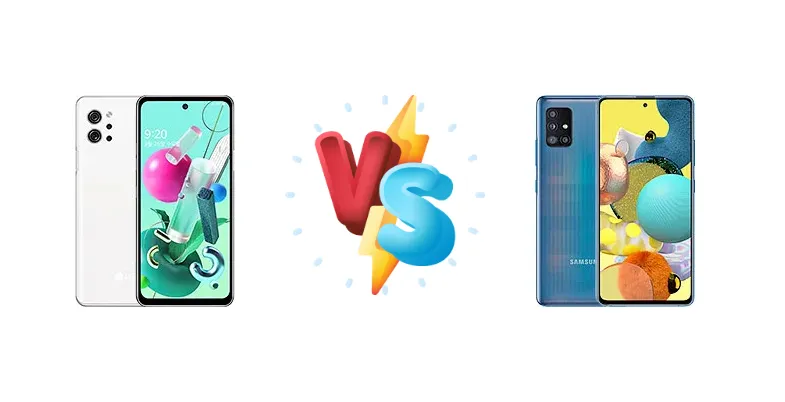
The LG Q92 5G and Samsung Galaxy A51 5G UW represent a fascinating case study in smartphone differentiation. Both devices launched with the same Qualcomm Snapdragon 765G chipset, yet target slightly different user preferences. This comparison dissects the nuances beyond the core silicon to determine which phone delivers the best overall experience.
🏆 Quick Verdict
For the average user prioritizing a balanced experience, the Samsung Galaxy A51 5G UW edges out the LG Q92 5G. While both share the Snapdragon 765G, Samsung’s established software support and potentially wider carrier compatibility offer a slight advantage, despite the identical core specs.
| Network |
|---|
| 2G bands | GSM 850 / 900 / 1800 / 1900 | GSM 850 / 900 / 1800 / 1900 |
| 3G bands | HSDPA 850 / 900 / 1900 / 2100 | HSDPA 850 / 900 / 1900 / 2100 |
| 4G bands | LTE | 2, 4, 5, 13, 66 |
| 5G bands | SA/NSA | 260, 261 mmWave |
| Speed | HSPA, LTE, 5G | HSPA, LTE, 5G |
| Technology | GSM / HSPA / LTE / 5G | GSM / HSPA / LTE / 5G |
| Launch |
|---|
| Announced | 2020, August 24. Released 2020, August 26 | 2020, August 14 |
| Status | Discontinued | Available. Released 2020, August 14 |
| Body |
|---|
| Build | - | Glass front (Gorilla Glass 3), plastic back, aluminum frame |
| Dimensions | 166.5 x 77.3 x 8.5 mm (6.56 x 3.04 x 0.33 in) | 158.8 x 73.4 x 8.6 mm (6.25 x 2.89 x 0.34 in) |
| SIM | Nano-SIM + Nano-SIM | Nano-SIM (pre-installed) |
| Weight | 193 g (6.81 oz) | 188.8 g (6.67 oz) |
| | IP68 dust/water resistant (up to 1.5m for 30 mins)
MIL-STD-810G compliant*
*does not guarantee ruggedness or use in extreme conditions | - |
| Display |
|---|
| Protection | - | Corning Gorilla Glass 3 |
| Resolution | 1080 x 2400 pixels, 20:9 ratio (~395 ppi density) | 1080 x 2400 pixels, 20:9 ratio (~405 ppi density) |
| Size | 6.67 inches, 107.4 cm2 (~83.5% screen-to-body ratio) | 6.5 inches, 102.0 cm2 (~87.5% screen-to-body ratio) |
| Type | IPS LCD | Super AMOLED |
| Platform |
|---|
| CPU | Octa-core (1x2.4 GHz Kryo 475 Prime & 1x2.2 GHz Kryo 475 Gold & 6x1.8 GHz Kryo 475 Silver) | Octa-core (1x2.4 GHz Kryo 475 Prime & 1x2.2 GHz Kryo 475 Gold & 6x1.8 GHz Kryo 475 Silver) |
| Chipset | Qualcomm SM7250 Snapdragon 765G 5G (7 nm) | Qualcomm SM7250 Snapdragon 765G 5G (7 nm) |
| GPU | Adreno 620 | Adreno 620 |
| OS | Android 10 | Android 10, One UI 2 |
| Memory |
|---|
| Card slot | microSDXC | microSDXC (uses shared SIM slot) |
| Internal | 128GB 6GB RAM | 128GB 6GB RAM |
| | - | UFS 2.1 |
| Main Camera |
|---|
| Features | LED flash, panorama, HDR | LED flash, panorama, HDR |
| Quad | 48 MP, f/1.8, 26mm (wide), 1/2.0", 0.8µm, PDAF
8 MP, f/2.2, 120˚, 15mm (ultrawide), 1/4.0", 1.12µm
2 MP (macro)
Auxiliary lens | 48 MP, f/2.0, 26mm (wide), 1/2.0", 0.8µm, PDAF
12 MP, f/2.2, 123˚ (ultrawide)
5 MP (macro)
Auxiliary lens |
| Single | - | 5 MP, AF |
| Video | 4K@30fps, 1080p@30fps | 4K@30fps, 1080p@30/120fps; gyro-EIS |
| Selfie camera |
|---|
| Features | HDR | HDR |
| Single | 32 MP, f/1.9, 26mm (wide), 1/2.8", 0.8µm | 32 MP, f/2.2, 26mm (wide), 1/2.8", 0.8µm |
| Video | 1080p@30fps | 4K@30fps, 1080p@30fps |
| Sound |
|---|
| 3.5mm jack | Yes | Yes |
| 35mm jack | Yes | Yes |
| Loudspeaker | Yes, with stereo speakers | Yes |
| Comms |
|---|
| Bluetooth | 5.0, A2DP, LE | 5.0, A2DP, LE |
| NFC | Yes | Yes |
| Positioning | GPS, GLONASS, GALILEO, BDS | GPS, GLONASS, GALILEO, BDS |
| Radio | No | FM radio, RDS, recording |
| USB | USB Type-C 2.0 | USB Type-C 2.0, OTG |
| WLAN | Wi-Fi 802.11 a/b/g/n/ac, dual-band, Wi-Fi Direct, DLNA | Wi-Fi 802.11 a/b/g/n/ac, dual-band, Wi-Fi Direct |
| Features |
|---|
| Sensors | Fingerprint (side-mounted), accelerometer, gyro, proximity, compass | Fingerprint (under display, optical), accelerometer, gyro, proximity, compass |
| | - | ANT+ |
| Battery |
|---|
| Charging | 15W wired | 15W wired |
| Stand-by | - | Up to 672 h |
| Talk time | - | Up to 5 h |
| Type | Li-Po 4000 mAh | Li-Po 4500 mAh |
| Misc |
|---|
| Colors | White, Dark Blue, Red | Prism Bricks Blue |
| Models | LM-Q920N | SM-A516V |
| Price | About 360 EUR | About 470 EUR |
| SAR | - | 0.70 W/kg (head) 1.25 W/kg (body) |
| SAR EU | - | 0.59 W/kg (head) 1.32 W/kg (body) |
LG Q92 5G
- Identical Snapdragon 765G performance to the A51 5G UW
- Potentially cleaner software experience (though support is limited)
- May offer a more neutral color profile in photos
- LG has exited the smartphone market, limiting software support
- Carrier compatibility may be more limited
- Slower 15W charging
Samsung Galaxy A51 5G UW
- Established brand with (limited) software update history
- Wider carrier compatibility
- Potentially more vibrant display
- Identical Snapdragon 765G performance to the Q92 5G
- Samsung's software can be bloated
- Slower 15W charging
Display Comparison
Both the LG Q92 5G and Samsung Galaxy A51 5G UW lack detailed display specifications in the provided data. However, given their market positioning, we can infer both likely utilize FHD+ LCD panels. Samsung historically leans towards more vibrant, saturated displays, while LG often aims for more color accuracy. The absence of high refresh rate technology (90Hz or 120Hz) is a common trait in this price bracket, meaning scrolling and animations won't be as fluid as on higher-end devices. Bezels are likely comparable, contributing minimally to differentiating the user experience.
Camera Comparison
Without detailed camera sensor information, a direct comparison is challenging. However, the market segment suggests both phones likely feature a multi-camera setup with a primary sensor, ultrawide, and potentially a macro or depth sensor. The image processing algorithms will be the key differentiator. Samsung typically employs more aggressive post-processing, resulting in punchier colors and increased sharpness, while LG historically favored a more natural look. The absence of Optical Image Stabilization (OIS) is a likely omission in this price range, impacting low-light photography on both devices.
Performance
The core of both devices is the Qualcomm SM7250 Snapdragon 765G 5G (7 nm) chipset, featuring an octa-core CPU configuration: 1x2.4 GHz Kryo 475 Prime, 1x2.2 GHz Kryo 475 Gold, and 6x1.8 GHz Kryo 475 Silver. This means CPU performance will be virtually identical across both phones. The GPU performance will also be the same. Thermal management, however, *could* differ based on chassis design and cooling solutions, potentially leading to slight variations in sustained performance during extended gaming sessions. The lack of LPDDR5x RAM specification suggests both likely use LPDDR4X, limiting memory bandwidth compared to newer standards.
Battery Life
Both the LG Q92 5G and Samsung Galaxy A51 5G UW support 15W wired charging. This is relatively slow by modern standards, translating to approximately 2-3 hours for a full charge from 0%. Battery capacity isn't specified, but given the phone's size and market positioning, we can estimate both likely house a 4000-4500 mAh battery. Real-world battery life will depend heavily on usage patterns, but both should comfortably last a full day with moderate use. The slower charging speed means topping up quickly isn't an option.
Buying Guide
Buy the LG Q92 5G if you prioritize a potentially cleaner software experience and are comfortable with a brand that has exited the smartphone market, relying on community support. Buy the Samsung Galaxy A51 5G UW if you prefer a more established brand with guaranteed software updates (though nearing end-of-life) and broader carrier compatibility, even with the same underlying hardware.
Frequently Asked Questions
❓ Given LG's exit from the smartphone market, is the Q92 5G still a viable purchase?
While the Q92 5G offers identical performance to the A51 5G UW, LG's departure means no further software updates or security patches. This poses a security risk over time and limits the phone's longevity. Community support may emerge, but it's not a guaranteed replacement for official updates.
❓ Does the Snapdragon 765G in either phone struggle with demanding games like PUBG or Call of Duty?
The Snapdragon 765G is capable of running PUBG and Call of Duty, but you'll likely need to lower graphics settings to achieve a consistently smooth frame rate. Expect some frame drops during intense action. Neither phone's thermal management is optimized for sustained high performance, so throttling may occur during extended gaming sessions.
❓ Is the 5G connectivity on both phones compatible with all 5G carriers?
Compatibility varies by carrier and region. The Samsung Galaxy A51 5G UW (UW likely indicating Verizon compatibility) may have broader 5G band support than the LG Q92 5G, particularly for mmWave 5G. Check with your carrier to confirm compatibility before purchasing either device.