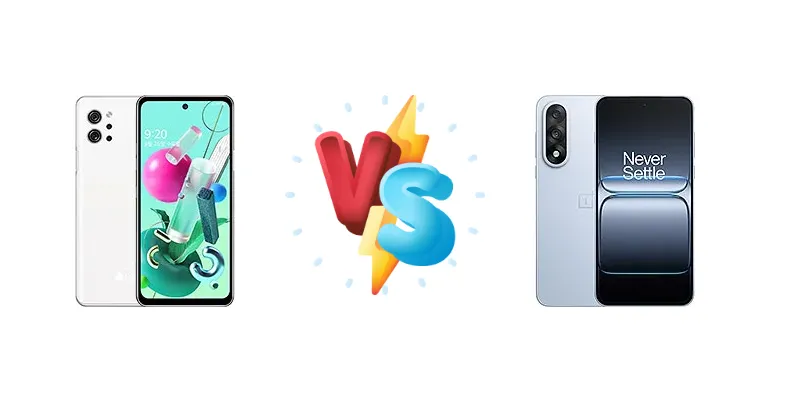
The LG Q92 5G, representing a mature 5G offering, now faces a newer contender in the OnePlus Nord 5. This comparison isn't about raw specs alone; it's about understanding where the newer Snapdragon 8s Gen 3 justifies a potential price premium over the established Snapdragon 765G, and how each phone caters to different user priorities, particularly regarding battery endurance and charging speed.
🏆 Quick Verdict
For the average user prioritizing sustained performance and rapid charging, the OnePlus Nord 5 is the clear winner. Its Snapdragon 8s Gen 3 delivers significantly more processing power, and the 80W charging is a game-changer. However, the LG Q92 5G remains a viable option for budget-conscious users who don't demand top-tier performance.
| Network |
|---|
| 2G bands | GSM 850 / 900 / 1800 / 1900 | GSM 850 / 900 / 1800 / 1900 |
| 3G bands | HSDPA 850 / 900 / 1900 / 2100 | HSDPA 850 / 900 / 1900 / 2100 |
| 4G bands | LTE | 1, 2, 3, 4, 5, 7, 8, 12, 17, 18, 19, 20, 26, 28, 32, 38, 39, 40, 41, 42, 66 - International |
| 5G bands | SA/NSA | 1, 2, 3, 5, 7, 8, 12, 20, 28, 38, 40, 41, 66, 75, 77, 78 SA/NSA - International |
| Speed | HSPA, LTE, 5G | HSPA, LTE, 5G |
| Technology | GSM / HSPA / LTE / 5G | GSM / HSPA / LTE / 5G |
| Launch |
|---|
| Announced | 2020, August 24. Released 2020, August 26 | 2025, July 08 |
| Status | Discontinued | Available. Released 2025, July 08 |
| Body |
|---|
| Build | - | Glass front (Gorilla Glass 7i), glass back, plastic frame |
| Dimensions | 166.5 x 77.3 x 8.5 mm (6.56 x 3.04 x 0.33 in) | 163.4 x 77 x 8.1 mm (6.43 x 3.03 x 0.32 in) |
| SIM | Nano-SIM + Nano-SIM | Nano-SIM + Nano-SIM |
| Weight | 193 g (6.81 oz) | 211 g (7.44 oz) |
| | IP68 dust/water resistant (up to 1.5m for 30 mins)
MIL-STD-810G compliant*
*does not guarantee ruggedness or use in extreme conditions | - |
| Display |
|---|
| Protection | - | Corning Gorilla Glass 7i, Mohs level 6 |
| Resolution | 1080 x 2400 pixels, 20:9 ratio (~395 ppi density) | 1272 x 2800 pixels (~450 ppi density) |
| Size | 6.67 inches, 107.4 cm2 (~83.5% screen-to-body ratio) | 6.83 inches, 113.3 cm2 (~90.1% screen-to-body ratio) |
| Type | IPS LCD | Swift AMOLED, 1B colors, 144Hz, 3840Hz PWM, HDR10+, 800 nits (typ), 1400 nits (HBM), 1800 nits (peak) |
| Platform |
|---|
| CPU | Octa-core (1x2.4 GHz Kryo 475 Prime & 1x2.2 GHz Kryo 475 Gold & 6x1.8 GHz Kryo 475 Silver) | Octa-core (1x3.0 GHz Cortex-X4 & 4x2.8 GHz Cortex-A720 & 3x2.0 GHz Cortex-A520) |
| Chipset | Qualcomm SM7250 Snapdragon 765G 5G (7 nm) | Qualcomm SM8635 Snapdragon 8s Gen 3 (4 nm) |
| GPU | Adreno 620 | Adreno 735 |
| OS | Android 10 | Android 15, up to 4 major Android upgrades, OxygenOS 15 |
| Memory |
|---|
| Card slot | microSDXC | No |
| Internal | 128GB 6GB RAM | 256GB 8GB RAM, 256GB 12GB RAM, 512GB 12GB RAM |
| Main Camera |
|---|
| Dual | - | 50 MP, f/1.8, 24mm (wide), 1/1.56", 1.0µm, PDAF, OIS
8 MP, f/2.2, 15mm, 116˚ (ultrawide), 1/4.0", 1.12µm, AF |
| Features | LED flash, panorama, HDR | LED flash, Ultra HDR, panorama |
| Quad | 48 MP, f/1.8, 26mm (wide), 1/2.0", 0.8µm, PDAF
8 MP, f/2.2, 120˚, 15mm (ultrawide), 1/4.0", 1.12µm
2 MP (macro)
Auxiliary lens | - |
| Video | 4K@30fps, 1080p@30fps | 4K@30/60fps, 1080p@30/60/120fps, gyro-EIS |
| Selfie camera |
|---|
| Features | HDR | Panorama |
| Single | 32 MP, f/1.9, 26mm (wide), 1/2.8", 0.8µm | 50 MP, f/2.0, 21mm (wide), 1/2.76", 0.64µm, AF |
| Video | 1080p@30fps | 4K@30/60fps, 1080p@30/60fps; gyro-EIS |
| Sound |
|---|
| 3.5mm jack | Yes | - |
| 35mm jack | Yes | No |
| Loudspeaker | Yes, with stereo speakers | Yes, with stereo speakers |
| Comms |
|---|
| Bluetooth | 5.0, A2DP, LE | 5.4, A2DP, LE, aptX HD, LHDC 5 |
| Infrared port | - | Yes |
| NFC | Yes | Yes |
| Positioning | GPS, GLONASS, GALILEO, BDS | GPS, GLONASS, GALILEO, BDS, QZSS, NavIC |
| Radio | No | No |
| USB | USB Type-C 2.0 | USB Type-C 2.0 |
| WLAN | Wi-Fi 802.11 a/b/g/n/ac, dual-band, Wi-Fi Direct, DLNA | Wi-Fi 802.11 a/b/g/n/ac/6, dual-band, Wi-Fi Direct |
| Features |
|---|
| Sensors | Fingerprint (side-mounted), accelerometer, gyro, proximity, compass | Fingerprint (under display, optical), accelerometer, gyro, proximity, compass |
| Battery |
|---|
| Charging | 15W wired | 80W wired, 33W PPS, 18W PD, 100% in just 54 min
5W reverse wired
Bypass charging |
| Type | Li-Po 4000 mAh | Market-dependent versions:· 5200 mAh (Europe)· 6800 mAh (Global) |
| Misc |
|---|
| Colors | White, Dark Blue, Red | Phantom Grey, Dry Ice, Marble Sands |
| Models | LM-Q920N | CPH2709 |
| Price | About 360 EUR | £ 339.00 / € 294.97 / ₹ 31,998 |
| SAR | - | 1.18 W/kg (head) 0.90 W/kg (body) |
| EU LABEL |
|---|
| Battery | - | 49:12h endurance, 1200 cycles |
| Energy | - | Class B |
| Free fall | - | Class C (90 falls) |
| Repairability | - | Class B |
LG Q92 5G
- More affordable price point
- Functional 5G connectivity
- Decent performance for basic tasks
- Significantly slower charging
- Less powerful processor
- Likely inferior display quality
OnePlus Nord 5
- Exceptional performance with Snapdragon 8s Gen 3
- Ultra-fast 80W charging
- Bright and vibrant display
- Higher price tag
- Potential for more heat generation under heavy load (mitigated by 4nm process)
- May be overkill for basic users
Display Comparison
The OnePlus Nord 5 boasts a significantly brighter display, peaking at 1330 nits, compared to the LG Q92 5G (brightness data unavailable). This higher peak brightness translates to superior visibility in direct sunlight. While the Q92 5G's display quality is likely adequate for everyday use, the Nord 5's panel offers a more vibrant and comfortable viewing experience. We can assume the Q92 5G uses an LCD panel, while the Nord 5 likely utilizes AMOLED, given its brightness and the current market trends. Bezels are likely comparable, but the Nord 5's display technology is a clear advantage.
Camera Comparison
Without detailed camera specs for the LG Q92 5G, a direct comparison is limited. However, the OnePlus Nord 5 likely benefits from a more advanced image signal processor (ISP) integrated within the Snapdragon 8s Gen 3. This translates to better image processing, noise reduction, and dynamic range. While the Q92 5G may offer acceptable image quality in good lighting conditions, the Nord 5 is expected to excel in low-light scenarios and provide more detailed, vibrant photos. We can assume the Nord 5 has OIS on its main sensor, a feature likely absent on the Q92 5G.
Performance
The core difference lies in the chipsets. The OnePlus Nord 5's Snapdragon 8s Gen 3 (4nm) is a substantial upgrade over the LG Q92 5G's Snapdragon 765G (7nm). The 8s Gen 3 features a Cortex-X4 prime core clocked at 3.0 GHz, alongside A720 and A520 cores, offering a significant leap in CPU and GPU performance. The 4nm process node also contributes to improved thermal efficiency, reducing the likelihood of throttling during prolonged use. The Q92 5G's Kryo 475 cores are competent for everyday tasks, but will struggle with demanding games and multitasking compared to the Nord 5. The Nord 5's LPDDR5x RAM (assumed) further enhances performance.
Battery Life
The OnePlus Nord 5 demonstrates a clear advantage in battery endurance, with a measured 49:12h endurance and 13:47h active use score. While the LG Q92 5G's battery capacity is unknown, the Nord 5's superior efficiency, coupled with its 80W charging, is a game-changer. The Nord 5 can reach 100% charge in just 54 minutes, while the Q92 5G's 15W charging is comparatively slow. The Nord 5 also offers 33W PPS, 18W PD, and 5W reverse wired charging, adding to its versatility. The bypass charging feature allows charging while using the phone, minimizing heat buildup.
Buying Guide
Buy the LG Q92 5G if you need a functional 5G phone on a tight budget and aren't heavily reliant on demanding applications or extended gaming sessions. Buy the OnePlus Nord 5 if you prioritize a smooth, responsive experience, fast charging, and the ability to handle graphically intensive tasks without compromise. The Nord 5 is for users who value future-proofing and a premium feel.
Frequently Asked Questions
❓ Does the Snapdragon 8s Gen 3 in the OnePlus Nord 5 get noticeably hot during extended gaming sessions?
While the Snapdragon 8s Gen 3 is a powerful chip, the 4nm manufacturing process helps mitigate heat generation. The OnePlus Nord 5 incorporates thermal management solutions to prevent significant throttling, but some warmth is expected during prolonged, demanding gaming. It will still perform better than the Q92 5G under load.
❓ Is the 15W charging on the LG Q92 5G realistically usable in 2024?
15W charging is slow by modern standards. Expect a full charge to take well over two hours. While functional, it's a significant inconvenience compared to the OnePlus Nord 5's 80W charging, especially for users who frequently need to top up their battery quickly.
❓ How does the 5G performance differ between the Snapdragon 765G and the Snapdragon 8s Gen 3?
The Snapdragon 8s Gen 3 features a more advanced 5G modem, offering potentially faster download and upload speeds, as well as improved network stability. However, real-world 5G performance is also dependent on carrier infrastructure and network conditions.
❓ What kind of gaming performance can I expect from the LG Q92 5G?
The LG Q92 5G can handle casual mobile games without issue. However, demanding titles will likely require reduced graphics settings and may experience occasional frame drops. It's not designed for high-end mobile gaming.