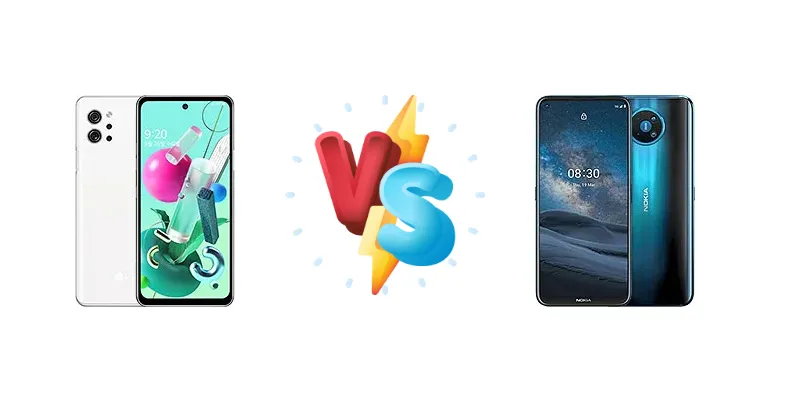
Both the LG Q92 5G and Nokia 8.3 5G represent compelling options in the mid-range 5G smartphone space, particularly as their prices have matured. Both devices leverage the Qualcomm Snapdragon 765G chipset, but subtle differences in charging capabilities and overall design philosophy create distinct user experiences. This comparison dissects these nuances to determine which phone delivers the best value.
🏆 Quick Verdict
For the average user prioritizing slightly faster charging and a potentially more streamlined software experience, the Nokia 8.3 5G edges out the LG Q92 5G. However, the difference is minimal, and the Q92 5G remains a strong contender, especially if found at a lower price point.
| Network |
|---|
| 2G bands | GSM 850 / 900 / 1800 / 1900 | GSM 850 / 900 / 1800 / 1900 |
| 3G bands | HSDPA 850 / 900 / 1900 / 2100 | HSDPA 850 / 900 / 1700(AWS) / 1900 / 2100 |
| 4G bands | LTE | 1, 2, 3, 4, 5, 7, 8, 12, 13, 17, 20, 28, 32, 38, 39, 40, 41, 66, 71 |
| 5G bands | SA/NSA | 1, 2, 3, 5, 7, 8, 28, 38, 40, 41, 66, 71, 78 SA/NSA |
| Speed | HSPA, LTE, 5G | HSPA 42.2/5.76 Mbps, LTE (4CA) Cat18 1200/150 Mbps, 5G 2.4/1.2 Gbps |
| Technology | GSM / HSPA / LTE / 5G | GSM / HSPA / LTE / 5G |
| Launch |
|---|
| Announced | 2020, August 24. Released 2020, August 26 | 2020, March 19. Released 2020, September 15 |
| Status | Discontinued | Discontinued |
| Body |
|---|
| Build | - | Glass front, plastic frame, glass back |
| Dimensions | 166.5 x 77.3 x 8.5 mm (6.56 x 3.04 x 0.33 in) | 171.9 x 78.6 x 9 mm (6.77 x 3.09 x 0.35 in) |
| SIM | Nano-SIM + Nano-SIM | · Nano-SIM· Nano-SIM + Nano-SIM |
| Weight | 193 g (6.81 oz) | 220 g (7.76 oz) |
| | IP68 dust/water resistant (up to 1.5m for 30 mins)
MIL-STD-810G compliant*
*does not guarantee ruggedness or use in extreme conditions | - |
| Display |
|---|
| Resolution | 1080 x 2400 pixels, 20:9 ratio (~395 ppi density) | 1080 x 2400 pixels, 20:9 ratio (~386 ppi density) |
| Size | 6.67 inches, 107.4 cm2 (~83.5% screen-to-body ratio) | 6.81 inches, 112.0 cm2 (~82.9% screen-to-body ratio) |
| Type | IPS LCD | IPS LCD |
| Platform |
|---|
| CPU | Octa-core (1x2.4 GHz Kryo 475 Prime & 1x2.2 GHz Kryo 475 Gold & 6x1.8 GHz Kryo 475 Silver) | Octa-core (1x2.4 GHz Kryo 475 Prime & 1x2.2 GHz Kryo 475 Gold & 6x1.8 GHz Kryo 475 Silver) |
| Chipset | Qualcomm SM7250 Snapdragon 765G 5G (7 nm) | Qualcomm SM7250 Snapdragon 765G 5G (7 nm) |
| GPU | Adreno 620 | Adreno 620 |
| OS | Android 10 | Android 10, upgradable to Android 12, Android One |
| Memory |
|---|
| Card slot | microSDXC | microSDXC (uses shared SIM slot) |
| Internal | 128GB 6GB RAM | 64GB 6GB RAM, 64GB 8GB RAM, 128GB 8GB RAM |
| Main Camera |
|---|
| Features | LED flash, panorama, HDR | Zeiss optics, Dual-LED flash, panorama, HDR |
| Quad | 48 MP, f/1.8, 26mm (wide), 1/2.0", 0.8µm, PDAF
8 MP, f/2.2, 120˚, 15mm (ultrawide), 1/4.0", 1.12µm
2 MP (macro)
Auxiliary lens | 64 MP, f/1.9, (wide), 1/1.72", 0.8µm, PDAF
12 MP, f/2.2, 120˚ (ultrawide), 1/2.43", 1.4µm, AF
2 MP (macro)
Auxiliary lens |
| Video | 4K@30fps, 1080p@30fps | 4K@30/60fps, 1080p@30/240fps, 720p@960fps, gyro-EIS |
| Selfie camera |
|---|
| Features | HDR | Zeiss optics, HDR |
| Single | 32 MP, f/1.9, 26mm (wide), 1/2.8", 0.8µm | 24 MP, f/2.0, (wide), 1/2.8", 0.9µm |
| Video | 1080p@30fps | 1080p@30fps |
| Sound |
|---|
| 3.5mm jack | Yes | Yes |
| 35mm jack | Yes | Yes |
| Loudspeaker | Yes, with stereo speakers | Yes |
| Comms |
|---|
| Bluetooth | 5.0, A2DP, LE | 5.0, A2DP, EDR, LE |
| NFC | Yes | Yes |
| Positioning | GPS, GLONASS, GALILEO, BDS | GPS, GLONASS, BDS |
| Radio | No | FM radio |
| USB | USB Type-C 2.0 | USB Type-C 2.0, OTG |
| WLAN | Wi-Fi 802.11 a/b/g/n/ac, dual-band, Wi-Fi Direct, DLNA | Wi-Fi 802.11 a/b/g/n/ac, dual-band, Wi-Fi Direct |
| Features |
|---|
| Sensors | Fingerprint (side-mounted), accelerometer, gyro, proximity, compass | Fingerprint (side-mounted), accelerometer, gyro, proximity, compass |
| Battery |
|---|
| Charging | 15W wired | 18W wired |
| Type | Li-Po 4000 mAh | Li-Po 4500 mAh |
| Misc |
|---|
| Colors | White, Dark Blue, Red | Polar Night |
| Models | LM-Q920N | TA-1243, TA-1251 |
| Price | About 360 EUR | About 470 EUR |
| SAR | - | 0.96 W/kg (head) 1.41 W/kg (body) |
| SAR EU | - | 0.96 W/kg (head) 1.41 W/kg (body) |
LG Q92 5G
- Potentially lower price point
- Larger display (assumed)
- LG’s software features
- Slower 15W charging
- LG’s software customizations may not appeal to all
Nokia 8.3 5G
- Faster 18W charging
- Cleaner Android experience
- Zeiss-branded camera (potential for better image quality)
- May be slightly more expensive
- Software update support is crucial to verify
Display Comparison
Both the LG Q92 5G and Nokia 8.3 5G feature displays that, while adequate for their price points, don't push any boundaries. Specifics regarding panel type (IPS vs AMOLED) and resolution are missing, but both likely utilize IPS LCDs given the market segment. The key difference lies in the overall user experience, which is heavily influenced by software calibration. Without detailed brightness measurements, it's difficult to declare a clear winner, but the Nokia 8.3 5G’s potential for better color accuracy due to its cleaner Android implementation could be a subtle advantage.
Camera Comparison
Camera performance is difficult to assess without detailed sensor information beyond the main lens. Both phones likely feature multi-camera setups, but the quality of secondary sensors (ultrawide, macro, depth) is often limited in this price range. The Snapdragon 765G’s ISP is capable, but image processing algorithms play a crucial role. Nokia’s partnership with Zeiss historically emphasizes natural color reproduction, while LG’s processing tends towards more vibrant, saturated images. Without sample images and detailed sensor specs, it’s impossible to definitively say which phone captures better photos, but the Nokia 8.3 5G’s Zeiss branding suggests a focus on image quality.
Performance
The core of both devices is the Qualcomm SM7250 Snapdragon 765G 5G (7 nm) chipset, featuring an octa-core CPU configuration identical in both phones: 1x2.4 GHz Kryo 475 Prime, 1x2.2 GHz Kryo 475 Gold, and 6x1.8 GHz Kryo 475 Silver. This means CPU performance will be virtually indistinguishable in day-to-day tasks. The GPU performance will also be nearly identical. Thermal management, however, could vary based on chassis design and cooling solutions, but without testing data, it’s impossible to determine which phone sustains peak performance for longer. The use of 5G connectivity on both devices means users can benefit from faster download and upload speeds where available, but this will impact battery life.
Battery Life
The Nokia 8.3 5G’s 18W wired charging offers a slight advantage over the LG Q92 5G’s 15W charging. While neither is exceptionally fast by modern standards, the 18W charging will result in quicker top-ups. The actual battery capacity of both devices is not specified, but the faster charging speed of the Nokia 8.3 5G means users will spend less time tethered to a wall outlet. The Snapdragon 765G’s power efficiency contributes to reasonable battery life on both devices, but 5G usage will significantly impact endurance.
Buying Guide
Buy the LG Q92 5G if you prioritize a larger display and are comfortable with LG’s software customizations, potentially finding it at a more aggressive price. Buy the Nokia 8.3 5G if you prefer a cleaner Android experience with guaranteed updates and value the slightly faster 18W charging for quicker top-ups, even if the battery capacity is similar.
Frequently Asked Questions
❓ Will the Snapdragon 765G in either phone struggle with demanding games like PUBG or Call of Duty?
The Snapdragon 765G is capable of running most popular games, but you’ll likely need to lower graphics settings for a consistently smooth experience. Both phones share the same chipset, so gaming performance will be very similar. Expect medium settings to be the sweet spot for optimal balance between visual fidelity and frame rates.
❓ How important is the 18W charging on the Nokia 8.3 5G compared to the 15W on the LG Q92 5G?
While not a massive difference, the 18W charging on the Nokia 8.3 5G will shave off approximately 15-30 minutes from a full 0-100% charge. This is particularly noticeable for quick top-ups when you only have a short amount of time to charge.
❓ What kind of software update support can I expect from Nokia and LG for these devices?
Nokia is generally known for providing more consistent and timely software updates, including security patches, compared to LG. LG’s update track record has been less reliable. This is a significant factor to consider if long-term software support is important to you.