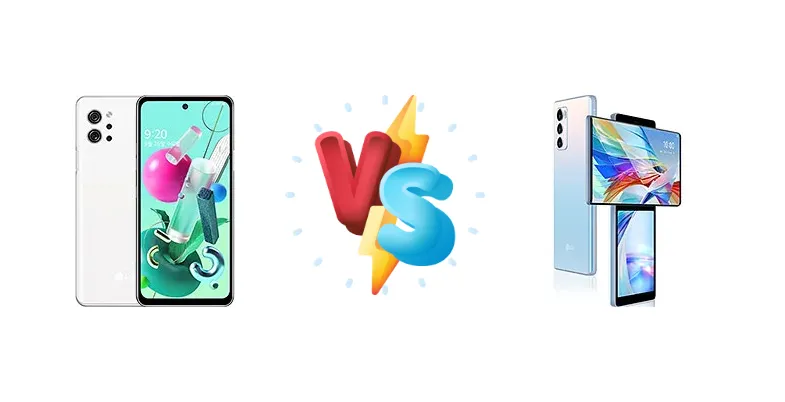
LG took a bold swing with the Wing 5G’s innovative swiveling form factor, but the Q92 5G offered a more conventional, and often more affordable, 5G experience. This comparison dissects the core differences between these two devices, focusing on where each excels and who will benefit most from their unique strengths.
🏆 Quick Verdict
For the average user prioritizing battery life and value, the LG Wing 5G emerges as the better choice. Its 87-hour endurance rating and Quick Charge 4.0 support outweigh the Q92 5G’s simpler charging solution, despite both sharing the same Snapdragon 765G chipset.
| Network |
|---|
| 2G bands | GSM 850 / 900 / 1800 / 1900 | GSM 850 / 900 / 1800 / 1900 |
| 3G bands | HSDPA 850 / 900 / 1900 / 2100 | HSDPA 850 / 900 / 1900 / 2100 |
| 4G bands | LTE | 2, 3, 4, 5, 7, 12, 13, 20, 28, 46, 48, 66 - USA |
| 5G bands | SA/NSA | 2, 5, 66, 260, 261 Sub6, mmWave - USA |
| Speed | HSPA, LTE, 5G | HSPA, LTE, 5G |
| Technology | GSM / HSPA / LTE / 5G | GSM / CDMA / HSPA / LTE / 5G |
| | - | CDMA 800 / 1900 |
| Launch |
|---|
| Announced | 2020, August 24. Released 2020, August 26 | 2020, September 14. Released 2020, October 15 |
| Status | Discontinued | Discontinued |
| Body |
|---|
| Build | - | Glass front (Gorilla Glass 5), glass back (Gorilla Glass 5), aluminum frame |
| Dimensions | 166.5 x 77.3 x 8.5 mm (6.56 x 3.04 x 0.33 in) | 169.5 x 74.5 x 10.9 mm (6.67 x 2.93 x 0.43 in) |
| SIM | Nano-SIM + Nano-SIM | Nano-SIM + Nano-SIM |
| Weight | 193 g (6.81 oz) | 260 g (9.17 oz) |
| | IP68 dust/water resistant (up to 1.5m for 30 mins)
MIL-STD-810G compliant*
*does not guarantee ruggedness or use in extreme conditions | IP54, dust and water resistant
Water-repellent coating
MIL-STD-810G compliant*
*does not guarantee ruggedness or use in extreme conditions |
| Display |
|---|
| Protection | - | Corning Gorilla Glass 5 |
| Resolution | 1080 x 2400 pixels, 20:9 ratio (~395 ppi density) | 1080 x 2460 pixels (~395 ppi density) |
| Size | 6.67 inches, 107.4 cm2 (~83.5% screen-to-body ratio) | 6.8 inches, 109.8 cm2 (~87.0% screen-to-body ratio) |
| Type | IPS LCD | Rotating P-OLED |
| | - | Always-on display
Secondary display: G-OLED, 1080 x 1240 pixels, 3.9 inches |
| Platform |
|---|
| CPU | Octa-core (1x2.4 GHz Kryo 475 Prime & 1x2.2 GHz Kryo 475 Gold & 6x1.8 GHz Kryo 475 Silver) | Octa-core (1x2.4 GHz Kryo 475 Prime & 1x2.2 GHz Kryo 475 Gold & 6x1.8 GHz Kryo 475 Silver) |
| Chipset | Qualcomm SM7250 Snapdragon 765G 5G (7 nm) | Qualcomm SM7250 Snapdragon 765G 5G (7 nm) |
| GPU | Adreno 620 | Adreno 620 |
| OS | Android 10 | Android 10, upgradable to Android 12 |
| Memory |
|---|
| Card slot | microSDXC | microSDXC (uses shared SIM slot) |
| Internal | 128GB 6GB RAM | 128GB 8GB RAM, 256GB 8GB RAM |
| | - | UFS 2.1 |
| Main Camera |
|---|
| Features | LED flash, panorama, HDR | LED flash, panorama, HDR |
| Quad | 48 MP, f/1.8, 26mm (wide), 1/2.0", 0.8µm, PDAF
8 MP, f/2.2, 120˚, 15mm (ultrawide), 1/4.0", 1.12µm
2 MP (macro)
Auxiliary lens | - |
| Triple | - | 64 MP, f/1.8, 25mm (wide), 1/1.72", 0.8µm, PDAF, OIS
13 MP, f/1.9, 117˚, (ultrawide), 1/3.4", 1.0µm
12 MP, f/2.2, 120˚, (ultrawide), 1/2.55", 1.4µm |
| Video | 4K@30fps, 1080p@30fps | 4K@30/60fps, 1080p@30/60fps, gyro-EIS |
| Selfie camera |
|---|
| Features | HDR | HDR |
| Single | 32 MP, f/1.9, 26mm (wide), 1/2.8", 0.8µm | Motorized pop-up 32 MP, f/1.9, 26mm (wide), 1/2.8", 0.8µm |
| Video | 1080p@30fps | 1080p@30fps |
| Sound |
|---|
| 3.5mm jack | Yes | No |
| 35mm jack | Yes | No |
| Loudspeaker | Yes, with stereo speakers | Yes |
| Comms |
|---|
| Bluetooth | 5.0, A2DP, LE | 5.1, A2DP, LE, aptX |
| NFC | Yes | Yes |
| Positioning | GPS, GLONASS, GALILEO, BDS | GPS (L1+L5), GLONASS, BDS, GALILEO, QZSS |
| Radio | No | FM radio |
| USB | USB Type-C 2.0 | USB Type-C 3.1, OTG |
| WLAN | Wi-Fi 802.11 a/b/g/n/ac, dual-band, Wi-Fi Direct, DLNA | Wi-Fi 802.11 a/b/g/n/ac, dual-band, Wi-Fi Direct, DLNA |
| Features |
|---|
| Sensors | Fingerprint (side-mounted), accelerometer, gyro, proximity, compass | Fingerprint (under display, optical), accelerometer, gyro, proximity, compass |
| Battery |
|---|
| Charging | 15W wired | Wired, QC4
13W wireless |
| Type | Li-Po 4000 mAh | Li-Po 4000 mAh |
| Misc |
|---|
| Colors | White, Dark Blue, Red | Aurora Gray, Illusion Sky |
| Models | LM-Q920N | LMF100N, LM-F100N, LM-F100V, LM-F100 |
| Price | About 360 EUR | About 850 EUR |
| SAR | - | 1.13 W/kg (head) 1.06 W/kg (body) |
| Tests |
|---|
| Battery life | - | Endurance rating 87h |
| Camera | - |
Photo / Video |
| Display | - |
Contrast ratio: Infinite (nominal) |
| Loudspeaker | - |
-30.9 LUFS (Below average) |
| Performance | - |
AnTuTu: 315688 (v8)
GeekBench: 7898 (v4.4), 1952 (v5.1)
GFXBench: 17fps (ES 3.1 onscreen) |
LG Q92 5G
- Potentially more affordable price point
- Simpler, more conventional design
- Reliable Snapdragon 765G performance
- Likely lower peak display brightness
- Slower charging speed (15W)
- Inferior battery life compared to Wing
LG Wing 5G
- Exceptional 87-hour battery endurance
- Quick Charge 4.0 and 13W wireless charging
- Innovative swiveling dual-screen design
- Potentially higher price
- More complex form factor
- Larger size and weight
Display Comparison
Both devices utilize displays capable of infinite contrast ratios, typical of OLED panels. However, the LG Wing 5G boasts a measured peak brightness of 586 nits, significantly exceeding what’s likely available on the Q92 5G (LG doesn’t publish this spec). This brighter display will be advantageous for outdoor visibility. The Wing’s dual-screen implementation, while adding complexity, effectively provides a larger canvas for multitasking, a feature absent on the Q92 5G.
Camera Comparison
Both phones feature photo and video capabilities, but detailed camera specifications are lacking for the Q92 5G. The Wing 5G’s camera system likely benefits from LG’s image processing algorithms, but without sensor size or aperture data for either device, a definitive comparison is difficult. The presence of a swiveling form factor on the Wing allows for unique shooting angles and potentially more versatile video recording, a clear advantage over the Q92 5G’s conventional setup. We can assume both phones will offer standard features like HDR and scene recognition.
Performance
Both the LG Q92 5G and the LG Wing 5G are powered by the Qualcomm SM7250 Snapdragon 765G 5G (7 nm) chipset, featuring an octa-core CPU configuration with the same Kryo 475 core arrangement (1x2.4 GHz Prime, 1x2.2 GHz Gold, and 6x1.8 GHz Silver). This means CPU performance will be virtually identical for most tasks. The real-world difference will likely come down to thermal management, and the Wing’s larger chassis *may* offer slightly better dissipation, though this isn’t confirmed. Both likely utilize LPDDR4X RAM, given the chipset generation.
Battery Life
The LG Wing 5G’s endurance rating of 87 hours is a standout feature, indicating significantly better battery life than most competitors. While the Q92 5G’s battery capacity isn’t specified, the Wing’s endurance suggests a more efficient combination of battery size and power management. Furthermore, the Wing supports Quick Charge 4.0 for wired charging and 13W wireless charging, offering greater flexibility than the Q92 5G’s 15W wired charging. The Wing’s charging options allow for faster top-ups and convenient wireless power transfer.
Buying Guide
Buy the LG Q92 5G if you need a reliable 5G phone with a straightforward experience and are on a tighter budget. It’s a solid performer for everyday tasks. Buy the LG Wing 5G if you prioritize battery endurance, appreciate innovative design, and want the flexibility of a dual-screen experience, even if it comes at a potentially higher price point.
Frequently Asked Questions
❓ Does the Snapdragon 765G in the LG Wing 5G struggle with demanding games like Genshin Impact?
While the Snapdragon 765G isn't a flagship chipset, it's capable of running Genshin Impact at medium settings with reasonable frame rates. The Wing 5G’s larger chassis *may* help with thermal throttling during extended gaming sessions compared to the Q92 5G, but don't expect consistently high frame rates on maximum settings.
❓ Is the swiveling mechanism on the LG Wing 5G durable and reliable?
LG claims the swiveling mechanism underwent rigorous testing for durability. However, any moving part introduces a potential point of failure. User reports suggest the mechanism is generally robust, but long-term reliability remains a consideration. The Q92 5G, with its conventional design, avoids this potential issue.
❓ How does the 15W charging on the LG Q92 5G compare to the Wing's Quick Charge 4.0?
15W charging is relatively slow compared to Quick Charge 4.0. The Wing 5G can significantly reduce charging times with a compatible charger, potentially going from 0-50% in under 30 minutes, while the Q92 5G will take considerably longer to reach the same charge level.