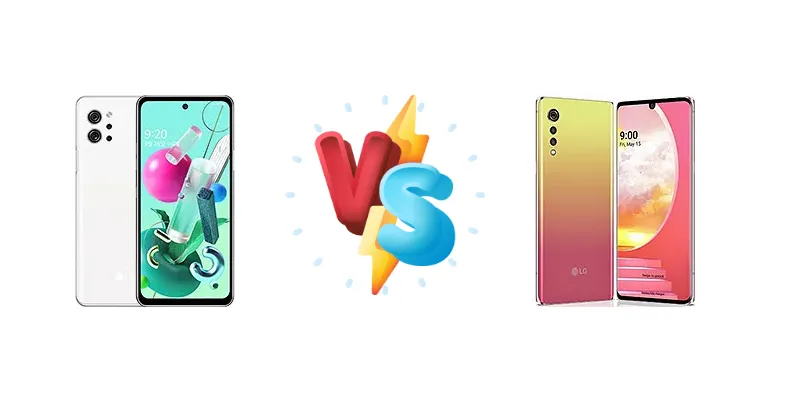
Both the LG Q92 5G and the LG Velvet 5G represent LG’s foray into accessible 5G connectivity, but they target slightly different priorities. The Q92 focuses on delivering 5G at a more budget-conscious price point, while the Velvet aims for a more premium experience with a refined design and faster charging capabilities. This comparison dissects the core differences to help you determine which device best suits your needs.
🏆 Quick Verdict
For most users, the LG Velvet 5G is the superior choice. While both phones share the same Snapdragon 765G chipset, the Velvet’s significantly faster 25W charging (with PD3.0 and QC4 support) and measured 617 nits display brightness, coupled with its 79-hour endurance rating, provide a more convenient and visually pleasing experience.
| Network |
|---|
| 2G bands | GSM 850 / 900 / 1800 / 1900 | GSM 850 / 900 / 1800 / 1900 |
| 3G bands | HSDPA 850 / 900 / 1900 / 2100 | HSDPA 850 / 900 / 1900 / 2100 |
| 4G bands | LTE | 1, 2, 3, 4, 5, 7, 8, 12, 17, 20, 28, 32, 38, 39, 40, 41 |
| 5G bands | SA/NSA | 1, 3, 28, 78 SA/NSA |
| Speed | HSPA, LTE, 5G | HSPA 42.2/5.76 Mbps, LTE (5CA) Cat16 1000/75 Mbps, 5G 2Gbps |
| Technology | GSM / HSPA / LTE / 5G | GSM / HSPA / LTE / 5G |
| Launch |
|---|
| Announced | 2020, August 24. Released 2020, August 26 | 2020, May 07. Released 2020, May 15 |
| Status | Discontinued | Discontinued |
| Body |
|---|
| Build | - | Glass front, glass back, aluminum frame |
| Dimensions | 166.5 x 77.3 x 8.5 mm (6.56 x 3.04 x 0.33 in) | 167.2 x 74.1 x 7.9 mm (6.58 x 2.92 x 0.31 in) |
| SIM | Nano-SIM + Nano-SIM | Nano-SIM + Nano-SIM |
| Weight | 193 g (6.81 oz) | 180 g (6.35 oz) |
| | IP68 dust/water resistant (up to 1.5m for 30 mins)
MIL-STD-810G compliant*
*does not guarantee ruggedness or use in extreme conditions | IP68 dust/water resistant (up to 1.5m for 30 mins)
MIL-STD-810G compliant*
*does not guarantee ruggedness or use in extreme conditions |
| Display |
|---|
| Resolution | 1080 x 2400 pixels, 20:9 ratio (~395 ppi density) | 1080 x 2460 pixels (~395 ppi density) |
| Size | 6.67 inches, 107.4 cm2 (~83.5% screen-to-body ratio) | 6.8 inches, 109.8 cm2 (~88.6% screen-to-body ratio) |
| Type | IPS LCD | P-OLED |
| Platform |
|---|
| CPU | Octa-core (1x2.4 GHz Kryo 475 Prime & 1x2.2 GHz Kryo 475 Gold & 6x1.8 GHz Kryo 475 Silver) | Octa-core (1x2.4 GHz Kryo 475 Prime & 1x2.2 GHz Kryo 475 Gold & 6x1.8 GHz Kryo 475 Silver) |
| Chipset | Qualcomm SM7250 Snapdragon 765G 5G (7 nm) | Qualcomm SM7250 Snapdragon 765G 5G (7 nm) |
| GPU | Adreno 620 | Adreno 620 |
| OS | Android 10 | Android 10, upgradable to Android 13, LG UX |
| Memory |
|---|
| Card slot | microSDXC | microSDXC (uses shared SIM slot) |
| Internal | 128GB 6GB RAM | 128GB 6GB RAM, 128GB 8GB RAM |
| | - | UFS 2.1 |
| Main Camera |
|---|
| Features | LED flash, panorama, HDR | LED flash, panorama, HDR |
| Quad | 48 MP, f/1.8, 26mm (wide), 1/2.0", 0.8µm, PDAF
8 MP, f/2.2, 120˚, 15mm (ultrawide), 1/4.0", 1.12µm
2 MP (macro)
Auxiliary lens | - |
| Triple | - | 48 MP, f/1.8, 26mm (wide), 1/2.0", 0.8µm, PDAF
8 MP, f/2.2, 120˚, 15mm (ultrawide), 1/4.0", 1.12µm
Auxiliary lens |
| Video | 4K@30fps, 1080p@30fps | 4K@30fps, 1080p@30/60fps, gyro-EIS |
| Selfie camera |
|---|
| Features | HDR | HDR |
| Single | 32 MP, f/1.9, 26mm (wide), 1/2.8", 0.8µm | 16 MP, f/1.9, 29mm (standard), 1/3.06, 1.0µm |
| Video | 1080p@30fps | 1080p@30fps |
| Sound |
|---|
| 3.5mm jack | Yes | Yes |
| 35mm jack | Yes | Yes |
| Loudspeaker | Yes, with stereo speakers | Yes, with stereo speakers |
| Comms |
|---|
| Bluetooth | 5.0, A2DP, LE | 5.1, A2DP, LE, aptX HD |
| NFC | Yes | Yes |
| Positioning | GPS, GLONASS, GALILEO, BDS | GPS (L1+L5), GLONASS, BDS, GALILEO, QZSS |
| Radio | No | FM radio (market/region dependent) |
| USB | USB Type-C 2.0 | USB Type-C, OTG |
| WLAN | Wi-Fi 802.11 a/b/g/n/ac, dual-band, Wi-Fi Direct, DLNA | Wi-Fi 802.11 a/b/g/n/ac, dual-band, Wi-Fi Direct, DLNA |
| Features |
|---|
| Sensors | Fingerprint (side-mounted), accelerometer, gyro, proximity, compass | Fingerprint (under display, optical), accelerometer, gyro, proximity, compass, barometer |
| Battery |
|---|
| Charging | 15W wired | 25W wired, PD3.0, QC4
9W wireless |
| Type | Li-Po 4000 mAh | Li-Po 4300 mAh |
| Misc |
|---|
| Colors | White, Dark Blue, Red | Aurora White, Aurora Green, Aurora Gray, Illusion Sunset, Red, Pink |
| Models | LM-Q920N | LM-G900N, LM-G900EM, LM-G900, LM-G900TM |
| Price | About 360 EUR | About 470 EUR |
| SAR | - | 0.23 W/kg (head) 1.02 W/kg (body) |
| Tests |
|---|
| Battery life | - | Endurance rating 79h |
| Camera | - |
Photo / Video |
| Display | - |
Contrast ratio: Infinite (nominal) |
| Loudspeaker | - |
-23.5 LUFS (Very good) |
| Performance | - |
AnTuTu: 297372 (v8)
GeekBench: 1905 (v5.1)
GFXBench: 16fps (ES 3.1 onscreen) |
LG Q92 5G
- More affordable price point
- 5G connectivity
- Functional and reliable performance
- Slower 15W charging
- Less detailed display specifications
- Likely less refined camera experience
LG Velvet 5G
- Faster 25W charging with PD3.0/QC4
- Brighter 617 nit display
- 79-hour endurance rating
- 9W wireless charging
- Higher price compared to the Q92 5G
- Shares the same Snapdragon 765G chipset
Display Comparison
The LG Velvet 5G boasts a notably brighter display, reaching a measured 617 nits, compared to the Q92 5G which lacks published brightness data. This difference translates to better visibility outdoors and a more vibrant viewing experience. While both likely utilize OLED panels given the 'Infinite' contrast ratio specification of the Velvet, the Velvet’s higher peak brightness is a clear advantage. The Q92’s display specifications are less detailed, suggesting a more standard panel aimed at cost savings.
Camera Comparison
Both phones are listed as having Photo/Video capabilities, but detailed camera specifications are absent. Without sensor size, aperture, or image processing details, a direct comparison is difficult. However, given the Velvet’s positioning as a more premium device, it’s reasonable to assume it benefits from more sophisticated image processing algorithms and potentially a larger primary sensor, leading to better image quality, particularly in low-light conditions. The lack of detail on the Q92 suggests a more basic camera experience.
Performance
Both the LG Q92 5G and the LG Velvet 5G are powered by the Qualcomm SM7250 Snapdragon 765G 5G (7 nm) chipset, featuring an octa-core CPU configuration (1x2.4 GHz Kryo 475 Prime, 1x2.2 GHz Kryo 475 Gold, and 6x1.8 GHz Kryo 475 Silver). This means CPU performance will be virtually identical between the two devices. However, the Velvet’s potential for sustained performance might be slightly better due to its more premium build quality potentially allowing for more effective thermal dissipation. Both devices will handle everyday tasks and moderate gaming without issue, but neither is positioned as a flagship gaming device.
Battery Life
The LG Velvet 5G shines in the battery and charging department. It achieves an impressive endurance rating of 79 hours, indicating excellent battery life. Crucially, it supports 25W wired charging with Power Delivery 3.0 (PD3.0) and Quick Charge 4 (QC4) standards, allowing for significantly faster charging times than the Q92 5G’s 15W wired charging. The Velvet also adds 9W wireless charging, a feature absent on the Q92. This faster charging capability is a major convenience factor for users who frequently need to top up their battery.
Buying Guide
Buy the LG Q92 5G if you prioritize affordability and a functional 5G experience without demanding fast charging or a particularly bright display. It’s ideal for users who primarily use their phone for basic tasks and don’t mind slower charging speeds. Buy the LG Velvet 5G if you value faster charging, a brighter and more vibrant display, and a more polished overall experience. This phone is better suited for users who consume a lot of media, game, or simply want the convenience of quickly topping up their battery.
Frequently Asked Questions
❓ Does the Snapdragon 765G in the LG Velvet 5G struggle with demanding games like Genshin Impact?
While the Snapdragon 765G is capable, Genshin Impact will likely require reduced graphics settings for a consistently smooth experience on both devices. The Velvet’s potentially better thermal management might allow for slightly longer sustained performance, but neither phone is a dedicated gaming device.
❓ How long does it realistically take to fully charge the LG Q92 5G with its 15W charger?
With its 15W charging, the LG Q92 5G will likely take around 2.5 to 3 hours to fully charge from 0% to 100%. This is considerably slower than the Velvet’s 25W charging, which can achieve a full charge in approximately 1 hour and 15 minutes.
❓ Is the 9W wireless charging on the LG Velvet 5G fast enough for overnight charging?
Yes, 9W wireless charging is perfectly suitable for overnight charging. It won't be as fast as wired charging, but it will comfortably top up the battery while you sleep, offering a convenient charging solution.