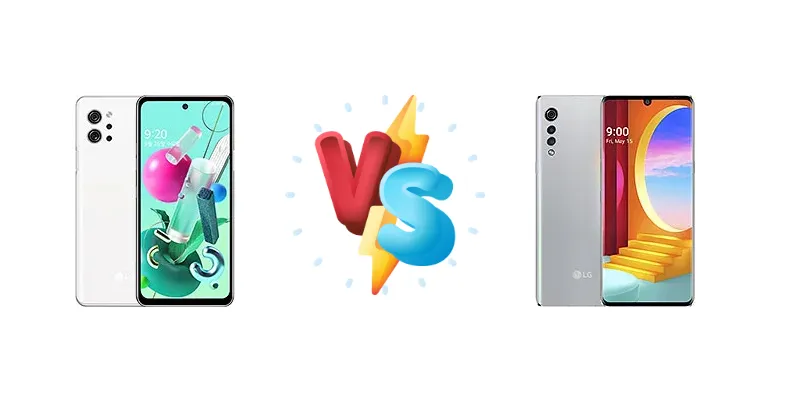
The LG Q92 5G and LG Velvet represent different approaches to the mid-range smartphone market. The Q92 5G prioritizes 5G connectivity and a newer chipset, while the Velvet focuses on a more premium design and a slightly older, but still capable, flagship processor. This comparison dissects their key differences to determine which device offers the best value.
🏆 Quick Verdict
For the average user prioritizing future-proofing and 5G access, the LG Q92 5G is the better choice. Its Snapdragon 765G offers a more efficient architecture and 5G capabilities, despite the Snapdragon 845 in the Velvet having a higher peak clock speed. The Velvet appeals to those valuing wireless charging and a potentially smoother experience in heavily threaded tasks.
| Network |
|---|
| 2G bands | GSM 850 / 900 / 1800 / 1900 | GSM 850 / 900 / 1800 / 1900 |
| 3G bands | HSDPA 850 / 900 / 1900 / 2100 | HSDPA 850 / 900 / 1900 / 2100 |
| 4G bands | LTE | 1, 3, 7, 8, 20, 28, 38, 40 |
| 5G bands | SA/NSA | - |
| Speed | HSPA, LTE, 5G | HSPA, LTE |
| Technology | GSM / HSPA / LTE / 5G | GSM / HSPA / LTE |
| Launch |
|---|
| Announced | 2020, August 24. Released 2020, August 26 | 2020, July 28. Released 2020, July 31 |
| Status | Discontinued | Discontinued |
| Body |
|---|
| Build | - | Glass front, glass back, aluminum frame |
| Dimensions | 166.5 x 77.3 x 8.5 mm (6.56 x 3.04 x 0.33 in) | 167.1 x 74.1 x 7.9 mm (6.58 x 2.92 x 0.31 in) |
| SIM | Nano-SIM + Nano-SIM | Nano-SIM + Nano-SIM |
| Weight | 193 g (6.81 oz) | 180 g (6.35 oz) |
| | IP68 dust/water resistant (up to 1.5m for 30 mins)
MIL-STD-810G compliant*
*does not guarantee ruggedness or use in extreme conditions | IP68 dust/water resistant (up to 1.5m for 30 min)
MIL-STD-810G compliant*
*does not guarantee ruggedness or use in extreme conditions |
| Display |
|---|
| Resolution | 1080 x 2400 pixels, 20:9 ratio (~395 ppi density) | 1080 x 2460 pixels (~395 ppi density) |
| Size | 6.67 inches, 107.4 cm2 (~83.5% screen-to-body ratio) | 6.8 inches, 109.8 cm2 (~88.7% screen-to-body ratio) |
| Type | IPS LCD | P-OLED |
| Platform |
|---|
| CPU | Octa-core (1x2.4 GHz Kryo 475 Prime & 1x2.2 GHz Kryo 475 Gold & 6x1.8 GHz Kryo 475 Silver) | Octa-core (4x2.8 GHz Kryo 385 Gold & 4x1.8 GHz Kryo 385 Silver) |
| Chipset | Qualcomm SM7250 Snapdragon 765G 5G (7 nm) | Qualcomm SDM845 Snapdragon 845 (10 nm) |
| GPU | Adreno 620 | Adreno 630 |
| OS | Android 10 | Android 10, upgradable to Android 12 |
| Memory |
|---|
| Card slot | microSDXC | microSDXC (uses shared SIM slot) |
| Internal | 128GB 6GB RAM | 128GB 6GB RAM |
| | - | UFS 2.1 |
| Main Camera |
|---|
| Features | LED flash, panorama, HDR | LED flash, panorama, HDR |
| Quad | 48 MP, f/1.8, 26mm (wide), 1/2.0", 0.8µm, PDAF
8 MP, f/2.2, 120˚, 15mm (ultrawide), 1/4.0", 1.12µm
2 MP (macro)
Auxiliary lens | - |
| Triple | - | 48 MP, f/1.8, 26mm (wide), 1/2.0", 0.8µm, PDAF
8 MP, f/2.2, 120˚, 15mm (ultrawide), 1/4.0", 1.12µm
Auxiliary lens |
| Video | 4K@30fps, 1080p@30fps | 4K@30fps, 1080p@30/60fps, gyro-EIS |
| Selfie camera |
|---|
| Features | HDR | HDR |
| Single | 32 MP, f/1.9, 26mm (wide), 1/2.8", 0.8µm | 16 MP, f/1.9, 29mm (standard), 1/3.06, 1.0µm |
| Video | 1080p@30fps | 4K@30fps, 1080p@30fps |
| Sound |
|---|
| 3.5mm jack | Yes | Yes |
| 35mm jack | Yes | Yes |
| Loudspeaker | Yes, with stereo speakers | Yes, with stereo speakers |
| Comms |
|---|
| Bluetooth | 5.0, A2DP, LE | 5.1, A2DP, LE |
| NFC | Yes | Yes |
| Positioning | GPS, GLONASS, GALILEO, BDS | GPS |
| Radio | No | FM radio |
| USB | USB Type-C 2.0 | USB Type-C, OTG |
| WLAN | Wi-Fi 802.11 a/b/g/n/ac, dual-band, Wi-Fi Direct, DLNA | Wi-Fi 802.11 a/b/g/n/ac, dual-band, Wi-Fi Direct |
| Features |
|---|
| Sensors | Fingerprint (side-mounted), accelerometer, gyro, proximity, compass | Fingerprint (under display, optical), accelerometer, gyro, proximity, compass, barometer |
| Battery |
|---|
| Charging | 15W wired | 15W wired, QC3
9W wireless |
| Type | Li-Po 4000 mAh | Li-Po 4300 mAh |
| Misc |
|---|
| Colors | White, Dark Blue, Red | Black, Aurora Silver |
| Models | LM-Q920N | LMG910EMW, LM-G910EMW |
| Price | About 360 EUR | About 360 EUR |
LG Q92 5G
- 5G Connectivity for faster data speeds
- More Power-Efficient Snapdragon 765G
- Modern Chipset Architecture
- Lacks Wireless Charging
- Potentially Less Refined Design
LG Velvet
- Wireless Charging (9W)
- Potentially Smoother Performance in Heavily Threaded Tasks
- More Premium Design Aesthetic
- Older Snapdragon 845 Chipset
- Less Power Efficient
Display Comparison
Both devices lack detailed display specifications in the provided data, but considering their market positioning, we can infer differences. The Velvet, being positioned as a more premium device, likely features a slightly more color-accurate and brighter display. However, the Q92 5G’s panel is likely still adequate for everyday use. The Velvet’s design language suggests a focus on minimizing bezels, potentially offering a more immersive viewing experience. Without specific nit ratings or panel technology details (like OLED vs LCD), a definitive winner is difficult to declare.
Camera Comparison
Without detailed camera sensor information, a direct comparison is limited. However, the market positioning suggests the Velvet may have a slightly more sophisticated camera system. The Snapdragon 845’s image signal processor (ISP) is more advanced than the 765G’s, potentially leading to better image processing, especially in low-light conditions. The absence of sensor size data prevents a definitive assessment, but the Velvet’s higher price point suggests a potentially larger main sensor. We can assume both phones will feature standard features like HDR and scene recognition, but the Velvet’s ISP likely offers more refined algorithms.
Performance
The core difference lies in the chipsets. The LG Q92 5G’s Snapdragon 765G (7nm) utilizes a more modern architecture than the LG Velvet’s Snapdragon 845 (10nm). While the 845 boasts higher clock speeds (2.8GHz vs 2.4GHz on the 765G’s prime core), the 7nm process node of the 765G provides superior power efficiency and thermal management. This translates to less throttling during sustained workloads. The 765G’s Kryo 475 cores are also designed for improved performance-per-watt. The Velvet’s 845, while powerful, will likely exhibit more thermal throttling under heavy load. The 5G modem integrated into the 765G is a significant advantage for future-proofing.
Battery Life
Both phones share the same 15W wired charging speed. However, the Velvet adds 9W wireless charging, a convenience the Q92 5G lacks. The Snapdragon 765G’s superior power efficiency in the Q92 5G will likely result in longer battery life despite potentially having a similar capacity battery. The 7nm process node contributes to reduced power consumption during both active use and standby. While the Velvet’s 845 can deliver bursts of higher performance, it does so at the cost of increased power draw, potentially leading to shorter overall battery life.
Buying Guide
Buy the LG Q92 5G if you need reliable 5G connectivity, a modern chipset with better power efficiency, and are comfortable with a more utilitarian design. Buy the LG Velvet if you prefer a more refined aesthetic, value the convenience of wireless charging (9W), and anticipate tasks that benefit from the Snapdragon 845’s four high-performance cores, such as video editing or specific demanding applications.
Frequently Asked Questions
❓ Will the Snapdragon 845 in the Velvet struggle with demanding games like Genshin Impact?
While the Snapdragon 845 is capable, it may exhibit noticeable frame drops and thermal throttling during extended gaming sessions with graphically intensive titles like Genshin Impact. The Snapdragon 765G in the Q92 5G, with its more efficient architecture, may provide a more consistent gaming experience, albeit potentially at slightly lower graphical settings.
❓ How much faster is 5G on the Q92 5G compared to 4G LTE?
5G speeds on the Q92 5G can be significantly faster than 4G LTE, potentially reaching speeds 10-100 times faster depending on network conditions and carrier support. This translates to quicker downloads, smoother streaming, and lower latency for online gaming. However, 5G availability varies greatly by location.
❓ Is the 9W wireless charging on the Velvet worth the trade-off in battery life compared to the Q92 5G?
For users who prioritize convenience, the 9W wireless charging on the Velvet is a definite plus. However, the Q92 5G’s superior power efficiency means you’ll likely get more overall usage time between charges. The trade-off depends on your charging habits and whether you frequently use wireless charging.