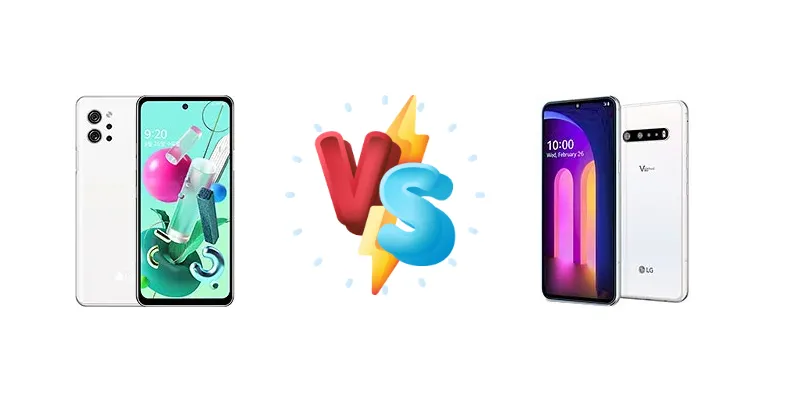
The LG V60 ThinQ 5G and LG Q92 5G represent different tiers within LG’s 5G smartphone lineup. The V60, released as a flagship, boasted top-tier specs, while the Q92 aimed for a more accessible price point. Now, with the V60’s price dropping, the question arises: does the older flagship still offer a compelling experience compared to the more affordable Q92?
🏆 Quick Verdict
For most users, the LG V60 ThinQ 5G remains the superior choice. Its Snapdragon 865 chipset delivers significantly faster performance and better long-term stability than the Q92’s Snapdragon 765G. While both phones offer similar battery endurance, the V60’s faster charging and overall processing power justify the price difference.
| Network |
|---|
| 2G bands | GSM 850 / 900 / 1800 / 1900 | GSM 850 / 900 / 1800 / 1900 |
| 3G bands | HSDPA 850 / 900 / 1900 / 2100 | HSDPA 850 / 900 / 1700(AWS) / 1900 / 2100 |
| 4G bands | LTE | 2, 4, 5, 12, 25, 26, 41, 46, 48, 66, 71 - USA |
| 5G bands | SA/NSA | 2, 25, 41, 66, 71 SA/NSA/Sub6 |
| Speed | HSPA, LTE, 5G | HSPA 42.2/5.76 Mbps, LTE (7CA) Cat22, 5G |
| Technology | GSM / HSPA / LTE / 5G | GSM / CDMA / HSPA / EVDO / LTE / 5G |
| | - | CDMA2000 1xEV-DO |
| Launch |
|---|
| Announced | 2020, August 24. Released 2020, August 26 | 2020, February 26. Released 2020, March 20 |
| Status | Discontinued | Discontinued |
| Body |
|---|
| Build | - | Glass front (Gorilla Glass 5), glass back (Gorilla Glass 6), aluminum frame |
| Dimensions | 166.5 x 77.3 x 8.5 mm (6.56 x 3.04 x 0.33 in) | 169.3 x 77.6 x 8.9 mm (6.67 x 3.06 x 0.35 in) |
| SIM | Nano-SIM + Nano-SIM | · Nano-SIM· Nano-SIM + Nano-SIM |
| Weight | 193 g (6.81 oz) | 213 g (Global)/ 218 g (Verizon) (7.51 oz) |
| | IP68 dust/water resistant (up to 1.5m for 30 mins)
MIL-STD-810G compliant*
*does not guarantee ruggedness or use in extreme conditions | IP68 dust/water resistant (up to 1.5m for 30 min)
MIL-STD-810G compliant*
Method 516.6, Procedure IV "Transit Drop"
*does not guarantee ruggedness or use in extreme conditions |
| Display |
|---|
| Protection | - | Corning Gorilla Glass 5 |
| Resolution | 1080 x 2400 pixels, 20:9 ratio (~395 ppi density) | 1080 x 2460 pixels (~395 ppi density) |
| Size | 6.67 inches, 107.4 cm2 (~83.5% screen-to-body ratio) | 6.8 inches, 109.8 cm2 (~83.6% screen-to-body ratio) |
| Type | IPS LCD | P-OLED, HDR10+ |
| | - | Always-on display |
| Platform |
|---|
| CPU | Octa-core (1x2.4 GHz Kryo 475 Prime & 1x2.2 GHz Kryo 475 Gold & 6x1.8 GHz Kryo 475 Silver) | Octa-core (1x2.84 GHz Cortex-A77 & 3x2.42 GHz Cortex-A77 & 4x1.80 GHz Cortex-A55) |
| Chipset | Qualcomm SM7250 Snapdragon 765G 5G (7 nm) | Qualcomm SM8250 Snapdragon 865 5G (7 nm+) |
| GPU | Adreno 620 | Adreno 650 |
| OS | Android 10 | Android 10, upgradable to Android 13 |
| Memory |
|---|
| Card slot | microSDXC | microSDXC (uses shared SIM slot) - dual-SIM model |
| Internal | 128GB 6GB RAM | 128GB 8GB RAM, 256GB 8GB RAM |
| | - | UFS 2.1 |
| Main Camera |
|---|
| Dual | - | 64 MP, f/1.8, 27mm (standard), 1/1.72", 0.8µm, dual pixel PDAF, OIS
13 MP, f/1.9, 12mm (ultrawide), 1/3.4", 1.0µm
0.3 MP, TOF 3D, f/1.4, (depth) |
| Features | LED flash, panorama, HDR | Dual-LED dual-tone flash, HDR, panorama |
| Quad | 48 MP, f/1.8, 26mm (wide), 1/2.0", 0.8µm, PDAF
8 MP, f/2.2, 120˚, 15mm (ultrawide), 1/4.0", 1.12µm
2 MP (macro)
Auxiliary lens | - |
| Video | 4K@30fps, 1080p@30fps | 8K@30fps, 4K@30/60fps, 1080p, HDR10+, 24-bit/192kHz stereo sound rec., gyro-EIS |
| Selfie camera |
|---|
| Features | HDR | HDR |
| Single | 32 MP, f/1.9, 26mm (wide), 1/2.8", 0.8µm | 10 MP, f/1.9, 30mm (standard), 1/3.1", 1.22µm |
| Video | 1080p@30fps | 4K@30fps, gyro-EIS |
| Sound |
|---|
| 3.5mm jack | Yes | Yes |
| 35mm jack | Yes | Yes |
| Loudspeaker | Yes, with stereo speakers | Yes, with stereo speakers |
| | - | 32-bit/192kHz audio
24-bit/192kHz audio recording |
| Comms |
|---|
| Bluetooth | 5.0, A2DP, LE | 5.1, A2DP, LE, aptX HD |
| NFC | Yes | Yes |
| Positioning | GPS, GLONASS, GALILEO, BDS | GPS, GLONASS, GALILEO, BDS |
| Radio | No | FM radio (USA model only) |
| USB | USB Type-C 2.0 | USB Type-C 3.1, OTG |
| WLAN | Wi-Fi 802.11 a/b/g/n/ac, dual-band, Wi-Fi Direct, DLNA | Wi-Fi 802.11 a/b/g/n/ac/6, dual-band, Wi-Fi Direct, DLNA |
| Features |
|---|
| Sensors | Fingerprint (side-mounted), accelerometer, gyro, proximity, compass | Fingerprint (under display, optical), accelerometer, gyro, proximity, compass, barometer |
| Battery |
|---|
| Charging | 15W wired | Wired, PD2.0, QC4
Wireless |
| Type | Li-Po 4000 mAh | Li-Po 5000 mAh |
| Misc |
|---|
| Colors | White, Dark Blue, Red | Classy Blue, Classy White |
| Models | LM-Q920N | LM-V600, A001LG |
| Price | About 360 EUR | About 700 EUR |
| Tests |
|---|
| Battery life | - |
Endurance rating 103h
|
LG Q92 5G
- More affordable price point
- Competent 5G connectivity
- Decent battery life
- Significantly slower processor
- Slower charging speeds (15W)
- Likely inferior camera performance
LG V60 ThinQ 5G
- Flagship-level Snapdragon 865 performance
- Faster charging with PD2.0 and QC4
- Potentially superior camera quality
- Wireless charging support
- Higher price (though decreasing)
- Potential for thermal throttling under heavy load
- May receive fewer software updates now that it's an older model
Display Comparison
While specific display specs like resolution and panel type aren't provided, both phones likely utilize LCD panels common in their respective price brackets. The V60, as a flagship, likely benefits from higher peak brightness and potentially better color calibration. However, without detailed measurements, it's difficult to quantify the difference. Bezels are expected to be larger on the Q92, reflecting its more budget-conscious design.
Camera Comparison
Without detailed camera sensor information, a direct comparison is limited. However, the V60, being a flagship, likely features a larger main sensor with a wider aperture, resulting in better low-light performance and dynamic range. The image processing pipeline on the V60 is also expected to be more sophisticated. The Q92 likely includes a standard set of lenses, but image quality will likely fall short of the V60’s capabilities. We can assume both phones feature similar software features, but the V60’s superior hardware will provide a better foundation for image capture.
Performance
The core difference lies in the chipsets. The LG V60’s Snapdragon 865 (7nm+) is a substantial upgrade over the Q92’s Snapdragon 765G (7nm). The 865 features a more powerful CPU configuration – a Cortex-A77 prime core clocked at 2.84 GHz versus the Q92’s 2.4 GHz Kryo 475 Prime. This translates to faster app loading, smoother multitasking, and significantly improved gaming performance. The 865’s Adreno 650 GPU also eclipses the 765G’s Adreno 620. While both support 5G, the 865’s modem is generally more efficient and capable. The V60’s potential for thermal throttling under sustained load is a concern, but the 7nm+ process and likely larger heat sink offer some mitigation.
Battery Life
Both the LG V60 and Q92 boast an endurance rating of 103 hours, suggesting similar real-world battery life despite potential differences in battery capacity (not specified). However, the V60’s charging capabilities are significantly superior, supporting PD2.0 and QC4 fast charging standards, alongside wireless charging. The Q92 is limited to 15W wired charging, resulting in a considerably longer 0-100% charge time. This faster charging is a key advantage for the V60, especially for users who frequently need to top up their battery.
Buying Guide
Buy the LG Q92 5G if you prioritize affordability and a balanced 5G experience for everyday tasks like browsing, social media, and light gaming. Buy the LG V60 ThinQ 5G if you demand flagship-level performance for demanding applications, gaming, and content creation, and appreciate faster charging speeds and potentially longer software support.
Frequently Asked Questions
❓ Will the Snapdragon 765G in the LG Q92 5G handle demanding games like Genshin Impact or Call of Duty Mobile?
While the Snapdragon 765G is capable of running these games, you'll likely need to lower graphics settings to achieve a smooth frame rate. The V60’s Snapdragon 865 provides a much more comfortable gaming experience with higher settings and sustained performance.
❓ Does the LG V60 ThinQ 5G suffer from significant overheating during prolonged gaming sessions?
The Snapdragon 865 is known to generate heat under sustained load. The V60 may experience some throttling, reducing performance slightly after extended gaming. However, LG likely implemented thermal management solutions to mitigate this issue, and it's still significantly better than the Q92's performance under load.
❓ How much faster is the charging on the LG V60 compared to the Q92?
The LG V60 supports PD2.0 and QC4 fast charging, potentially reaching 25W or higher depending on the charger. The Q92 is limited to 15W, meaning a full charge will take considerably longer – potentially double the time.
❓ Is the 5G connectivity on the LG Q92 5G as reliable as on the LG V60 ThinQ 5G?
Both phones support 5G, but the V60’s Snapdragon 865 modem is generally more efficient and supports a wider range of 5G bands, potentially leading to a more stable and faster connection in certain areas.