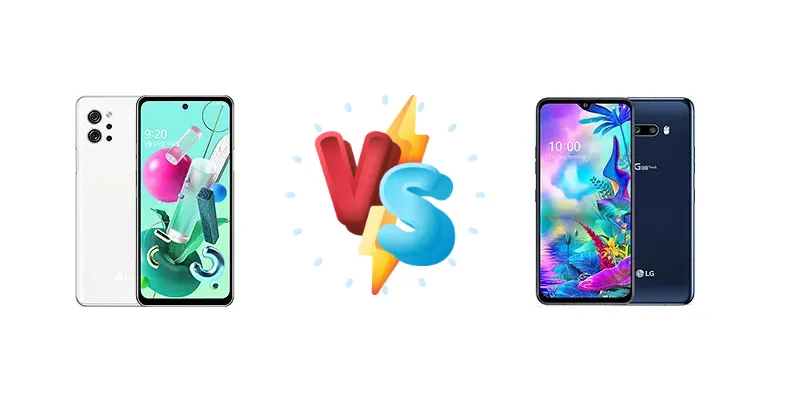
The LG Q92 5G and V50S ThinQ 5G represent different approaches to 5G connectivity. The Q92 aimed to bring 5G to a more accessible price point, while the V50S was a flagship offering, albeit one released as the 865 generation was emerging. This comparison dissects their key differences to help you determine which device best suits your needs and budget.
🏆 Quick Verdict
For the average user prioritizing value and sufficient performance for everyday tasks, the LG Q92 5G is the better choice. While the V50S ThinQ 5G boasts a more powerful Snapdragon 855, the Q92’s modern 5G modem and lower price make it a more compelling option in today’s market.
| Network |
|---|
| 2G bands | GSM 850 / 900 / 1800 / 1900 | GSM 850 / 900 / 1800 / 1900 |
| 3G bands | HSDPA 850 / 900 / 1900 / 2100 | HSDPA 850 / 900 / 1700(AWS) / 1900 / 2100 |
| 4G bands | LTE | 1, 2, 3, 4, 5, 7, 8, 12, 13, 17, 20, 25, 26, 28, 40, 41 |
| 5G bands | SA/NSA | 41 NSA |
| Speed | HSPA, LTE, 5G | HSPA 42.2/5.76 Mbps, LTE Cat19 1600/75 Mbps, 5G (2+ Gbps DL) |
| Technology | GSM / HSPA / LTE / 5G | GSM / CDMA / HSPA / EVDO / LTE / 5G |
| | - | CDMA2000 1xEV-DO |
| Launch |
|---|
| Announced | 2020, August 24. Released 2020, August 26 | 2019, October. Released 2019, October |
| Status | Discontinued | Discontinued |
| Body |
|---|
| Build | - | Glass front (Gorilla Glass 5), glass back (Gorilla Glass 6), aluminum frame |
| Dimensions | 166.5 x 77.3 x 8.5 mm (6.56 x 3.04 x 0.33 in) | 159.3 x 75.8 x 8.4 mm (6.27 x 2.98 x 0.33 in) |
| SIM | Nano-SIM + Nano-SIM | · Nano-SIM· Nano-SIM + Nano-SIM |
| Weight | 193 g (6.81 oz) | 192 g (6.77 oz) |
| | IP68 dust/water resistant (up to 1.5m for 30 mins)
MIL-STD-810G compliant*
*does not guarantee ruggedness or use in extreme conditions | IP68 dust/water resistant (up to 1.5m for 30 min)
MIL-STD-810G compliant*
*does not guarantee ruggedness or use in extreme conditions |
| Display |
|---|
| Protection | - | Corning Gorilla Glass 5 |
| Resolution | 1080 x 2400 pixels, 20:9 ratio (~395 ppi density) | 1080 x 2340 pixels, 19.5:9 ratio (~403 ppi density) |
| Size | 6.67 inches, 107.4 cm2 (~83.5% screen-to-body ratio) | 6.4 inches, 100.5 cm2 (~83.3% screen-to-body ratio) |
| Type | IPS LCD | OLED, HDR10 |
| | - | Always-on display |
| Platform |
|---|
| CPU | Octa-core (1x2.4 GHz Kryo 475 Prime & 1x2.2 GHz Kryo 475 Gold & 6x1.8 GHz Kryo 475 Silver) | Octa-core (1x2.84 GHz Kryo 485 & 3x2.42 GHz Kryo 485 & 4x1.78 GHz Kryo 485) |
| Chipset | Qualcomm SM7250 Snapdragon 765G 5G (7 nm) | Qualcomm SM8150 Snapdragon 855 (7 nm) |
| GPU | Adreno 620 | Adreno 640 |
| OS | Android 10 | Android 9.0 (Pie), upgradable to Android 12 |
| Memory |
|---|
| Card slot | microSDXC | microSDXC (uses shared SIM slot) - dual-SIM model |
| Internal | 128GB 6GB RAM | 256GB 8GB RAM |
| | - | UFS 2.1 |
| Main Camera |
|---|
| Dual | - | 12 MP, f/1.8, 27mm (standard), 1/2.55", 1.4µm, dual pixel PDAF, OIS
13 MP, f/2.4, 9mm (ultrawide), 1/3.4", 1.0µm |
| Features | LED flash, panorama, HDR | Dual-LED dual-tone flash, HDR, panorama |
| Quad | 48 MP, f/1.8, 26mm (wide), 1/2.0", 0.8µm, PDAF
8 MP, f/2.2, 120˚, 15mm (ultrawide), 1/4.0", 1.12µm
2 MP (macro)
Auxiliary lens | - |
| Video | 4K@30fps, 1080p@30fps | 4K@30/60fps, 1080p@30/60/240fps, 24-bit/192kHz stereo sound rec., gyro-EIS |
| Selfie camera |
|---|
| Features | HDR | HDR |
| Single | 32 MP, f/1.9, 26mm (wide), 1/2.8", 0.8µm | 32 MP, f/1.9, 26mm (wide), 1/2.8", 0.8µm |
| Video | 1080p@30fps | 4K@30fps, gyro-EIS |
| Sound |
|---|
| 3.5mm jack | Yes | Yes |
| 35mm jack | Yes | Yes |
| Loudspeaker | Yes, with stereo speakers | Yes, with stereo speakers |
| | - | 32-bit/192kHz audio
24-bit/192kHz audio recording
Tuned by Meridian Audio |
| Comms |
|---|
| Bluetooth | 5.0, A2DP, LE | 5.0, A2DP, LE, aptX HD |
| NFC | Yes | Yes |
| Positioning | GPS, GLONASS, GALILEO, BDS | GPS, GLONASS, GALILEO, BDS |
| Radio | No | FM radio |
| USB | USB Type-C 2.0 | USB Type-C 3.1, OTG |
| WLAN | Wi-Fi 802.11 a/b/g/n/ac, dual-band, Wi-Fi Direct, DLNA | Wi-Fi 802.11 a/b/g/n/ac, dual-band, Wi-Fi Direct, DLNA |
| Features |
|---|
| Sensors | Fingerprint (side-mounted), accelerometer, gyro, proximity, compass | Fingerprint (under display, optical), accelerometer, gyro, proximity, compass, barometer |
| Battery |
|---|
| Charging | 15W wired | 21W wired, PD, QC3
9W wireless |
| Type | Li-Po 4000 mAh | Li-Po 4000 mAh, non-removable |
| Misc |
|---|
| Colors | White, Dark Blue, Red | Aurora Black |
| Models | LM-Q920N | LM-V510N |
| Price | About 360 EUR | About 1100 EUR |
LG Q92 5G
- More affordable price point
- Modern 5G modem for improved connectivity
- Potentially better thermal management due to efficient chipset
- Lower peak performance compared to the V50S
- Slower charging speeds
- Likely lower quality display
LG V50S ThinQ 5G
- Significantly more powerful Snapdragon 855 processor
- Faster 21W wired charging with PD and QC3
- 9W wireless charging support
- Higher price
- Potential for thermal throttling under heavy load
- Older chipset generation
Display Comparison
Neither LG provides detailed display specs beyond resolution. However, the V50S, being a flagship, likely benefits from a higher peak brightness and potentially better color calibration. Both likely utilize LCD panels, common for the era. The Q92’s focus on affordability likely meant compromises in display quality compared to the V50S’s more premium panel. Bezels are expected to be larger on the Q92 due to its lower price point.
Camera Comparison
Detailed camera specs are unavailable, but the V50S, as a flagship, likely features a larger main sensor and more sophisticated image processing. The Q92 likely relies on software optimizations to compensate for a potentially smaller sensor. The presence of OIS (Optical Image Stabilization) is more probable on the V50S, improving low-light performance and video stability. The inclusion of a 2MP macro lens on either device is largely a marketing gimmick and offers minimal practical benefit.
Performance
The core difference lies in the chipsets. The LG V50S ThinQ 5G’s Snapdragon 855 (7nm) features a Kryo 485 CPU with a prime core clocked at 2.84 GHz, offering significantly higher peak performance than the Q92’s Snapdragon 765G (7nm). The 765G, while capable, is designed for efficiency and mid-range tasks, with its Kryo 475 CPU topping out at 2.4 GHz. The 855’s Adreno 640 GPU also provides a substantial graphical advantage. However, the 855 is known to throttle under sustained load, a potential issue the 765G’s more efficient design might mitigate. The Q92 benefits from a more modern 5G modem integrated into the 765G.
Battery Life
The LG V50S ThinQ 5G’s 21W wired charging with support for Power Delivery (PD) and Quick Charge 3.0 is a clear advantage over the Q92’s 15W charging. While both likely have similar battery capacities (around 4000mAh is typical for this era), the faster charging on the V50S translates to significantly quicker top-ups. The V50S also adds 9W wireless charging, a convenience the Q92 lacks. The Snapdragon 855’s higher power draw, however, may offset some of the charging advantage in real-world usage.
Buying Guide
Buy the LG Q92 5G if you need a reliable 5G connection without breaking the bank, and your primary use cases involve social media, streaming, and light gaming. Buy the LG V50S ThinQ 5G if you prioritize raw processing power for demanding applications, enjoy faster charging speeds, and are willing to pay a premium for a more feature-rich flagship experience.
Frequently Asked Questions
❓ Does the Snapdragon 855 in the V50S ThinQ 5G overheat during prolonged gaming sessions?
The Snapdragon 855 is known to experience thermal throttling under sustained heavy load, such as extended gaming. While LG likely implemented thermal management solutions, users may experience performance drops after prolonged use. The Q92’s Snapdragon 765G, being more efficient, is less prone to overheating.
❓ Is the 5G connectivity on the LG Q92 5G significantly slower than on the V50S ThinQ 5G?
While the V50S utilizes an older 5G modem, the difference in real-world 5G speeds between the two devices is unlikely to be substantial for most users. Both support sub-6GHz 5G, and network conditions are often the limiting factor. The Q92’s more modern modem may offer slightly better efficiency and compatibility with newer 5G networks.
❓ Can either of these phones be upgraded to newer versions of Android?
Both devices are past their prime software support window. Expect limited or no further Android updates. Security patches may also be discontinued. This is a significant consideration for long-term usability.