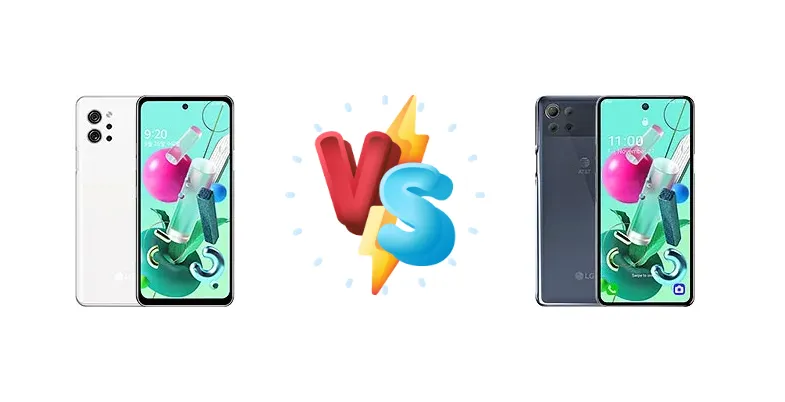
LG's Q and K series represent their attempts to deliver 5G connectivity at more accessible price points. The Q92 5G and K92 5G, while visually similar, diverge significantly under the hood. This comparison dissects those differences, focusing on the chipset, charging capabilities, and overall performance to determine which device offers the best experience for your money.
🏆 Quick Verdict
For most users, the LG Q92 5G emerges as the stronger choice. Its Snapdragon 765G chipset provides a noticeable performance uplift, particularly in graphics-intensive tasks, and while charging is slower, the overall processing power justifies the trade-off. The K92 5G remains a viable option for those prioritizing faster charging and a lower price.
| Network |
|---|
| 2G bands | GSM 850 / 900 / 1800 / 1900 | GSM 850 / 900 / 1800 / 1900 |
| 3G bands | HSDPA 850 / 900 / 1900 / 2100 | HSDPA 850 / 900 / 1700(AWS) / 1900 / 2100 |
| 4G bands | LTE | LTE |
| 5G bands | SA/NSA | SA/NSA/Sub6 |
| Speed | HSPA, LTE, 5G | HSPA, LTE, 5G |
| Technology | GSM / HSPA / LTE / 5G | GSM / HSPA / LTE / 5G |
| Launch |
|---|
| Announced | 2020, August 24. Released 2020, August 26 | 2020, September 29. Released 2020, November 06 |
| Status | Discontinued | Discontinued |
| Body |
|---|
| Dimensions | 166.5 x 77.3 x 8.5 mm (6.56 x 3.04 x 0.33 in) | 166.4 x 77.2 x 8.4 mm (6.55 x 3.04 x 0.33 in) |
| SIM | Nano-SIM + Nano-SIM | Nano-SIM + Nano-SIM |
| Weight | 193 g (6.81 oz) | 202.4 g (7.13 oz) |
| | IP68 dust/water resistant (up to 1.5m for 30 mins)
MIL-STD-810G compliant*
*does not guarantee ruggedness or use in extreme conditions | - |
| Display |
|---|
| Resolution | 1080 x 2400 pixels, 20:9 ratio (~395 ppi density) | 1080 x 2400 pixels, 20:9 ratio (~393 ppi density) |
| Size | 6.67 inches, 107.4 cm2 (~83.5% screen-to-body ratio) | 6.7 inches, 108.4 cm2 (~84.4% screen-to-body ratio) |
| Type | IPS LCD | IPS LCD |
| Platform |
|---|
| CPU | Octa-core (1x2.4 GHz Kryo 475 Prime & 1x2.2 GHz Kryo 475 Gold & 6x1.8 GHz Kryo 475 Silver) | Octa-core (2x2.0 GHz Kryo 560 Gold & 6x1.7 GHz Kryo 560 Silver) |
| Chipset | Qualcomm SM7250 Snapdragon 765G 5G (7 nm) | Qualcomm SM6350 Snapdragon 690 5G (8 nm) |
| GPU | Adreno 620 | Adreno 619L |
| OS | Android 10 | Android 10 |
| Memory |
|---|
| Card slot | microSDXC | microSDXC |
| Internal | 128GB 6GB RAM | 128GB 6GB RAM |
| Main Camera |
|---|
| Features | LED flash, panorama, HDR | Quad-LED flash, panorama, HDR |
| Quad | 48 MP, f/1.8, 26mm (wide), 1/2.0", 0.8µm, PDAF
8 MP, f/2.2, 120˚, 15mm (ultrawide), 1/4.0", 1.12µm
2 MP (macro)
Auxiliary lens | 64 MP, f/1.8, 25mm (wide), 1/1.97", 0.7µm, PDAF
5 MP, f/2.2, 115˚ (ultrawide), 1/5.0", 1.12µm
2 MP (macro)
Auxiliary lens |
| Video | 4K@30fps, 1080p@30fps | 4K@30fps, 1080p@30fps |
| Selfie camera |
|---|
| Features | HDR | - |
| Single | 32 MP, f/1.9, 26mm (wide), 1/2.8", 0.8µm | 16 MP, f/2.0, 27mm (wide), 1/3.06, 1.0µm |
| Video | 1080p@30fps | 1080p@30fps |
| Sound |
|---|
| 3.5mm jack | Yes | Yes |
| 35mm jack | Yes | Yes |
| Loudspeaker | Yes, with stereo speakers | Yes, with stereo speakers |
| Comms |
|---|
| Bluetooth | 5.0, A2DP, LE | 5.1, A2DP, LE |
| NFC | Yes | Yes |
| Positioning | GPS, GLONASS, GALILEO, BDS | GPS, GLONASS, GALILEO |
| Radio | No | No |
| USB | USB Type-C 2.0 | USB Type-C 3.1 |
| WLAN | Wi-Fi 802.11 a/b/g/n/ac, dual-band, Wi-Fi Direct, DLNA | Wi-Fi 802.11 a/b/g/n/ac, dual-band, Wi-Fi Direct |
| Features |
|---|
| Sensors | Fingerprint (side-mounted), accelerometer, gyro, proximity, compass | Fingerprint (side-mounted), accelerometer, proximity, compass |
| Battery |
|---|
| Charging | 15W wired | Quick Charge 4.0 |
| Type | Li-Po 4000 mAh | Li-Po 4000 mAh |
| Misc |
|---|
| Colors | White, Dark Blue, Red | Titan Gray |
| Models | LM-Q920N | LMK920, LM-K920 |
| Price | About 360 EUR | About 340 EUR |
LG Q92 5G
- More powerful Snapdragon 765G chipset
- Superior graphics performance for gaming
- Potentially better image processing capabilities
- Slower 15W wired charging
- Battery capacity not specified
LG K92 5G
- Faster Quick Charge 4.0 charging
- Potentially better battery life under light use (due to 8nm process)
- More affordable price point
- Less powerful Snapdragon 690 chipset
- Lower graphics performance
- Potentially slower app launch speeds
Display Comparison
Both the Q92 5G and K92 5G feature 6.8-inch displays, but detailed panel specifications like brightness and color accuracy are not provided. However, given their market positioning, it's reasonable to assume both utilize IPS LCD panels. The lack of high refresh rate support is a common omission in this price bracket. Bezels are likely comparable, focusing on maximizing screen real estate within their respective budgets. The absence of LTPO technology suggests neither device offers variable refresh rate capabilities for power saving.
Camera Comparison
Detailed camera specifications beyond the presence of multiple lenses are unavailable. However, the chipset difference suggests the Q92 5G’s image signal processor (ISP) will offer more advanced processing capabilities, potentially leading to better dynamic range and noise reduction. While both likely feature a standard wide-angle lens, the Q92 5G’s more powerful chipset could enable features like faster autofocus and more sophisticated scene detection. The inclusion of a dedicated AI engine within the 765G further enhances image processing potential. We can assume both devices include standard features like HDR and portrait modes, but the Q92 5G is likely to deliver superior results.
Performance
The core difference lies in the chipsets. The LG Q92 5G boasts the Qualcomm SM7250 Snapdragon 765G (7nm), featuring an octa-core CPU with a prime Kryo 475 core clocked at 2.4GHz. This is paired with a Kryo 475 Gold core at 2.2GHz and six Kryo 475 Silver cores at 1.8GHz. In contrast, the K92 5G utilizes the Snapdragon 690 (8nm) with a dual-core Kryo 560 Gold configuration at 2.0GHz and six Kryo 560 Silver cores at 1.7GHz. The 7nm process node of the 765G generally translates to better power efficiency and thermal performance compared to the 8nm 690. The 765G’s CPU architecture also provides a performance advantage, particularly in single-core tasks. This benefits app launch speeds and overall responsiveness. The 765G also includes a more capable Adreno GPU, making it the superior choice for mobile gaming.
Battery Life
Battery capacity is not specified for either device. However, the LG K92 5G’s support for Quick Charge 4.0 is a significant advantage. This allows for significantly faster charging speeds compared to the Q92 5G’s 15W wired charging. While a larger battery capacity on the Q92 5G could partially offset the slower charging, Quick Charge 4.0 provides a more convenient user experience, allowing for a substantial charge in a short amount of time. The 8nm process of the Snapdragon 690 in the K92 5G may also contribute to slightly better battery life under light workloads, but the 7nm 765G in the Q92 5G will likely perform better under sustained load.
Buying Guide
Buy the LG Q92 5G if you need a smoother experience for gaming, multitasking, or demanding applications. The Snapdragon 765G offers a more future-proof platform. Buy the LG K92 5G if you prioritize quick top-ups and are primarily focused on everyday tasks like browsing, social media, and light video consumption. The Snapdragon 690 is sufficient for these workloads, and Quick Charge 4.0 provides a convenient charging experience.
Frequently Asked Questions
❓ Will the LG Q92 5G handle demanding games like PUBG Mobile or Call of Duty Mobile at high settings?
The Snapdragon 765G in the Q92 5G is capable of running these games at medium to high settings with playable frame rates. While it won't match the performance of flagship chipsets, it provides a significantly better gaming experience than the Snapdragon 690 in the K92 5G, especially for sustained gameplay.
❓ How long does it realistically take to fully charge the LG K92 5G with Quick Charge 4.0?
With a compatible Quick Charge 4.0 charger, the LG K92 5G should be able to charge from 0% to 100% in approximately 1 hour and 30 minutes to 2 hours, depending on usage during charging. This is considerably faster than the Q92 5G’s 15W charging.
❓ Is the difference in chipset performance between the Snapdragon 765G and 690 noticeable for everyday tasks like browsing and social media?
For basic tasks, the difference is less pronounced. Both chipsets are capable of handling everyday usage smoothly. However, the Q92 5G will exhibit faster app launch times and smoother multitasking due to the 765G’s more powerful CPU and memory controller.