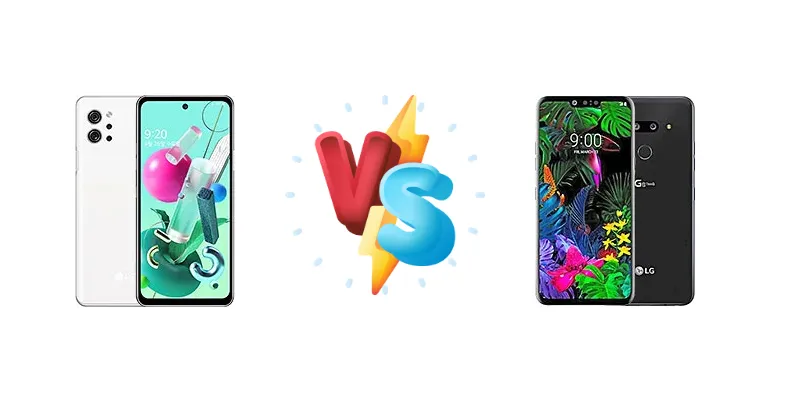
The LG Q92 5G and G8 ThinQ represent different points in LG’s smartphone strategy. The Q92 5G arrived as a more affordable entry into the 5G space, while the G8 ThinQ was a flagship aiming to compete with the top-tier devices of its time. This comparison dissects their key differences, focusing on performance, display, camera capabilities, and battery life to determine which device offers the best value in today’s market.
🏆 Quick Verdict
For the average user prioritizing future-proofing and 5G connectivity, the LG Q92 5G is the better choice. While the G8 ThinQ boasts a more powerful Snapdragon 855, the Q92 5G’s 5G capabilities and lower price point make it a more compelling option, especially considering the G8’s age and potential for software support limitations.
| Network |
|---|
| 2G bands | GSM 850 / 900 / 1800 / 1900 | GSM 850 / 900 / 1800 / 1900 |
| 3G bands | HSDPA 850 / 900 / 1900 / 2100 | HSDPA 850 / 900 / 1900 / 2100 |
| 4G bands | LTE | 1, 2, 3, 4, 5, 7, 8, 12, 13, 14, 17, 20, 25, 26, 28, 29, 30, 38, 39, 40, 41, 46, 48, 66, 71 - USA |
| 5G bands | SA/NSA | - |
| Speed | HSPA, LTE, 5G | HSPA 42.2/5.76 Mbps, LTE Cat19 1600/150 Mbps |
| Technology | GSM / HSPA / LTE / 5G | GSM / CDMA / HSPA / EVDO / LTE |
| | - | 2, 3, 4, 5, 7, 13, 20, 28, 46, 48, 66 - Verison |
| Launch |
|---|
| Announced | 2020, August 24. Released 2020, August 26 | 2019, February 24. Released 2019, April 11 |
| Status | Discontinued | Discontinued |
| Body |
|---|
| Build | - | Glass front (Gorilla Glass 5), glass back (Gorilla Glass 6), aluminum frame |
| Dimensions | 166.5 x 77.3 x 8.5 mm (6.56 x 3.04 x 0.33 in) | 151.9 x 71.8 x 8.4 mm (5.98 x 2.83 x 0.33 in) |
| SIM | Nano-SIM + Nano-SIM | · Nano-SIM· Nano-SIM + Nano-SIM |
| Weight | 193 g (6.81 oz) | 167 g (5.89 oz) |
| | IP68 dust/water resistant (up to 1.5m for 30 mins)
MIL-STD-810G compliant*
*does not guarantee ruggedness or use in extreme conditions | IP68 dust/water resistant (up to 1.5m for 30 min)
MIL-STD-810G compliant*
Method 516.6, Procedure IV "Transit Drop"
*does not guarantee ruggedness or use in extreme conditions |
| Display |
|---|
| Protection | - | Corning Gorilla Glass 5 |
| Resolution | 1080 x 2400 pixels, 20:9 ratio (~395 ppi density) | 1440 x 3120 pixels, 19.5:9 ratio (~564 ppi density) |
| Size | 6.67 inches, 107.4 cm2 (~83.5% screen-to-body ratio) | 6.1 inches, 91.0 cm2 (~83.5% screen-to-body ratio) |
| Type | IPS LCD | P-OLED, HDR10 |
| | - | Always-on display |
| Platform |
|---|
| CPU | Octa-core (1x2.4 GHz Kryo 475 Prime & 1x2.2 GHz Kryo 475 Gold & 6x1.8 GHz Kryo 475 Silver) | Octa-core (1x2.84 GHz Kryo 485 & 3x2.42 GHz Kryo 485 & 4x1.78 GHz Kryo 485) |
| Chipset | Qualcomm SM7250 Snapdragon 765G 5G (7 nm) | Qualcomm SM8150 Snapdragon 855 (7 nm) |
| GPU | Adreno 620 | Adreno 640 |
| OS | Android 10 | Android 9.0 (Pie), upgradable to Android 11 |
| Memory |
|---|
| Card slot | microSDXC | microSDXC (dedicated slot) - single-SIM modelmicroSDXC (uses shared SIM slot) - dual-SIM model |
| Internal | 128GB 6GB RAM | 128GB 6GB RAM |
| | - | UFS 2.1 |
| Main Camera |
|---|
| Dual or Triple | - | 12 MP, f/1.5, 27mm (standard), 1/2.55", 1.4µm, dual pixel PDAF, OIS
16 MP, f/1.9, 16mm (ultrawide), 1/3.1", 1.0µm, no AF
or
12 MP, f/1.5, 27mm (standard), 1/2.55", 1.4µm, dual pixel PDAF, OIS
16 MP, f/1.9, 16mm (ultrawide), 1/3.1", 1.0µm, no AF
12 MP, 52mm (telephoto), f/2.4, 1.0µm, 2x optical zoom, dual pixel PDAF, OIS |
| Features | LED flash, panorama, HDR | LED flash, HDR, panorama |
| Quad | 48 MP, f/1.8, 26mm (wide), 1/2.0", 0.8µm, PDAF
8 MP, f/2.2, 120˚, 15mm (ultrawide), 1/4.0", 1.12µm
2 MP (macro)
Auxiliary lens | - |
| Video | 4K@30fps, 1080p@30fps | 4K@30/60fps, 1080p@30/60fps, 720p@240fps, HDR10, 24-bit/192kHz stereo sound rec. |
| Selfie camera |
|---|
| Features | HDR | HDR |
| Single | 32 MP, f/1.9, 26mm (wide), 1/2.8", 0.8µm | 8 MP, f/1.7, 26mm (wide), 1/3.6", 1.22µm, AF
TOF 3D, f/1.4, (depth/biometrics sensor) |
| Video | 1080p@30fps | 1080p@60fps |
| Sound |
|---|
| 3.5mm jack | Yes | Yes |
| 35mm jack | Yes | Yes |
| Loudspeaker | Yes, with stereo speakers | Yes |
| | - | 32-bit/192kHz audio |
| Comms |
|---|
| Bluetooth | 5.0, A2DP, LE | 5.0, A2DP, LE, aptX HD |
| NFC | Yes | Yes |
| Positioning | GPS, GLONASS, GALILEO, BDS | GPS, GLONASS, GALILEO, BDS |
| Radio | No | FM radio (market/region dependent) |
| USB | USB Type-C 2.0 | USB Type-C 3.1, OTG |
| WLAN | Wi-Fi 802.11 a/b/g/n/ac, dual-band, Wi-Fi Direct, DLNA | Wi-Fi 802.11 a/b/g/n/ac, dual-band, Wi-Fi Direct, DLNA |
| Features |
|---|
| Sensors | Fingerprint (side-mounted), accelerometer, gyro, proximity, compass | Face ID, Hand ID, fingerprint (rear-mounted), accelerometer, gyro, proximity, compass, barometer |
| Battery |
|---|
| Charging | 15W wired | 21W wired, PD, QC3
9W wireless |
| Type | Li-Po 4000 mAh | Li-Po 3500 mAh, non-removable |
| Misc |
|---|
| Colors | White, Dark Blue, Red | Platinum Gray, New Aurora Black, New Moroccan Blue, Carmine Red |
| Models | LM-Q920N | LMG820QM7, LM-G820UMB, LMG820UM0, LMG820UM1, LMG820UM2, LM-G820N, LM-G820, LM-G820QM |
| Price | About 360 EUR | About 350 EUR |
| Tests |
|---|
| Audio quality | - |
Noise -94.1dB / Crosstalk -87.6dB |
| Battery life | - |
Endurance rating 79h
|
| Camera | - |
Photo / Video |
| Display | - |
Contrast ratio: infinite |
| Loudspeaker | - |
Voice 68dB / Noise 74dB / Ring 92dB
|
| Performance | - |
AnTuTu: 331537 (v7), 362730 (v8)
GeekBench: 10735 (v4.4), 2700 (v5.1)
GFXBench: 20fps (ES 3.1 onscreen) |
LG Q92 5G
- 5G Connectivity for faster data speeds
- More affordable price point
- Modern chipset with integrated 5G modem
- Lower peak performance compared to Snapdragon 855
- Likely lower display quality (LCD vs OLED)
- Slower charging speed (15W)
LG G8 ThinQ
- Powerful Snapdragon 855 processor
- Brighter and higher contrast display
- Faster 21W wired and 9W wireless charging
- Lacks 5G connectivity
- Older chipset with potential software support limitations
- Higher price point (likely, given its original flagship status)
Display Comparison
The LG G8 ThinQ’s display boasts a measured peak brightness of 655 nits, offering excellent visibility in bright sunlight. While the Q92 5G’s display specifications aren’t provided, it’s likely lower, typical of its mid-range positioning. The G8’s ‘infinite’ contrast ratio suggests a high-quality OLED panel, delivering deep blacks and vibrant colors. The Q92 5G likely utilizes an LCD panel, which, while still capable, won’t match the G8’s contrast. The G8’s display is the clear winner for users prioritizing visual fidelity and outdoor usability.
Camera Comparison
Both devices offer photo and video capabilities, but detailed sensor information is lacking for both. The G8 ThinQ, being a flagship, likely features a more sophisticated camera system with larger sensors and better image processing. The Q92 5G’s camera is likely tuned for general-purpose photography. Without specific sensor size or aperture data, it’s difficult to make a definitive judgment, but the G8’s flagship status suggests a superior camera experience, particularly in low-light conditions. The inclusion of OIS on the G8 is also probable, further enhancing image quality.
Performance
The core difference lies in the chipsets: the LG G8 ThinQ features the Qualcomm Snapdragon 855 (7nm), while the Q92 5G uses the Snapdragon 765G (7nm). The Snapdragon 855’s Kryo 485 CPU, with a prime core clocked at 2.84 GHz, offers significantly higher peak performance than the Q92 5G’s Kryo 475 Prime at 2.4 GHz. However, the 765G integrates a 5G modem, a feature absent in the G8. The 855’s architecture (1+3+4 core configuration) is geared towards sustained performance, while the 765G (1+1+6) balances performance and efficiency. For demanding applications, the G8 will perform better, but the Q92 5G offers the benefit of 5G connectivity.
Battery Life
Both phones share an endurance rating of 79 hours, indicating similar real-world battery life despite the Q92 5G’s unspecified battery capacity. However, the G8 ThinQ offers significantly faster charging at 21W with Power Delivery and Quick Charge 3.0, plus 9W wireless charging. The Q92 5G is limited to 15W wired charging. This means the G8 can replenish its battery much quicker, a significant convenience factor. The G8’s faster charging offsets any potential capacity differences, making it the winner in this category.
Buying Guide
Buy the LG Q92 5G if you need 5G connectivity on a budget and prioritize future network compatibility. It’s ideal for users who stream a lot of video, download large files, or live in areas with expanding 5G coverage. Buy the LG G8 ThinQ if you prioritize raw processing power for demanding tasks like video editing or gaming, and value the faster 21W charging and potentially superior display brightness, accepting the trade-off of lacking 5G and facing potential software obsolescence.
Frequently Asked Questions
❓ Will the LG G8 ThinQ still receive software updates?
Given the G8 ThinQ’s age, its long-term software support is uncertain. While it initially launched with Android 9, it received updates to Android 10 and 11. However, future updates are unlikely, potentially leaving it vulnerable to security risks and lacking new features. The Q92 5G, being a newer device, has a higher probability of receiving further updates.
❓ How much faster is 5G on the LG Q92 5G compared to 4G?
5G speeds on the LG Q92 5G can be significantly faster than 4G, potentially reaching several gigabits per second in ideal conditions. However, actual speeds depend on network availability and coverage. In areas with robust 5G infrastructure, users can expect much faster download and upload speeds, lower latency, and a more responsive online experience.
❓ Is the Snapdragon 765G in the Q92 5G powerful enough for gaming?
The Snapdragon 765G is capable of handling most mobile games at medium to high settings. While it doesn’t match the raw power of the Snapdragon 855 in the G8 ThinQ, it provides a smooth gaming experience for the majority of titles. Demanding games may require some graphical settings adjustments to maintain optimal frame rates.
❓ Does the LG G8 ThinQ's 21W charging make a noticeable difference?
Yes, the 21W charging on the G8 ThinQ is considerably faster than the Q92 5G’s 15W charging. This translates to a significantly reduced charging time, allowing you to quickly top up your battery when needed. It's a practical advantage for users who frequently find themselves with low battery levels.