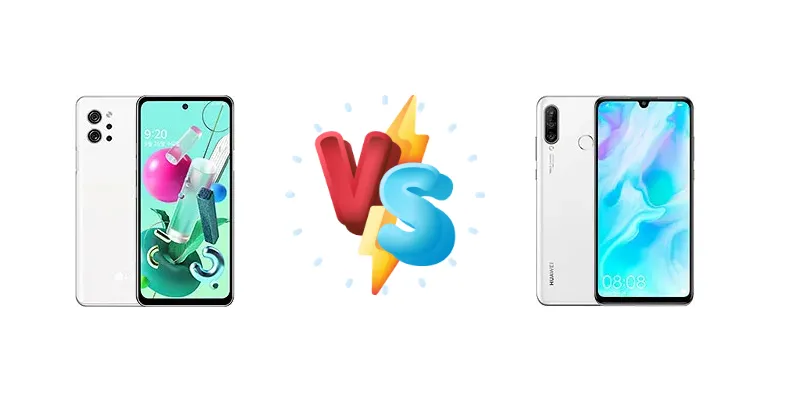
The LG Q92 5G and Huawei P30 lite represent different approaches to the mid-range smartphone market. The Q92 5G, released later, brings 5G connectivity and a more modern chipset to the table, while the P30 lite focuses on delivering a solid all-around experience with a strong emphasis on battery endurance. This comparison dissects their key differences to help you determine which device best suits your needs.
🏆 Quick Verdict
For users prioritizing future-proofing and faster data speeds, the LG Q92 5G is the clear winner. Its Snapdragon 765G offers significantly better performance and 5G support. However, the Huawei P30 lite remains a viable option for those on a tighter budget who value long battery life and a proven, reliable experience.
| Network |
|---|
| 2G bands | GSM 850 / 900 / 1800 / 1900 | GSM 850 / 900 / 1800 / 1900 |
| 3G bands | HSDPA 850 / 900 / 1900 / 2100 | HSDPA 850 / 900 / 1700(AWS) / 1900 / 2100 - Europe, Canada |
| 4G bands | LTE | 1, 3, 4, 7, 8, 20, 38 - Europe |
| 5G bands | SA/NSA | - |
| Speed | HSPA, LTE, 5G | HSPA 42.2/5.76 Mbps, LTE (2CA) Cat6 400/50 Mbps |
| Technology | GSM / HSPA / LTE / 5G | GSM / HSPA / LTE |
| | - | 1, 2, 3, 4, 5, 7, 8, 12, 17, 28, 66 - Canada |
| Launch |
|---|
| Announced | 2020, August 24. Released 2020, August 26 | 2019, March 27. Released 2019, April 25 |
| Status | Discontinued | Discontinued |
| Body |
|---|
| Build | - | Glass front, glass back, plastic frame |
| Dimensions | 166.5 x 77.3 x 8.5 mm (6.56 x 3.04 x 0.33 in) | 152.9 x 72.7 x 7.4 mm (6.02 x 2.86 x 0.29 in) |
| SIM | Nano-SIM + Nano-SIM | · Nano-SIM· Nano-SIM + Nano-SIM |
| Weight | 193 g (6.81 oz) | 159 g (5.61 oz) |
| | IP68 dust/water resistant (up to 1.5m for 30 mins)
MIL-STD-810G compliant*
*does not guarantee ruggedness or use in extreme conditions | - |
| Display |
|---|
| Resolution | 1080 x 2400 pixels, 20:9 ratio (~395 ppi density) | 1080 x 2312 pixels, 19.3:9 ratio (~415 ppi density) |
| Size | 6.67 inches, 107.4 cm2 (~83.5% screen-to-body ratio) | 6.15 inches, 93.6 cm2 (~84.2% screen-to-body ratio) |
| Type | IPS LCD | IPS LCD |
| Platform |
|---|
| CPU | Octa-core (1x2.4 GHz Kryo 475 Prime & 1x2.2 GHz Kryo 475 Gold & 6x1.8 GHz Kryo 475 Silver) | Octa-core (4x2.2 GHz Cortex-A73 & 4x1.7 GHz Cortex-A53) |
| Chipset | Qualcomm SM7250 Snapdragon 765G 5G (7 nm) | Kirin 710 (12 nm) |
| GPU | Adreno 620 | Mali-G51 MP4 |
| OS | Android 10 | Android 9.0 (Pie), upgradable to Android 10, EMUI 10.0 |
| Memory |
|---|
| Card slot | microSDXC | microSDXC (uses shared SIM slot) |
| Internal | 128GB 6GB RAM | 64GB 4GB RAM, 128GB 4GB RAM, 128GB 6GB RAM, 128GB 8GB RAM, 256GB 4GB RAM, 256GB 6GB RAM |
| | - | eMMC 5.1 |
| Main Camera |
|---|
| Features | LED flash, panorama, HDR | LED flash, HDR, panorama |
| Quad | 48 MP, f/1.8, 26mm (wide), 1/2.0", 0.8µm, PDAF
8 MP, f/2.2, 120˚, 15mm (ultrawide), 1/4.0", 1.12µm
2 MP (macro)
Auxiliary lens | - |
| Triple | - | 48 MP, f/1.8, 27mm (wide), 1/2.0", 0.8µm, PDAF
8 MP, 17mm (ultrawide)
Auxiliary lens
or
24 MP, f/1.8, (wide), PDAF
8 MP, 17mm (ultrawide)
Auxiliary lens |
| Video | 4K@30fps, 1080p@30fps | 1080p@30fps (gyro-EIS) |
| Selfie camera |
|---|
| Features | HDR | Panorama |
| Single | 32 MP, f/1.9, 26mm (wide), 1/2.8", 0.8µm | 24 MP, f/2.0, 26mm (wide), 1/2.8", 0.9µm
or
32 MP, f/2.0, 26mm (wide), 1/2.8", 0.8µm |
| Video | 1080p@30fps | 1080p@30fps |
| Sound |
|---|
| 3.5mm jack | Yes | Yes |
| 35mm jack | Yes | Yes |
| Loudspeaker | Yes, with stereo speakers | Yes |
| Comms |
|---|
| Bluetooth | 5.0, A2DP, LE | 4.2, A2DP, LE, aptX HD |
| NFC | Yes | Yes - MAR-L21MEA, MAR-LX1M only |
| Positioning | GPS, GLONASS, GALILEO, BDS | GPS, GLONASS, BDS |
| Radio | No | FM radio (market dependent) |
| USB | USB Type-C 2.0 | USB Type-C 2.0, OTG |
| WLAN | Wi-Fi 802.11 a/b/g/n/ac, dual-band, Wi-Fi Direct, DLNA | Wi-Fi 802.11 a/b/g/n/ac, dual-band, Wi-Fi Direct |
| Features |
|---|
| Sensors | Fingerprint (side-mounted), accelerometer, gyro, proximity, compass | Fingerprint (rear-mounted), accelerometer, gyro, proximity, compass |
| Battery |
|---|
| Charging | 15W wired | 18W wired |
| Type | Li-Po 4000 mAh | Li-Po 3340 mAh, non-removable |
| Misc |
|---|
| Colors | White, Dark Blue, Red | Peacock Blue, Midnight Black, Pearl White |
| Models | LM-Q920N | MAR-LX1M, MAR-AL00, MAR-TL00, MAR-LX2, Marie-L21A, Marie-L01A, Marie-L21MEA, Marie-L22A, MAR-LX1A, MAR-LX3A, MAR-LX2J, MAR-LX1B, MAR-LX3Bm, MAR-LX3Am |
| Price | About 360 EUR | About 420 EUR |
| Tests |
|---|
| Audio quality | - |
Noise -94.4dB / Crosstalk -71.2dB |
| Battery life | - |
Endurance rating 94h
|
| Camera | - |
Photo / Video |
| Display | - |
Contrast ratio: 1231:1 (nominal) |
| Loudspeaker | - |
Voice 71dB / Noise 73dB / Ring 83dB
|
| Performance | - |
AnTuTu: 141600 (v7)
GeekBench: 5549 (v4.4)
GFXBench: 6.9fps (ES 3.1 onscreen) |
LG Q92 5G
- 5G Connectivity for faster data speeds
- More Powerful Snapdragon 765G processor
- Potential for better camera image processing
- Slower 15W charging
- Display specifications are unknown
- Potentially higher price
Huawei P30 lite
- Excellent 94-hour battery endurance
- Faster 18W wired charging
- Lower price point
- Older Kirin 710 chipset
- No 5G connectivity
- Less powerful CPU and GPU
Display Comparison
The Huawei P30 lite boasts a measured peak brightness of 501 nits and a 1231:1 contrast ratio, providing a reasonably viewable experience. However, the LG Q92 5G’s display specifications are not provided, making a direct comparison difficult. Given LG’s history with IPS LCDs, it likely offers similar color accuracy, but without knowing its peak brightness or contrast ratio, it’s hard to definitively say. The P30 lite’s contrast ratio, while nominal, suggests decent black levels for its price point.
Camera Comparison
Both phones offer photo and video capabilities, but detailed camera specifications are limited. Without sensor size or aperture information, a direct comparison is challenging. However, the LG Q92 5G’s more modern chipset likely provides superior image signal processing (ISP) capabilities, potentially leading to better image quality, especially in low-light conditions. The P30 lite’s camera performance is likely adequate for casual use, but the Q92 5G has the potential for more detailed and dynamic images.
Performance
The core difference lies in the chipsets. The LG Q92 5G’s Qualcomm Snapdragon 765G (7nm) is a substantial upgrade over the Huawei P30 lite’s Kirin 710 (12nm). The 7nm process node of the Snapdragon 765G translates to better power efficiency and thermal performance, allowing for sustained performance during demanding tasks. The Snapdragon 765G’s octa-core CPU, with its Kryo architecture (1x2.4 GHz Prime, 1x2.2 GHz Gold, 6x1.8 GHz Silver), offers a more balanced and powerful configuration compared to the Kirin 710’s (4x2.2 GHz Cortex-A73 & 4x1.7 GHz Cortex-A53). This means faster app loading times, smoother multitasking, and a better gaming experience on the LG Q92 5G.
Battery Life
Both devices share an endurance rating of 94 hours, suggesting comparable battery life in typical usage scenarios. However, the LG Q92 5G’s 15W wired charging is slower than the Huawei P30 lite’s 18W wired charging. While both offer similar overall endurance, the P30 lite will replenish its battery slightly faster. The Snapdragon 765G’s 7nm process *could* offset some of the charging speed difference through improved power efficiency, but this depends heavily on software optimization and usage patterns.
Buying Guide
Buy the LG Q92 5G if you need 5G connectivity, a more responsive processor for multitasking and gaming, and are willing to trade some battery life for performance. Buy the Huawei P30 lite if you prioritize all-day battery life, a lower price point, and a familiar, stable software experience, and don't require 5G capabilities.
Frequently Asked Questions
❓ Will the Snapdragon 765G in the LG Q92 5G handle demanding games like PUBG or Call of Duty?
Yes, the Snapdragon 765G is capable of running PUBG and Call of Duty at medium to high settings. While it's not a flagship-level chip, its Adreno 620 GPU provides sufficient graphical power for a smooth gaming experience. However, sustained performance may be limited by thermal throttling, depending on the phone's cooling solution.
❓ Does the Huawei P30 lite's battery life hold up with heavy social media and video streaming use?
The Huawei P30 lite's 94-hour endurance rating suggests it can handle moderate to heavy use, including social media and video streaming. However, prolonged use of these apps will naturally drain the battery faster. The 18W charging will help to quickly top up the battery when needed.
❓ Is the lack of 5G on the Huawei P30 lite a significant drawback in 2024?
For users in areas with widespread 5G coverage, the lack of 5G on the P30 lite is a noticeable limitation. 5G offers significantly faster download and upload speeds, which can be beneficial for streaming, gaming, and large file transfers. However, if 5G is not available or not a priority, the P30 lite remains a viable option.