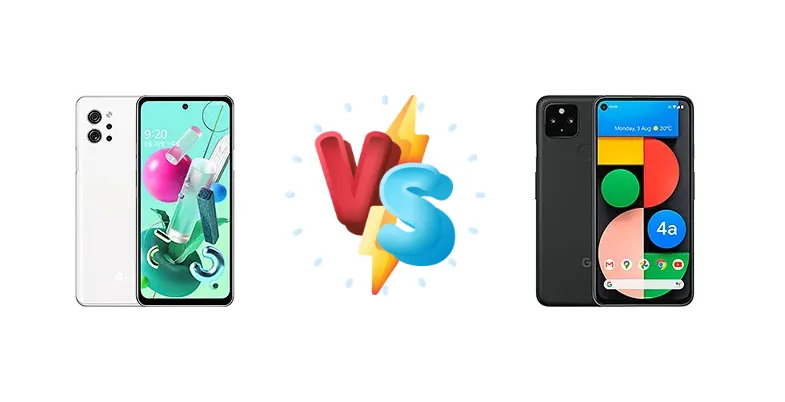
The LG Q92 5G and Google Pixel 4a 5G represent compelling options in the mid-range 5G smartphone market. Both devices leverage the Qualcomm Snapdragon 765G chipset, promising similar performance, but diverge significantly in areas like charging technology and software implementation. This comparison dissects these differences to determine which phone delivers the most complete package for the average user.
🏆 Quick Verdict
For most users, the Google Pixel 4a 5G emerges as the better choice. While both phones share the same Snapdragon 765G processor, the Pixel 4a 5G’s superior software experience, faster 18W PD2.0 charging, and generally more refined camera processing provide a more polished and user-friendly experience.
| Network |
|---|
| 2G bands | GSM 850 / 900 / 1800 / 1900 | GSM 850 / 900 / 1800 / 1900 |
| 3G bands | HSDPA 850 / 900 / 1900 / 2100 | HSDPA 850 / 900 / 1700(AWS) / 1900 / 2100 |
| 4G bands | LTE | 1, 2, 3, 4, 5, 7, 8, 12, 13, 14, 17, 18, 19, 20, 25, 26, 28, 29, 30, 32, 38, 39, 40, 41, 42, 46, 48, 66, 71 |
| 5G bands | SA/NSA | 1, 2, 3, 5, 7, 8, 12, 28, 41, 66, 71, 77, 78 Sub6, mmWave (market dependant) |
| Speed | HSPA, LTE, 5G | HSPA, LTE, 5G |
| Technology | GSM / HSPA / LTE / 5G | GSM / HSPA / LTE / 5G |
| Launch |
|---|
| Announced | 2020, August 24. Released 2020, August 26 | 2020, September 30 |
| Status | Discontinued | Available. Released 2020, November 05 |
| Body |
|---|
| Build | - | Glass front (Gorilla Glass 3), plastic back, plastic frame |
| Dimensions | 166.5 x 77.3 x 8.5 mm (6.56 x 3.04 x 0.33 in) | 153.9 x 74 x 8.2 mm (Sub-6) or 8.5 mm (Sub-6 and mmWave) |
| SIM | Nano-SIM + Nano-SIM | Nano-SIM + eSIM |
| Weight | 193 g (6.81 oz) | 168 g (5G Sub-6); 171 g ( 5G Sub-6 and mmWave) (5.93 oz) |
| | IP68 dust/water resistant (up to 1.5m for 30 mins)
MIL-STD-810G compliant*
*does not guarantee ruggedness or use in extreme conditions | - |
| Display |
|---|
| Protection | - | Corning Gorilla Glass 3 |
| Resolution | 1080 x 2400 pixels, 20:9 ratio (~395 ppi density) | 1080 x 2340 pixels, 19.5:9 ratio (~413 ppi density) |
| Size | 6.67 inches, 107.4 cm2 (~83.5% screen-to-body ratio) | 6.2 inches, 95.7 cm2 (~84.1% screen-to-body ratio) |
| Type | IPS LCD | OLED, HDR |
| | - | Always-on display |
| Platform |
|---|
| CPU | Octa-core (1x2.4 GHz Kryo 475 Prime & 1x2.2 GHz Kryo 475 Gold & 6x1.8 GHz Kryo 475 Silver) | Octa-core (1x2.4 GHz Kryo 475 Prime & 1x2.2 GHz Kryo 475 Gold & 6x1.8 GHz Kryo 475 Silver) |
| Chipset | Qualcomm SM7250 Snapdragon 765G 5G (7 nm) | Qualcomm SM7250 Snapdragon 765G 5G (7 nm) |
| GPU | Adreno 620 | Adreno 620 |
| OS | Android 10 | Android 11, upgradable to Android 14 |
| Memory |
|---|
| Card slot | microSDXC | No |
| Internal | 128GB 6GB RAM | 128GB 6GB RAM |
| | - | UFS 2.1 |
| Main Camera |
|---|
| Dual | - | 12.2 MP, f/1.7, 27mm (wide), 1/2.55", 1.4µm, dual pixel PDAF, OIS
16 MP, f/2.2, 107˚ (ultrawide), 1.0µm |
| Features | LED flash, panorama, HDR | LED flash, Pixel Shift, Auto-HDR, panorama |
| Quad | 48 MP, f/1.8, 26mm (wide), 1/2.0", 0.8µm, PDAF
8 MP, f/2.2, 120˚, 15mm (ultrawide), 1/4.0", 1.12µm
2 MP (macro)
Auxiliary lens | - |
| Video | 4K@30fps, 1080p@30fps | 4K@30/60fps, 1080p@30/60/120/240fps; gyro-EIS |
| Selfie camera |
|---|
| Features | HDR | HDR |
| Single | 32 MP, f/1.9, 26mm (wide), 1/2.8", 0.8µm | 8 MP, f/2.0, 24mm (wide), 1/4.0", 1.12µm |
| Video | 1080p@30fps | 1080p@30fps |
| Sound |
|---|
| 3.5mm jack | Yes | Yes |
| 35mm jack | Yes | Yes |
| Loudspeaker | Yes, with stereo speakers | Yes, with stereo speakers |
| Comms |
|---|
| Bluetooth | 5.0, A2DP, LE | 5.0, A2DP, LE, aptX HD |
| NFC | Yes | Yes |
| Positioning | GPS, GLONASS, GALILEO, BDS | GPS, GLONASS, GALILEO, QZSS, BDS |
| Radio | No | No |
| USB | USB Type-C 2.0 | USB Type-C 3.1 |
| WLAN | Wi-Fi 802.11 a/b/g/n/ac, dual-band, Wi-Fi Direct, DLNA | Wi-Fi 802.11 a/b/g/n/ac, dual-band, Wi-Fi Direct |
| Features |
|---|
| Sensors | Fingerprint (side-mounted), accelerometer, gyro, proximity, compass | Fingerprint (rear-mounted), accelerometer, gyro, proximity, compass, barometer |
| Battery |
|---|
| Charging | 15W wired | 18W wired, PD2.0 |
| Type | Li-Po 4000 mAh | Li-Po 3885 mAh |
| Misc |
|---|
| Colors | White, Dark Blue, Red | Just Black, Clearly White |
| Models | LM-Q920N | GD1YQ, G025I, G025E, G025H, G6QU3 |
| Price | About 360 EUR | About 140 EUR |
LG Q92 5G
- Potentially lower price point
- Likely larger display size
- LG’s UX offers customization options
- Slower 15W charging
- Less refined software experience
- Potentially less consistent camera performance
Google Pixel 4a 5G
- Faster 18W PD2.0 charging
- Clean Android experience with timely updates
- Superior computational photography
- Potentially higher price
- Smaller display size
- Less customization options in the UI
Display Comparison
Both the LG Q92 5G and Google Pixel 4a 5G utilize LCD panels, but specific details like resolution and peak brightness are not provided in the context data. However, given the Q92’s positioning, it likely targets a larger screen size. The Pixel 4a 5G, benefiting from Google’s software optimization, likely delivers more accurate color reproduction. The absence of high refresh rate panels on either device is typical for this price segment, focusing instead on power efficiency.
Camera Comparison
Without detailed sensor information, a direct camera comparison is challenging. However, Google’s Pixel line is renowned for its computational photography prowess. The Pixel 4a 5G will likely excel in dynamic range and low-light performance due to Google’s image processing algorithms. The LG Q92 5G may offer more versatility with potentially more camera lenses (though the context data doesn't confirm this), but image quality is likely to be less consistent. The absence of details regarding OIS (Optical Image Stabilization) makes it difficult to assess video recording capabilities.
Performance
The core of both devices is the Qualcomm SM7250 Snapdragon 765G 5G (7 nm) chipset, featuring an octa-core CPU configuration with the same Kryo 475 core arrangement (1x2.4 GHz Prime, 1x2.2 GHz Gold, and 6x1.8 GHz Silver). This means raw processing power will be nearly identical. Performance differences will likely stem from RAM management and thermal throttling. While RAM specifications aren't provided, the Pixel 4a 5G’s software optimization may lead to more efficient memory usage. The 7nm process node of the Snapdragon 765G offers a good balance between performance and power consumption, but sustained workloads could induce throttling on both devices.
Battery Life
The LG Q92 5G supports 15W wired charging, while the Google Pixel 4a 5G boasts 18W wired charging with PD2.0 support. PD2.0 allows for more efficient power delivery, potentially reducing charging times. While battery capacity isn't specified, the faster charging speed of the Pixel 4a 5G provides a tangible advantage for users who prioritize quick top-ups. The Snapdragon 765G’s 7nm process contributes to reasonable power efficiency, but real-world battery life will depend on usage patterns and software optimization.
Buying Guide
Buy the LG Q92 5G if you prioritize a larger display and potentially lower price, and are comfortable with LG’s UX skin. Buy the Google Pixel 4a 5G if you value a clean Android experience, faster charging speeds, and Google’s renowned computational photography capabilities, even if it means a slightly smaller screen.
Frequently Asked Questions
❓ Does the Snapdragon 765G in either phone struggle with demanding games like Genshin Impact?
While the Snapdragon 765G is capable, demanding games like Genshin Impact will likely require reduced graphics settings on both the LG Q92 5G and Pixel 4a 5G to maintain a stable frame rate. Thermal throttling could also become a factor during extended gaming sessions.
❓ How does the software update policy differ between LG and Google on these devices?
Google guarantees longer and more frequent software updates for the Pixel 4a 5G, including major Android version updates and security patches. LG’s update track record is less consistent, meaning the Q92 5G may receive fewer updates over its lifespan.
❓ Is the difference in charging speed (15W vs 18W) noticeable in everyday use?
Yes, the 18W PD2.0 charging on the Pixel 4a 5G will noticeably reduce charging times compared to the LG Q92 5G’s 15W charging. This difference is particularly beneficial for users who frequently need to quickly top up their battery.