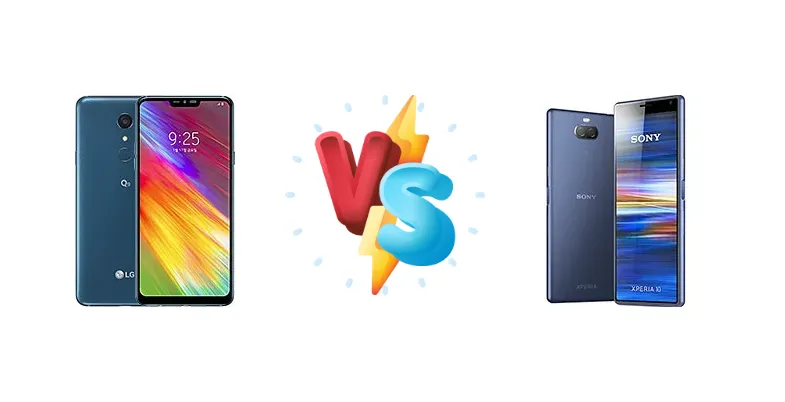
The LG Q9 and Sony Xperia 10 represent different approaches to the mid-range smartphone market. The Q9, leveraging the older but potent Snapdragon 821, aims for performance, while the Xperia 10 prioritizes endurance and a balanced experience with the Snapdragon 630. This comparison dissects their key differences to determine which device best suits your needs.
🏆 Quick Verdict
For users prioritizing raw performance and responsiveness, the LG Q9 is the clear winner. Its Snapdragon 821 chipset delivers significantly more processing power. However, the Sony Xperia 10 offers comparable battery life and a similar charging experience, making it a viable option for those seeking efficiency over speed.
| Network |
|---|
| 2G bands | GSM 850 / 900 / 1800 / 1900 | GSM 850 / 900 / 1800 / 1900 |
| 3G bands | HSDPA 850 / 900 / 1900 / 2100 | HSDPA 850 / 900 / 1900 / 2100 - I3113, I4113, I4193 |
| 4G bands | 1, 3, 5, 7, 8, 28, 38 | 1, 2, 3, 5, 7, 8, 20, 28, 32, 38 - I3113, I4113 |
| Speed | HSPA 42.2/5.76 Mbps, LTE (3CA) Cat11 600/50 Mbps | HSPA 42.2/5.76 Mbps, LTE (2CA) Cat12 600/50 Mbps |
| Technology | GSM / HSPA / LTE | GSM / HSPA / LTE |
| | - | 1, 2, 3, 5, 7, 8, 20, 28, 38, 39, 40, 41 - I4193 |
| Launch |
|---|
| Announced | 2019, January. Released 2019, July | 2019, February 25. Released 2019, February 27 |
| Status | Discontinued | Discontinued |
| Body |
|---|
| Build | - | Glass front (Gorilla Glass 5), plastic back, plastic frame |
| Dimensions | 153.2 x 71.9 x 7.9 mm (6.03 x 2.83 x 0.31 in) | 156 x 68 x 8.4 mm (6.14 x 2.68 x 0.33 in) |
| SIM | · Nano-SIM· Nano-SIM + Nano-SIM | · Nano-SIM· Nano-SIM + Nano-SIM |
| Weight | 159 g (5.61 oz) | 162 g (5.71 oz) |
| | IP68 dust/water resistant (up to 1.5m for 30 mins)
MIL-STD-810G compliant*
*does not guarantee ruggedness or use in extreme conditions | - |
| Display |
|---|
| Protection | - | Corning Gorilla Glass 5 |
| Resolution | 1440 x 3120 pixels, 19.5:9 ratio (~564 ppi density) | 1080 x 2520 pixels, 21:9 ratio (~457 ppi density) |
| Size | 6.1 inches, 91.0 cm2 (~82.6% screen-to-body ratio) | 6.0 inches, 84.1 cm2 (~79.3% screen-to-body ratio) |
| Type | IPS LCD, HDR10 | IPS LCD |
| | Always-on display | - |
| Platform |
|---|
| CPU | Quad-core (2x2.15 GHz Kryo & 2x1.6 GHz Kryo) | Octa-core 2.2 GHz Cortex-A53 |
| Chipset | Qualcomm MSM8996 Snapdragon 821 (14 nm) | Qualcomm SDM630 Snapdragon 630 (14 nm) |
| GPU | Adreno 530 | Adreno 508 |
| OS | Android 8.1 (Oreo) | Android 9.0 (Pie) |
| Memory |
|---|
| Card slot | microSDXC (dedicated slot) | microSDXC (uses shared SIM slot) |
| Internal | 64GB 4GB RAM | 64GB 3GB RAM, 64GB 4GB RAM |
| | UFS 2.0 | eMMC 5.1 |
| Main Camera |
|---|
| Dual | - | 13 MP, f/2.0, 27mm (wide), 1/3.1", 1.12µm, PDAF
Auxiliary lens |
| Features | LED flash, HDR, panorama | LED flash, HDR, panorama |
| Single | 16 MP, f/2.2, 28mm (wide), PDAF | - |
| Video | 4K@30fps | 4K@30fps, 1080p@30fps |
| Selfie camera |
|---|
| Features | HDR | - |
| Single | 8 MP, f/1.9, 26mm (wide) | 8 MP, f/2.0, 24mm (wide), 1/4.0", 1.12µm |
| Video | 1080p@30fps | 1080p@30fps |
| Sound |
|---|
| 3.5mm jack | Yes | Yes |
| 35mm jack | Yes | Yes |
| Loudspeaker | Yes | Yes |
| | 32-bit/192kHz audio | 24-bit/192kHz audio
|
| Comms |
|---|
| Bluetooth | 5.0, A2DP, LE | 5.0, A2DP, LE, aptX HD |
| NFC | Yes | Yes |
| Positioning | GPS, GLONASS, BDS | GPS, GLONASS |
| Radio | FM radio | FM radio |
| USB | USB Type-C 3.1, OTG | USB Type-C 2.0, OTG |
| WLAN | Wi-Fi 802.11 a/b/g/n/ac, dual-band, Wi-Fi Direct, DLNA | Wi-Fi 802.11 a/b/g/n/ac, dual-band, Wi-Fi Direct |
| Features |
|---|
| Sensors | Fingerprint (rear-mounted), accelerometer, gyro, proximity, compass | Fingerprint (side-mounted), accelerometer, proximity, compass |
| Battery |
|---|
| Charging | 18W wired, QC3 | 18W wired, PD, QC3 |
| Type | Li-Ion 3000 mAh, non-removable | Li-Ion 2870 mAh, non-removable |
| Misc |
|---|
| Colors | Carmine Red, New Aurora Black, New Moroccan Blue | Black, Navy, Silver, Pink |
| Models | LM-Q925S, LM-Q925L, LM-Q925K | I3113, I4113, I4193, I3123 |
| Price | About 400 EUR | About 280 EUR |
| Tests |
|---|
| Audio quality | - |
Noise -92.2dB / Crosstalk -97.1dB |
| Battery life | - |
Endurance rating 65h
|
| Camera | - |
Photo / Video |
| Display | - |
Contrast ratio: 1517:1 (nominal) |
| Loudspeaker | - |
-30.2 LUFS (Below average)
|
| Performance | - |
AnTuTu: 89697 (v7), 112198 (v8)
GeekBench: 3985 (v4.4), 990 (v5.1)
GFXBench: 4.3fps (ES 3.1 onscreen) |
LG Q9
- Significantly faster processor (Snapdragon 821)
- Better performance for demanding apps and games
- Potentially smoother user experience
- Likely shorter battery life due to more powerful processor
- Battery capacity is unknown
- Display specs are limited
Sony Xperia 10
- Excellent battery life (65h endurance rating)
- Efficient Snapdragon 630 processor
- Fast charging support (18W, PD, QC3)
- Slower processor compared to the LG Q9
- Less capable for demanding tasks and gaming
- Camera details are limited
Display Comparison
Both the LG Q9 and Sony Xperia 10 share a nominal contrast ratio of 1517:1, suggesting similar visual pop. However, detailed display specs like peak brightness, color gamut coverage, and panel type are missing for the Q9. The Xperia 10’s display, while not exceptional, delivers a consistent viewing experience. Without further data on the Q9’s panel, it’s difficult to assess its color accuracy or outdoor visibility relative to the Xperia 10.
Camera Comparison
Both devices offer photo and video capabilities, but specifics are limited. Without sensor size, aperture, or image processing details, a direct comparison is challenging. The Xperia 10 likely benefits from Sony’s image processing expertise, potentially delivering more refined images. The LG Q9’s camera performance will heavily rely on its sensor and software optimization, which are currently unknown. We can assume both phones will struggle in low-light conditions without OIS or large sensors.
Performance
The core difference lies in the chipsets. The LG Q9’s Snapdragon 821, a quad-core processor with Kryo cores clocked up to 2.15 GHz, represents a significant leap in performance over the Sony Xperia 10’s Snapdragon 630. The 630’s octa-core Cortex-A53 configuration at 2.2 GHz relies on higher core count but lower individual core performance. This translates to faster app loading, smoother multitasking, and better gaming performance on the Q9. The 821’s architecture is simply more efficient at handling complex tasks. While both are built on a 14nm process, the 821’s design is optimized for higher sustained performance.
Battery Life
The Sony Xperia 10 boasts an endurance rating of 65 hours, indicating excellent battery life. The LG Q9’s battery capacity is unknown, but its more powerful processor will likely consume more power. Both devices support 18W wired charging with QC3 and PD, offering similar charging speeds. The Xperia 10’s efficiency advantage could offset any potential capacity difference, resulting in comparable real-world usage times, despite the Q9’s more demanding chipset.
Buying Guide
Buy the LG Q9 if you need a phone capable of handling demanding applications, occasional gaming, and benefit from a smoother overall user experience. Buy the Sony Xperia 10 if you prioritize long battery life, a consistent and reliable experience for everyday tasks, and value a balanced feature set over peak performance.
Frequently Asked Questions
❓ Will the Snapdragon 630 in the Xperia 10 struggle with graphically intensive games?
The Snapdragon 630 is a capable processor for casual gaming, but it will likely struggle with demanding titles at higher settings. Expect to lower graphics settings and potentially experience frame drops in games like PUBG or Fortnite. The LG Q9’s Snapdragon 821 offers a significantly better gaming experience.
❓ How much faster is the LG Q9 in real-world use compared to the Xperia 10?
The Snapdragon 821 in the LG Q9 will feel noticeably faster in everyday tasks like app launching, web browsing, and multitasking. The difference will be most apparent when switching between multiple apps or running resource-intensive applications. The Xperia 10 will still be perfectly usable, but the Q9 offers a smoother and more responsive experience.
❓ Does the Xperia 10's battery life suffer significantly when using data instead of Wi-Fi?
While the Xperia 10 boasts excellent battery life, using mobile data will inevitably reduce it. The Snapdragon 630 is efficient, but constantly maintaining a cellular connection consumes more power than Wi-Fi. Expect a noticeable, but not drastic, decrease in battery life when primarily using mobile data.