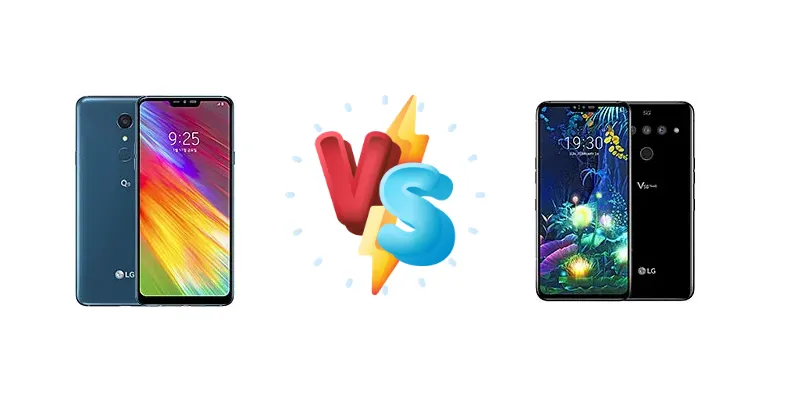
The LG Q9 and V50 ThinQ 5G represent different eras of LG's smartphone strategy. The Q9, released as a more affordable option, utilized a slightly older but still capable Snapdragon 821. The V50, however, was LG’s 5G flagship, boasting the more powerful Snapdragon 855. This comparison dissects the key differences to determine which device holds up better today, considering price drops and evolving user needs.
🏆 Quick Verdict
For most users, the LG V50 ThinQ 5G is the superior choice. While both phones offer a 96-hour endurance rating, the Snapdragon 855’s performance advantage, coupled with 5G connectivity and faster charging (including wireless), justifies the price difference, even on the used market. The Q9 remains a viable option for extremely budget-conscious users.
| Network |
|---|
| 2G bands | GSM 850 / 900 / 1800 / 1900 | GSM 850 / 900 / 1800 / 1900 |
| 3G bands | HSDPA 850 / 900 / 1900 / 2100 | HSDPA 850 / 900 / 1700(AWS) / 1900 / 2100 - USA |
| 4G bands | 1, 3, 5, 7, 8, 28, 38 | 1, 2, 3, 4, 5, 7, 8, 12, 13, 17, 20, 25, 26, 28, 40, 41, 46, 66, 71 - USA |
| 5G bands | - | 41, 260, 261 NSA |
| Speed | HSPA 42.2/5.76 Mbps, LTE (3CA) Cat11 600/50 Mbps | HSPA 42.2/5.76 Mbps, LTE (6CA) Cat18 1200/75 Mbps, 5G (2+ Gbps DL) |
| Technology | GSM / HSPA / LTE | GSM / CDMA / HSPA / EVDO / LTE / 5G |
| | - | CDMA2000 1xEV-DO |
| Launch |
|---|
| Announced | 2019, January. Released 2019, July | 2019, February 24. Released 2019, April 19 |
| Status | Discontinued | Discontinued |
| Body |
|---|
| Build | - | Glass front (Gorilla Glass 5), glass back (Gorilla Glass 6), aluminum frame |
| Dimensions | 153.2 x 71.9 x 7.9 mm (6.03 x 2.83 x 0.31 in) | 159.2 x 76.1 x 8.3 mm (6.27 x 3.00 x 0.33 in) |
| SIM | · Nano-SIM· Nano-SIM + Nano-SIM | · Nano-SIM· Nano-SIM + Nano-SIM |
| Weight | 159 g (5.61 oz) | 183 g (6.46 oz) |
| | IP68 dust/water resistant (up to 1.5m for 30 mins)
MIL-STD-810G compliant*
*does not guarantee ruggedness or use in extreme conditions | IP68 dust/water resistant (up to 1.5m for 30 min)
MIL-STD-810G compliant*
*does not guarantee ruggedness or use in extreme conditions |
| Display |
|---|
| Protection | - | Corning Gorilla Glass 5 |
| Resolution | 1440 x 3120 pixels, 19.5:9 ratio (~564 ppi density) | 1440 x 3120 pixels, 19.5:9 ratio (~538 ppi density) |
| Size | 6.1 inches, 91.0 cm2 (~82.6% screen-to-body ratio) | 6.4 inches, 100.2 cm2 (~82.7% screen-to-body ratio) |
| Type | IPS LCD, HDR10 | P-OLED, HDR10 |
| | Always-on display | Always-on display |
| Platform |
|---|
| CPU | Quad-core (2x2.15 GHz Kryo & 2x1.6 GHz Kryo) | Octa-core (1x2.84 GHz Kryo 485 & 3x2.42 GHz Kryo 485 & 4x1.78 GHz Kryo 485) |
| Chipset | Qualcomm MSM8996 Snapdragon 821 (14 nm) | Qualcomm SM8150 Snapdragon 855 (7 nm) |
| GPU | Adreno 530 | Adreno 640 |
| OS | Android 8.1 (Oreo) | Android 9.0 (Pie), upgradable to Android 11 |
| Memory |
|---|
| Card slot | microSDXC (dedicated slot) | microSDXC (dedicated slot) |
| Internal | 64GB 4GB RAM | 128GB 6GB RAM |
| | UFS 2.0 | UFS 2.1 |
| Main Camera |
|---|
| Features | LED flash, HDR, panorama | LED flash, HDR, panorama |
| Single | 16 MP, f/2.2, 28mm (wide), PDAF | - |
| Triple | - | 12 MP, 27mm (wide), f/1.5, 1/2.55", 1.4µm, dual pixel PDAF, 3-axis OIS
12 MP, 52mm (telephoto), f/2.4, 1/3.4", 1.0µm, 2x optical zoom, PDAF, OIS
16 MP, 16mm (ultrawide), f/1.9, 1/3.1", 1.0µm, no AF |
| Video | 4K@30fps | 4K@30/60fps, 1080p@30/60/240fps, 24-bit/192kHz stereo sound rec., HDR10 video, gyro-EIS |
| Selfie camera |
|---|
| Dual | - | 8 MP, f/1.9, 26mm (wide), 1/4.0", 1.12µm
5 MP, 21mm (wide), f/2.2, 1/5.0", 1.12µm |
| Features | HDR | HDR |
| Single | 8 MP, f/1.9, 26mm (wide) | - |
| Video | 1080p@30fps | 1080p@60fps |
| Sound |
|---|
| 3.5mm jack | Yes | Yes |
| 35mm jack | Yes | Yes |
| Loudspeaker | Yes | Yes, with stereo speakers |
| | 32-bit/192kHz audio | 32-bit/192kHz audio
24-bit/192kHz audio recording
Tuned with Meridian Audio |
| Comms |
|---|
| Bluetooth | 5.0, A2DP, LE | 5.0, A2DP, LE, aptX HD |
| NFC | Yes | Yes |
| Positioning | GPS, GLONASS, BDS | GPS, GLONASS, GALILEO |
| Radio | FM radio | FM radio |
| USB | USB Type-C 3.1, OTG | USB Type-C 3.1 |
| WLAN | Wi-Fi 802.11 a/b/g/n/ac, dual-band, Wi-Fi Direct, DLNA | Wi-Fi 802.11 a/b/g/n/ac, dual-band, Wi-Fi Direct, DLNA |
| Features |
|---|
| Sensors | Fingerprint (rear-mounted), accelerometer, gyro, proximity, compass | Fingerprint (rear-mounted), accelerometer, gyro, proximity, compass, barometer |
| Battery |
|---|
| Charging | 18W wired, QC3 | 18W wired, PD2.0, QC3, 50% in 36 min
10W wireless (Qi) |
| Type | Li-Ion 3000 mAh, non-removable | Li-Po 4000 mAh, non-removable |
| Misc |
|---|
| Colors | Carmine Red, New Aurora Black, New Moroccan Blue | New Aurora Black |
| Models | LM-Q925S, LM-Q925L, LM-Q925K | LM-V500, LM-V500N, LM-V500EM, LM-V500XM, LM-V450PM, LM-V450 |
| Price | About 400 EUR | About 550 EUR |
| Tests |
|---|
| Audio quality | - |
Noise -92.5dB / Crosstalk -92.6dB |
| Battery life | - |
Endurance rating 96h
|
| Camera | - |
Photo / Video |
| Display | - |
Contrast ratio: 194000:1 (nominal) |
| Loudspeaker | - |
-25.2 LUFS (Very good)
|
| Performance | - |
AnTuTu: 343758 (v7), 421934 (v8)
GeekBench: 10928 (v4.4), 2672 (v5.1)
GFXBench: 22fps (ES 3.1 onscreen) |
LG Q9
- More affordable price point
- Compact and lightweight design
- Adequate performance for basic tasks
- Outdated Snapdragon 821 processor
- Slower charging speeds
- Less vibrant display
LG V50 ThinQ 5G
- Powerful Snapdragon 855 processor
- 5G connectivity
- Faster charging with wireless support
- Higher price (even used)
- Larger and heavier design
- May require a 5G SIM/plan to fully utilize
Display Comparison
The LG V50 ThinQ 5G boasts a brighter display, measured at 533 nits, compared to the Q9’s unspecified brightness. More importantly, the V50’s contrast ratio of 194000:1 indicates a superior panel capable of deeper blacks and more vibrant colors. While both likely utilize OLED technology (typical for LG flagships), the V50’s display offers a more visually immersive experience. The Q9’s display, while adequate, will appear less vibrant in direct sunlight.
Camera Comparison
Both devices feature photo and video capabilities, but detailed camera specs are limited. Given the V50’s flagship status, it likely incorporates a more advanced image signal processor (ISP) within the Snapdragon 855, resulting in better image quality, particularly in low-light conditions. While both likely have similar primary camera resolutions, the V50’s processing power allows for more sophisticated computational photography features. The Q9’s camera will be serviceable, but the V50 will deliver more consistently impressive results.
Performance
The core difference lies in the chipsets. The LG V50’s Snapdragon 855, built on a 7nm process, is a substantial upgrade over the Q9’s Snapdragon 821 (14nm). The 855 features an octa-core CPU configuration (1x2.84 GHz Kryo 485, 3x2.42 GHz Kryo 485, 4x1.78 GHz Kryo 485) versus the Q9’s quad-core (2x2.15 GHz Kryo & 2x1.6 GHz Kryo). This translates to significantly faster app loading times, smoother multitasking, and improved gaming performance on the V50. The 7nm process also contributes to better thermal efficiency, reducing throttling during sustained workloads.
Battery Life
Interestingly, both phones share an endurance rating of 96 hours. However, this doesn’t tell the whole story. The V50 benefits from faster charging speeds – 18W wired with PD2.0 and QC3, achieving 50% charge in 36 minutes, plus 10W wireless charging. The Q9 is limited to 18W wired with QC3. While the battery capacity isn’t specified for either, the Snapdragon 855’s improved efficiency likely contributes to comparable real-world battery life despite potentially having a smaller battery cell.
Buying Guide
Buy the LG Q9 if you prioritize extreme affordability and a compact form factor for basic smartphone tasks like calling, texting, and light social media. You’re willing to compromise on performance and future-proofing. Buy the LG V50 ThinQ 5G if you want a significantly faster processor for gaming and multitasking, 5G connectivity for faster data speeds, and the convenience of wireless charging. You value a more premium experience and are willing to spend a bit more.
Frequently Asked Questions
❓ Is the LG V50 ThinQ 5G still worth buying in 2024, considering 5G rollout?
Yes, even if 5G isn't fully available in your area, the Snapdragon 855 provides a substantial performance boost over the Q9, making it a better long-term investment. The V50 will also be future-proofed for when 5G becomes more widespread.
❓ Does the Snapdragon 821 in the LG Q9 struggle with modern apps and games?
The Snapdragon 821 is showing its age. While it can handle basic apps and light gaming, you'll likely experience slowdowns and lag with more demanding titles or multitasking. It's best suited for users with minimal smartphone needs.
❓ Can I use fast charging with any USB-C charger on the LG V50 ThinQ 5G?
The LG V50 supports Quick Charge 3.0 and Power Delivery 2.0. While it will charge with any USB-C charger, you'll only achieve the fastest 18W charging speeds with a charger that specifically supports these protocols.
❓ Is the lack of software updates a concern for either of these phones?
Yes, both the Q9 and V50 are no longer receiving official software updates from LG. This means you'll miss out on the latest security patches and features. Consider this a risk when purchasing either device.