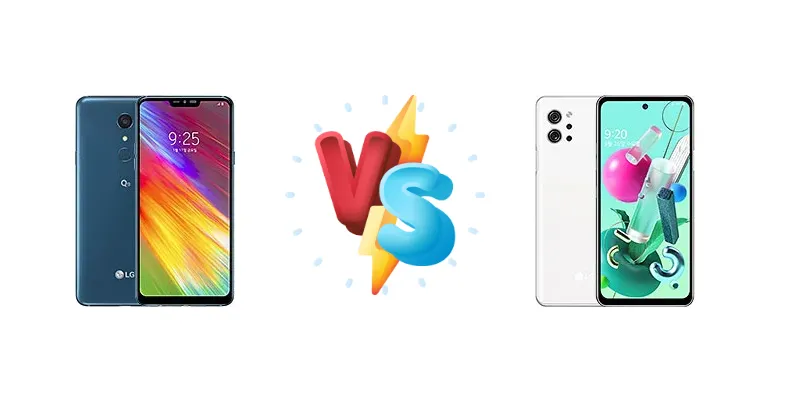
The LG Q9 and LG Q92 5G represent different approaches to the mid-range smartphone market. The Q9, released in 2016, leverages the then-flagship Snapdragon 821, while the Q92 5G, a 2020 release, opts for the more modern, and power-efficient Snapdragon 765G with integrated 5G connectivity. This comparison dissects the trade-offs between raw processing power and modern features, helping you determine which device best suits your needs.
🏆 Quick Verdict
For the average user in 2024, the LG Q92 5G is the better choice. While the Q9 boasts a more powerful processor on paper, the Q92 5G’s newer 7nm process, 5G capabilities, and improved efficiency outweigh the Q9’s raw speed, especially considering battery life and long-term usability.
| Network |
|---|
| 2G bands | GSM 850 / 900 / 1800 / 1900 | GSM 850 / 900 / 1800 / 1900 |
| 3G bands | HSDPA 850 / 900 / 1900 / 2100 | HSDPA 850 / 900 / 1900 / 2100 |
| 4G bands | 1, 3, 5, 7, 8, 28, 38 | LTE |
| 5G bands | - | SA/NSA |
| Speed | HSPA 42.2/5.76 Mbps, LTE (3CA) Cat11 600/50 Mbps | HSPA, LTE, 5G |
| Technology | GSM / HSPA / LTE | GSM / HSPA / LTE / 5G |
| Launch |
|---|
| Announced | 2019, January. Released 2019, July | 2020, August 24. Released 2020, August 26 |
| Status | Discontinued | Discontinued |
| Body |
|---|
| Dimensions | 153.2 x 71.9 x 7.9 mm (6.03 x 2.83 x 0.31 in) | 166.5 x 77.3 x 8.5 mm (6.56 x 3.04 x 0.33 in) |
| SIM | · Nano-SIM· Nano-SIM + Nano-SIM | Nano-SIM + Nano-SIM |
| Weight | 159 g (5.61 oz) | 193 g (6.81 oz) |
| | IP68 dust/water resistant (up to 1.5m for 30 mins)
MIL-STD-810G compliant*
*does not guarantee ruggedness or use in extreme conditions | IP68 dust/water resistant (up to 1.5m for 30 mins)
MIL-STD-810G compliant*
*does not guarantee ruggedness or use in extreme conditions |
| Display |
|---|
| Resolution | 1440 x 3120 pixels, 19.5:9 ratio (~564 ppi density) | 1080 x 2400 pixels, 20:9 ratio (~395 ppi density) |
| Size | 6.1 inches, 91.0 cm2 (~82.6% screen-to-body ratio) | 6.67 inches, 107.4 cm2 (~83.5% screen-to-body ratio) |
| Type | IPS LCD, HDR10 | IPS LCD |
| | Always-on display | - |
| Platform |
|---|
| CPU | Quad-core (2x2.15 GHz Kryo & 2x1.6 GHz Kryo) | Octa-core (1x2.4 GHz Kryo 475 Prime & 1x2.2 GHz Kryo 475 Gold & 6x1.8 GHz Kryo 475 Silver) |
| Chipset | Qualcomm MSM8996 Snapdragon 821 (14 nm) | Qualcomm SM7250 Snapdragon 765G 5G (7 nm) |
| GPU | Adreno 530 | Adreno 620 |
| OS | Android 8.1 (Oreo) | Android 10 |
| Memory |
|---|
| Card slot | microSDXC (dedicated slot) | microSDXC |
| Internal | 64GB 4GB RAM | 128GB 6GB RAM |
| | UFS 2.0 | - |
| Main Camera |
|---|
| Features | LED flash, HDR, panorama | LED flash, panorama, HDR |
| Quad | - | 48 MP, f/1.8, 26mm (wide), 1/2.0", 0.8µm, PDAF
8 MP, f/2.2, 120˚, 15mm (ultrawide), 1/4.0", 1.12µm
2 MP (macro)
Auxiliary lens |
| Single | 16 MP, f/2.2, 28mm (wide), PDAF | - |
| Video | 4K@30fps | 4K@30fps, 1080p@30fps |
| Selfie camera |
|---|
| Features | HDR | HDR |
| Single | 8 MP, f/1.9, 26mm (wide) | 32 MP, f/1.9, 26mm (wide), 1/2.8", 0.8µm |
| Video | 1080p@30fps | 1080p@30fps |
| Sound |
|---|
| 3.5mm jack | Yes | Yes |
| 35mm jack | Yes | Yes |
| Loudspeaker | Yes | Yes, with stereo speakers |
| | 32-bit/192kHz audio | - |
| Comms |
|---|
| Bluetooth | 5.0, A2DP, LE | 5.0, A2DP, LE |
| NFC | Yes | Yes |
| Positioning | GPS, GLONASS, BDS | GPS, GLONASS, GALILEO, BDS |
| Radio | FM radio | No |
| USB | USB Type-C 3.1, OTG | USB Type-C 2.0 |
| WLAN | Wi-Fi 802.11 a/b/g/n/ac, dual-band, Wi-Fi Direct, DLNA | Wi-Fi 802.11 a/b/g/n/ac, dual-band, Wi-Fi Direct, DLNA |
| Features |
|---|
| Sensors | Fingerprint (rear-mounted), accelerometer, gyro, proximity, compass | Fingerprint (side-mounted), accelerometer, gyro, proximity, compass |
| Battery |
|---|
| Charging | 18W wired, QC3 | 15W wired |
| Type | Li-Ion 3000 mAh, non-removable | Li-Po 4000 mAh |
| Misc |
|---|
| Colors | Carmine Red, New Aurora Black, New Moroccan Blue | White, Dark Blue, Red |
| Models | LM-Q925S, LM-Q925L, LM-Q925K | LM-Q920N |
| Price | About 400 EUR | About 360 EUR |
LG Q9
- Higher peak CPU performance for short bursts.
- Quick Charge 3.0 support (18W).
- Potentially lower initial purchase price (due to age).
- Less power-efficient chipset (14nm).
- No 5G connectivity.
- Older architecture, limited software support.
LG Q92 5G
- Integrated 5G connectivity.
- More power-efficient chipset (7nm).
- Better sustained performance due to octa-core CPU.
- Likely improved camera image processing.
- Slower charging speed (15W).
- Potentially higher initial purchase price.
Display Comparison
Unfortunately, detailed display specs are unavailable. However, given the release timelines, we can infer differences. The Q9 likely features an LCD panel common for its era, while the Q92 5G may have benefitted from advancements in LCD technology, potentially offering improved color accuracy and viewing angles. The Q92 5G’s later release date suggests a higher probability of a more refined display experience, though neither is expected to compete with modern OLED panels.
Camera Comparison
Without detailed camera specifications, a direct comparison is difficult. However, the Q92 5G’s later release likely benefited from advancements in image processing algorithms. While the Q9 may have a comparable megapixel count, the 765G’s ISP (Image Signal Processor) is more advanced, potentially resulting in better dynamic range, noise reduction, and overall image quality. The Q92 5G’s 5G connectivity also enables faster uploads of photos and videos.
Performance
The core difference lies in the chipsets. The LG Q9’s Snapdragon 821, built on a 14nm process, features a quad-core CPU configuration (2x2.15 GHz Kryo & 2x1.6 GHz Kryo). This architecture prioritizes peak performance. Conversely, the LG Q92 5G’s Snapdragon 765G, fabricated on a more efficient 7nm node, utilizes an octa-core setup (1x2.4 GHz Kryo 475 Prime & 1x2.2 GHz Kryo 475 Gold & 6x1.8 GHz Kryo 475 Silver). While the 821 has higher single-core clock speeds, the 765G’s increased core count and smaller process node translate to better sustained performance and significantly improved power efficiency. The 765G also integrates a 5G modem, a feature absent in the Q9. This means the Q92 5G will handle multitasking and graphically intensive tasks more consistently over extended periods, and offers access to next-generation cellular networks.
Battery Life
The LG Q9 supports 18W Quick Charge 3.0, while the Q92 5G is limited to 15W wired charging. However, the Snapdragon 765G’s 7nm process is significantly more power-efficient than the 821’s 14nm process. This means the Q92 5G will likely offer longer battery life despite the slightly slower charging speed. The Q9’s higher power draw will necessitate more frequent charging, even with the faster charging standard.
Buying Guide
Buy the LG Q9 if you prioritize maximum raw processing power for demanding tasks and don't require 5G connectivity. It's a good option for users who want to squeeze every ounce of performance out of older, but still capable, hardware. Buy the LG Q92 5G if you value 5G connectivity, longer battery life, and a more modern chipset with better thermal management, even if it means sacrificing some peak CPU performance.
Frequently Asked Questions
❓ Will the LG Q9 struggle with modern apps and games?
Yes, the Snapdragon 821, while powerful for its time, will likely exhibit performance limitations with newer, more demanding applications and games. The 7nm Snapdragon 765G in the Q92 5G is better equipped to handle these workloads due to its improved efficiency and architecture.
❓ How much of a real-world difference will the 5G connectivity of the Q92 5G make?
The benefit of 5G depends on your location and carrier coverage. However, if you live in an area with robust 5G infrastructure, the Q92 5G will offer significantly faster download and upload speeds, lower latency, and a more responsive online experience compared to the Q9’s 4G LTE capabilities.
❓ Is the difference in charging speed (18W vs 15W) noticeable in everyday use?
While 18W is faster, the Q92 5G’s superior battery efficiency means you’ll likely be charging it less frequently. The difference in charging time for a full charge won’t be dramatic, and the longer battery life will likely be more impactful for most users.