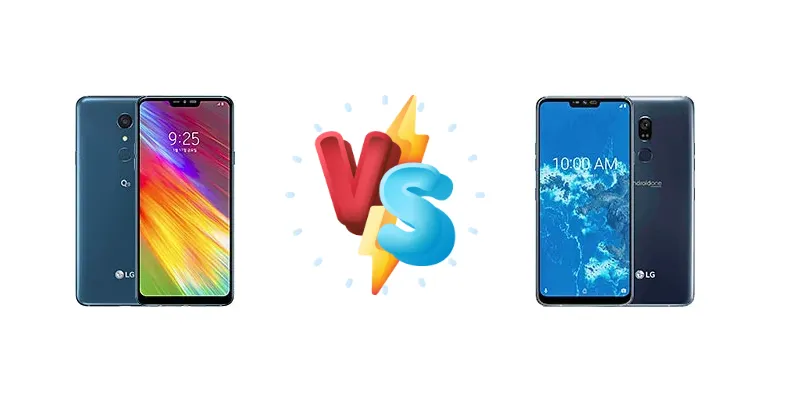
The LG Q9 and G7 One represent interesting points in LG’s smartphone history. The Q9, with its Snapdragon 821, aimed for a premium experience at a slightly lower price point. The G7 One, leveraging the Snapdragon 835, was part of the Android One program, promising faster updates and a cleaner software experience. Today, both represent budget-friendly options, but significant hardware differences dictate which is the better choice.
🏆 Quick Verdict
For most users in 2024, the LG G7 One is the superior choice. While both phones offer 18W Quick Charge 3.0, the Snapdragon 835’s more efficient 10nm process and octa-core CPU provide a noticeable performance boost, especially in multi-tasking and demanding applications. The G7 One’s inclusion of wireless charging (in the USA variant) further sweetens the deal.
| Network |
|---|
| 2G bands | GSM 850 / 900 / 1800 / 1900 | GSM 850 / 900 / 1800 / 1900 |
| 3G bands | HSDPA 850 / 900 / 1900 / 2100 | HSDPA 850 / 900 / 1900 / 2100 |
| 4G bands | 1, 3, 5, 7, 8, 28, 38 | 1, 3, 5, 7, 8, 20 |
| Speed | HSPA 42.2/5.76 Mbps, LTE (3CA) Cat11 600/50 Mbps | HSPA, LTE |
| Technology | GSM / HSPA / LTE | GSM / HSPA / LTE |
| Launch |
|---|
| Announced | 2019, January. Released 2019, July | 2018, August. Released 2018, October |
| Status | Discontinued | Discontinued |
| Body |
|---|
| Dimensions | 153.2 x 71.9 x 7.9 mm (6.03 x 2.83 x 0.31 in) | 153.2 x 71.9 x 7.9 mm (6.03 x 2.83 x 0.31 in) |
| SIM | · Nano-SIM· Nano-SIM + Nano-SIM | · Nano-SIM· Nano-SIM + Nano-SIM |
| Weight | 159 g (5.61 oz) | 156 g (5.50 oz) |
| | IP68 dust/water resistant (up to 1.5m for 30 mins)
MIL-STD-810G compliant*
*does not guarantee ruggedness or use in extreme conditions | IP68 dust/water resistant (up to 1.5m for 30 mins)
MIL-STD-810G compliant*
*does not guarantee ruggedness or use in extreme conditions |
| Display |
|---|
| Resolution | 1440 x 3120 pixels, 19.5:9 ratio (~564 ppi density) | 1440 x 3120 pixels, 19.5:9 ratio (~563 ppi density) |
| Size | 6.1 inches, 91.0 cm2 (~82.6% screen-to-body ratio) | 6.1 inches, 91.3 cm2 (~82.9% screen-to-body ratio) |
| Type | IPS LCD, HDR10 | IPS LCD, HDR10 |
| | Always-on display | Always-on display |
| Platform |
|---|
| CPU | Quad-core (2x2.15 GHz Kryo & 2x1.6 GHz Kryo) | Octa-core (4x2.45 GHz Kryo & 4x1.9 GHz Kryo) |
| Chipset | Qualcomm MSM8996 Snapdragon 821 (14 nm) | Qualcomm MSM8998 Snapdragon 835 (10 nm) |
| GPU | Adreno 530 | Adreno 540 |
| OS | Android 8.1 (Oreo) | Android 8.1 (Oreo), upgradable to Android 10, Android One |
| Memory |
|---|
| Card slot | microSDXC (dedicated slot) | microSDXC (uses shared SIM slot) |
| Internal | 64GB 4GB RAM | 32GB 4GB RAM, 64GB 4GB RAM |
| | UFS 2.0 | - |
| Main Camera |
|---|
| Features | LED flash, HDR, panorama | Laser AF, LED flash, HDR, panorama |
| Single | 16 MP, f/2.2, 28mm (wide), PDAF | 16 MP, f/1.6, 31mm (standard), 1/3.1", 1.0µm, PDAF, OIS |
| Video | 4K@30fps | 4K@30fps |
| Selfie camera |
|---|
| Features | HDR | - |
| Single | 8 MP, f/1.9, 26mm (wide) | 8 MP, f/1.9, 26mm (wide) |
| Video | 1080p@30fps | 1080p@30fps |
| Sound |
|---|
| 3.5mm jack | Yes | Yes |
| 35mm jack | Yes | Yes |
| Loudspeaker | Yes | Yes |
| | 32-bit/192kHz audio | 32-bit/192kHz audio |
| Comms |
|---|
| Bluetooth | 5.0, A2DP, LE | 5.0, A2DP, LE, aptX HD |
| NFC | Yes | Yes |
| Positioning | GPS, GLONASS, BDS | GPS, GLONASS, BDS |
| Radio | FM radio | FM radio |
| USB | USB Type-C 3.1, OTG | USB Type-C 3.1, OTG |
| WLAN | Wi-Fi 802.11 a/b/g/n/ac, dual-band, Wi-Fi Direct, DLNA | Wi-Fi 802.11 a/b/g/n/ac, dual-band, Wi-Fi Direct, DLNA |
| Features |
|---|
| Sensors | Fingerprint (rear-mounted), accelerometer, gyro, proximity, compass | Fingerprint (rear-mounted), accelerometer, gyro, proximity, compass, barometer |
| Battery |
|---|
| Charging | 18W wired, QC3 | 18W wired, QC3
Wireless (USA) |
| Type | Li-Ion 3000 mAh, non-removable | Li-Po 3000 mAh, non-removable |
| Misc |
|---|
| Colors | Carmine Red, New Aurora Black, New Moroccan Blue | New Aurora Black, New Moroccan Blue |
| Models | LM-Q925S, LM-Q925L, LM-Q925K | LMQ910UM, LM-Q910, LM-X510K, LM-Q927L, LM-X510S |
| Price | About 400 EUR | About 350 EUR |
LG Q9
- Potentially lower price point
- Flagship-level Snapdragon 821 processor
- Quick Charge 3.0 support
- Less efficient 14nm Snapdragon 821
- No wireless charging
- Older software and potentially fewer updates
LG G7 One
- More efficient 10nm Snapdragon 835
- Octa-core CPU for better multitasking
- Wireless charging (USA variant)
- Android One program for faster updates
- Potentially higher price
- May not offer a dramatically different camera experience
Display Comparison
Neither LG provided display specs in the context data. However, given their market positioning, both likely featured IPS LCD panels. The Q9, being slightly older, may have had narrower viewing angles and lower peak brightness. The G7 One, benefiting from later display technology, likely offered improved color accuracy and potentially a slightly higher peak brightness, though neither are expected to compete with modern OLED panels. Bezels were likely comparable, reflecting the design trends of their respective release years.
Camera Comparison
Without specific camera sensor details, a direct comparison is difficult. However, both phones likely featured similar camera setups targeting the mid-range market. The G7 One, being a slightly newer model, may have benefited from improved image processing algorithms. The Snapdragon 835’s ISP (Image Signal Processor) is also more capable than the 821’s, potentially resulting in better dynamic range and noise reduction. It’s reasonable to assume both phones would have struggled in low-light conditions compared to modern smartphone cameras.
Performance
The core difference lies in the chipsets. The LG G7 One’s Snapdragon 835, built on a 10nm process, is a clear upgrade over the Q9’s Snapdragon 821 (14nm). The 835’s octa-core CPU (4x2.45 GHz Kryo & 4x1.9 GHz Kryo) offers superior multi-core performance compared to the Q9’s quad-core configuration (2x2.15 GHz Kryo & 2x1.6 GHz Kryo). This translates to faster app loading times, smoother multitasking, and improved performance in graphically intensive games. The 10nm process also contributes to better thermal efficiency, reducing the likelihood of throttling under sustained load. While both utilize Qualcomm’s Kryo cores, the 835’s architecture is more advanced.
Battery Life
Battery capacity isn’t specified, but the Snapdragon 835’s 10nm process gives the G7 One a significant advantage in power efficiency. While both support 18W Quick Charge 3.0, the G7 One will likely achieve a full charge faster and offer longer battery life during typical usage. The G7 One’s inclusion of wireless charging (USA variant) is a major convenience feature absent on the Q9, further extending its usability for users who prefer cable-free charging.
Buying Guide
Buy the LG Q9 if you prioritize finding the absolute lowest price for a phone with a flagship-level processor, and are comfortable with potentially shorter battery life and a less refined software experience. Buy the LG G7 One if you value performance, software updates (as part of the Android One program), and the convenience of wireless charging, even if it means spending a bit more upfront.
Frequently Asked Questions
❓ Will the LG G7 One’s Snapdragon 835 handle demanding games like PUBG or Call of Duty Mobile?
Yes, the Snapdragon 835 is capable of running most mobile games at medium to high settings. While it won’t match the performance of newer chipsets, it provides a smooth and enjoyable gaming experience, especially considering the phone’s price point. Expect playable frame rates, though you may need to adjust graphics settings for optimal performance.
❓ Does the Android One program on the LG G7 One guarantee long-term software support?
The Android One program promised faster and more consistent updates. However, LG has since discontinued support for these devices. While the G7 One likely received updates for a longer period than the Q9, it is unlikely to receive any further major Android version updates at this point. Security patches may also be discontinued.
❓ Is the difference in performance between the Snapdragon 821 and 835 noticeable in everyday tasks?
Yes, the difference is noticeable, particularly when multitasking or opening multiple apps. The Snapdragon 835’s octa-core CPU and more efficient architecture result in snappier performance and reduced lag. While both phones are capable of handling basic tasks, the G7 One will feel more responsive and fluid in demanding scenarios.