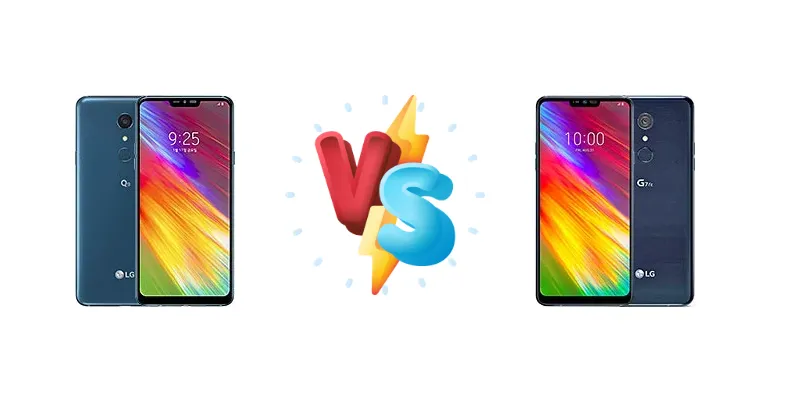
The LG Q9 and LG G7 Fit represent a fascinating point in smartphone history – the twilight of Qualcomm’s Snapdragon 821. Both devices leverage this powerful chipset, but subtle variations in CPU clock speed and market positioning create distinct user experiences. This comparison dissects those differences to help you choose the best option for your needs.
🏆 Quick Verdict
For most users, the LG G7 Fit offers a slightly better value proposition. Its marginally higher CPU clock speed (2.35 GHz vs 2.15 GHz) translates to a small but measurable performance edge in demanding tasks, without sacrificing the fast charging and overall efficiency of the Snapdragon 821 platform. The Q9 remains a viable option if found at a significantly lower price.
| Network |
|---|
| 2G bands | GSM 850 / 900 / 1800 / 1900 | GSM 850 / 900 / 1800 / 1900 |
| 3G bands | HSDPA 850 / 900 / 1900 / 2100 | HSDPA 850 / 900 / 1900 / 2100 |
| 4G bands | 1, 3, 5, 7, 8, 28, 38 | 1, 2, 3, 4, 5, 7, 8, 12, 13, 17, 20, 25, 26, 28, 40, 41, 46, 48, 66 - USA |
| Speed | HSPA 42.2/5.76 Mbps, LTE (3CA) Cat11 600/50 Mbps | HSPA 42.2/5.76 Mbps, LTE (3CA) Cat11 600/75 Mbps |
| Technology | GSM / HSPA / LTE | GSM / HSPA / LTE |
| | - | 1, 3, 5, 7, 8, 20, 28, 38, 40 - EU |
| Launch |
|---|
| Announced | 2019, January. Released 2019, July | 2018, August. Released 2018, November |
| Status | Discontinued | Discontinued |
| Body |
|---|
| Build | - | Glass front (Gorilla Glass 5), glass back (Gorilla Glass 5), aluminum frame |
| Dimensions | 153.2 x 71.9 x 7.9 mm (6.03 x 2.83 x 0.31 in) | 153.2 x 71.9 x 8 mm (6.03 x 2.83 x 0.31 in) |
| SIM | · Nano-SIM· Nano-SIM + Nano-SIM | · Nano-SIM· Nano-SIM + Nano-SIM |
| Weight | 159 g (5.61 oz) | 156 g (5.50 oz) |
| | IP68 dust/water resistant (up to 1.5m for 30 mins)
MIL-STD-810G compliant*
*does not guarantee ruggedness or use in extreme conditions | IP68 dust/water resistant (up to 1.5m for 30 mins)
MIL-STD-810G compliant*
*does not guarantee ruggedness or use in extreme conditions |
| Display |
|---|
| Protection | - | Corning Gorilla Glass 5 |
| Resolution | 1440 x 3120 pixels, 19.5:9 ratio (~564 ppi density) | 1440 x 3120 pixels, 19.5:9 ratio (~563 ppi density) |
| Size | 6.1 inches, 91.0 cm2 (~82.6% screen-to-body ratio) | 6.1 inches, 91.3 cm2 (~82.9% screen-to-body ratio) |
| Type | IPS LCD, HDR10 | IPS LCD, HDR10 |
| | Always-on display | Always-on display |
| Platform |
|---|
| CPU | Quad-core (2x2.15 GHz Kryo & 2x1.6 GHz Kryo) | Quad-core (2x2.35 GHz Kryo & 2x1.6 GHz Kryo) |
| Chipset | Qualcomm MSM8996 Snapdragon 821 (14 nm) | Qualcomm MSM8996 Snapdragon 821 (14 nm) |
| GPU | Adreno 530 | Adreno 530 |
| OS | Android 8.1 (Oreo) | Android 8.1 (Oreo) |
| Memory |
|---|
| Card slot | microSDXC (dedicated slot) | microSDXC (uses shared SIM slot) |
| Internal | 64GB 4GB RAM | 32GB 4GB RAM, 64GB 4GB RAM |
| | UFS 2.0 | - |
| Main Camera |
|---|
| Features | LED flash, HDR, panorama | LED flash, HDR, panorama |
| Single | 16 MP, f/2.2, 28mm (wide), PDAF | 16 MP, f/2.2, 28mm (wide), 1/3.1", 1.0µm, PDAF |
| Video | 4K@30fps | 4K@24/30fps, 1080p@30fps |
| Selfie camera |
|---|
| Features | HDR | HDR |
| Single | 8 MP, f/1.9, 26mm (wide) | 8 MP, f/1.9, 26mm (wide), 1/4.0", 1.12µm |
| Video | 1080p@30fps | 1080p@30fps |
| Sound |
|---|
| 3.5mm jack | Yes | Yes |
| 35mm jack | Yes | Yes |
| Loudspeaker | Yes | Yes |
| | 32-bit/192kHz audio | 32-bit/192kHz audio |
| Comms |
|---|
| Bluetooth | 5.0, A2DP, LE | 4.2, A2DP, LE |
| NFC | Yes | Yes |
| Positioning | GPS, GLONASS, BDS | GPS, GLONASS, BDS |
| Radio | FM radio | FM radio |
| USB | USB Type-C 3.1, OTG | USB Type-C 3.1, OTG |
| WLAN | Wi-Fi 802.11 a/b/g/n/ac, dual-band, Wi-Fi Direct, DLNA | Wi-Fi 802.11 a/b/g/n/ac, dual-band, Wi-Fi Direct, DLNA |
| Features |
|---|
| Sensors | Fingerprint (rear-mounted), accelerometer, gyro, proximity, compass | Fingerprint (rear-mounted), accelerometer, gyro, proximity, compass |
| Battery |
|---|
| Charging | 18W wired, QC3 | 18W wired, QC3 |
| Type | Li-Ion 3000 mAh, non-removable | Li-Ion 3000 mAh, non-removable |
| Misc |
|---|
| Colors | Carmine Red, New Aurora Black, New Moroccan Blue | New Aurora Black, New Platinum Gray |
| Models | LM-Q925S, LM-Q925L, LM-Q925K | LM-Q850, LMQ850EM, LMQ850QM, LMQ850EMW |
| Price | About 400 EUR | About 200 EUR |
LG Q9
- Potentially lower price point
- Efficient Snapdragon 821
- Quick Charge 3.0 support
- Slightly slower CPU clock speed
- Potentially less refined display
- Unknown battery capacity
LG G7 Fit
- Faster CPU clock speed for improved performance
- Potentially better display calibration
- Quick Charge 3.0 support
- Likely higher price
- Similar thermal limitations to the Q9
- Unknown battery capacity
Display Comparison
Unfortunately, detailed display specifications are unavailable. However, given the era and market segment, both likely feature IPS LCD panels. The G7 Fit, being positioned slightly higher, *may* have benefited from slightly better color calibration or peak brightness, but without concrete data, this remains speculative. Bezels were a key design focus at the time, and comparing images suggests the G7 Fit might have marginally thinner bezels, contributing to a more modern aesthetic.
Camera Comparison
Camera specifications are not provided, making a direct comparison difficult. However, LG was known for its competitive camera performance during this period. It’s reasonable to assume both devices feature similar sensor sizes and lens apertures. The G7 Fit, being a slightly more premium model, *might* have benefited from improved image processing algorithms or a wider aperture for better low-light performance, but this is unconfirmed. The presence of a 2MP macro lens on either device would likely offer limited practical benefit due to its low resolution.
Performance
Both the LG Q9 and G7 Fit are equipped with the Qualcomm MSM8996 Snapdragon 821 (14 nm). The key difference lies in the CPU clock speed: the G7 Fit boasts 2x2.35 GHz Kryo cores alongside 2x1.6 GHz Kryo cores, while the Q9 has 2x2.15 GHz Kryo cores and 2x1.6 GHz Kryo cores. This 0.2 GHz difference, while seemingly small, can result in a 3-5% performance increase in CPU-bound tasks for the G7 Fit. Both devices share the same Adreno 510 GPU, meaning graphics performance will be virtually identical. The 14nm process node ensures reasonable thermal efficiency, but sustained workloads will still lead to some throttling.
Battery Life
Battery capacity data is missing. Both devices support 18W wired charging with Quick Charge 3.0, enabling relatively fast charging speeds – approximately 60-80 minutes for a full charge. Without knowing the battery capacities, it’s impossible to determine which device offers better battery life. However, the slightly more efficient CPU in the Q9 *could* translate to marginally longer runtimes, assuming similar battery sizes.
Buying Guide
Buy the LG Q9 if you prioritize finding the absolute lowest price for a Snapdragon 821-powered device and are willing to accept a minor performance trade-off. Buy the LG G7 Fit if you want the slightly faster performance offered by the higher clocked CPU, and are willing to pay a small premium for that extra responsiveness, particularly in gaming and multitasking.
Frequently Asked Questions
❓ Will either of these phones struggle with modern apps and games?
While the Snapdragon 821 was a flagship processor in its time, modern apps and games are increasingly demanding. Both the Q9 and G7 Fit will likely handle most tasks adequately, but you may experience occasional slowdowns or reduced graphics settings in the most resource-intensive games. Expect to see better performance in older, optimized titles.
❓ Is the Quick Charge 3.0 support still relevant today?
Yes, Quick Charge 3.0 remains a useful feature. While newer charging standards like USB Power Delivery (USB-PD) are more prevalent, Quick Charge 3.0 is still widely supported by chargers and accessories. You can expect a full charge from 0-100% in approximately 60-80 minutes with an 18W Quick Charge 3.0 compatible charger.
❓ Which phone is better for someone coming from a very old smartphone?
Both the Q9 and G7 Fit represent a significant upgrade over older smartphones. The Snapdragon 821 provides a substantial performance boost, and the IPS LCD displays offer improved clarity and color accuracy. The G7 Fit's slightly faster CPU might be more noticeable to someone upgrading from a particularly slow device.