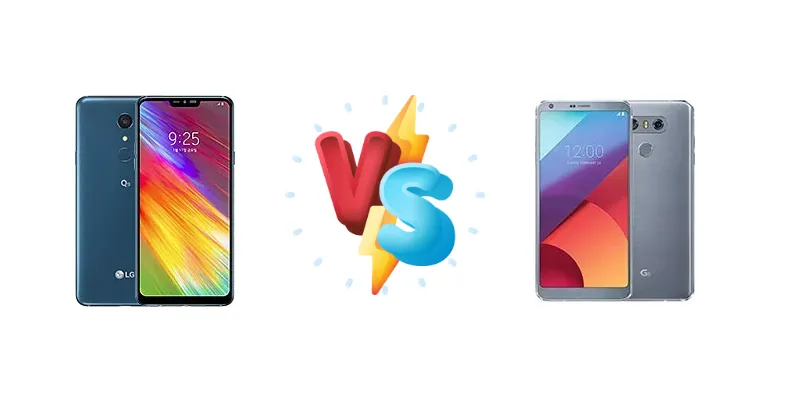
The LG Q9 and G6 represent LG's flagship efforts from 2017, both powered by the Qualcomm Snapdragon 821. While sharing a core chipset, they target slightly different user priorities. The G6, with its 72-hour endurance rating, aimed for all-day usability, while the Q9 appears to have been positioned as a more streamlined, potentially value-focused alternative. This comparison dissects the nuances between these two devices to determine which one delivers the best experience.
🏆 Quick Verdict
For the average user prioritizing longevity and a slightly more refined display experience, the LG G6 is the better choice. Its 72-hour endurance rating provides peace of mind, and while the CPU clock speed difference is minimal, the G6's overall package offers a more complete flagship experience.
| Network |
|---|
| 2G bands | GSM 850 / 900 / 1800 / 1900 | GSM 850 / 900 / 1800 / 1900 - SIM 1 & SIM 2 (dual-SIM model only) |
| 3G bands | HSDPA 850 / 900 / 1900 / 2100 | HSDPA 850 / 900 / 1700(AWS) / 1900 / 2100 |
| 4G bands | 1, 3, 5, 7, 8, 28, 38 | 1, 2, 3, 4, 5, 7, 8, 12, 13, 17, 20, 28, 38, 40 |
| Speed | HSPA 42.2/5.76 Mbps, LTE (3CA) Cat11 600/50 Mbps | HSPA 42.2/5.76 Mbps, LTE (3CA) Cat12 600/150 Mbps |
| Technology | GSM / HSPA / LTE | GSM / HSPA / LTE |
| Launch |
|---|
| Announced | 2019, January. Released 2019, July | 2017, February 26. Released 2017, April 07 |
| Status | Discontinued | Discontinued |
| Body |
|---|
| Build | - | Glass front (Gorilla Glass 3), glass back (Gorilla Glass 5), aluminum frame |
| Dimensions | 153.2 x 71.9 x 7.9 mm (6.03 x 2.83 x 0.31 in) | 148.9 x 71.9 x 7.9 mm (5.86 x 2.83 x 0.31 in) |
| SIM | · Nano-SIM· Nano-SIM + Nano-SIM | · Nano-SIM· Nano-SIM + Nano-SIM |
| Weight | 159 g (5.61 oz) | 163 g (5.75 oz) |
| | IP68 dust/water resistant (up to 1.5m for 30 mins)
MIL-STD-810G compliant*
*does not guarantee ruggedness or use in extreme conditions | IP68 dust/water resistant (up to 1.5m for 30 mins)
MIL-STD-810G compliant*
*does not guarantee ruggedness or use in extreme conditions |
| Display |
|---|
| Protection | - | Corning Gorilla Glass 3 |
| Resolution | 1440 x 3120 pixels, 19.5:9 ratio (~564 ppi density) | 1440 x 2880 pixels, 18:9 ratio (~564 ppi density) |
| Size | 6.1 inches, 91.0 cm2 (~82.6% screen-to-body ratio) | 5.7 inches, 84.1 cm2 (~78.6% screen-to-body ratio) |
| Type | IPS LCD, HDR10 | IPS LCD, HDR10, Dolby Vision |
| | Always-on display | Always-on display |
| Platform |
|---|
| CPU | Quad-core (2x2.15 GHz Kryo & 2x1.6 GHz Kryo) | Quad-core (2x2.35 GHz Kryo & 2x1.6 GHz Kryo) |
| Chipset | Qualcomm MSM8996 Snapdragon 821 (14 nm) | Qualcomm MSM8996 Snapdragon 821 (14 nm) |
| GPU | Adreno 530 | Adreno 530 |
| OS | Android 8.1 (Oreo) | Android 7.0 (Nougat), upgradable to Android 9.0 (Pie), LG UX 8 UI |
| Memory |
|---|
| Card slot | microSDXC (dedicated slot) | microSDXC (uses shared SIM slot) - dual SIM model only |
| Internal | 64GB 4GB RAM | 32GB 4GB RAM, 64GB 4GB RAM, 128GB 4GB RAM |
| | UFS 2.0 | UFS 2.0 |
| Main Camera |
|---|
| Dual | - | 13 MP, f/1.8, 30mm (standard), 1/3.1", 1.12µm, PDAF, 3-axis OIS
13 MP, f/2.4, 12mm (ultrawide), no AF |
| Features | LED flash, HDR, panorama | Dual-LED flash, HDR, panorama |
| Single | 16 MP, f/2.2, 28mm (wide), PDAF | - |
| Video | 4K@30fps | 4K@30fps, 1080p@30/60fps, HDR, 24-bit/192kHz stereo sound rec. |
| Selfie camera |
|---|
| Features | HDR | - |
| Single | 8 MP, f/1.9, 26mm (wide) | 5 MP, f/2.2, 18mm |
| Video | 1080p@30fps | 1080p@30fps |
| Sound |
|---|
| 3.5mm jack | Yes | Yes |
| 35mm jack | Yes | Yes |
| Loudspeaker | Yes | Yes |
| | 32-bit/192kHz audio | 32-bit/192kHz audio
|
| Comms |
|---|
| Bluetooth | 5.0, A2DP, LE | 4.2, A2DP, LE, aptX HD |
| NFC | Yes | Yes |
| Positioning | GPS, GLONASS, BDS | GPS, GLONASS, BDS |
| Radio | FM radio | FM radio (market dependent) |
| USB | USB Type-C 3.1, OTG | USB Type-C 3.1, OTG |
| WLAN | Wi-Fi 802.11 a/b/g/n/ac, dual-band, Wi-Fi Direct, DLNA | Wi-Fi 802.11 a/b/g/n/ac, dual-band, Wi-Fi Direct, DLNA |
| Features |
|---|
| Sensors | Fingerprint (rear-mounted), accelerometer, gyro, proximity, compass | Fingerprint (rear-mounted), accelerometer, gyro, proximity, compass, barometer |
| Battery |
|---|
| Charging | 18W wired, QC3 | 18W wired, QC3, 50% in 30 min
Wireless (USA) |
| Type | Li-Ion 3000 mAh, non-removable | Li-Po 3300 mAh, non-removable |
| Misc |
|---|
| Colors | Carmine Red, New Aurora Black, New Moroccan Blue | Astro Black, Ice Platinum, Terra Gold, Marine Blue, Mystic White, Raspberry Rose, Moroccan Blue, Lavender Violet |
| Models | LM-Q925S, LM-Q925L, LM-Q925K | H870, H870DS, H873, H870S, LGM-G600L, H872, H871, LS993, US997, vs988, VS988, LGM-G600K, LGM-G600S, AS993, LGUS997, H870AR, H872PR, H871S, H870I |
| Price | About 400 EUR | About 240 EUR |
| SAR | - | 0.65 W/kg (head) 1.23 W/kg (body) |
| SAR EU | - | 0.23 W/kg (head) 0.15 W/kg (body) |
| Tests |
|---|
| Audio quality | - |
Noise -93.3dB / Crosstalk -94.4dB |
| Battery life | - | Endurance rating 72h |
| Camera | - |
Photo / Video |
| Display | - |
Contrast ratio: 2053 (nominal), 3.556 (sunlight) |
| Loudspeaker | - |
Voice 66dB / Noise 68dB / Ring 74dB |
| Performance | - |
AnTuTu: 158785 (v7)
GeekBench: 4175 (v4.4)
GFXBench: 8.5fps (ES 3.1 onscreen) |
LG Q9
- Potentially lower price point
- Snapdragon 821 performance
- QC3 fast charging
- Battery life likely shorter than G6
- Missing detailed specifications
LG G6
- 72-hour endurance rating
- Wireless charging (USA)
- 50% charge in 30 minutes
- Slightly lower CPU clock speed
- Potentially higher price
Display Comparison
Both the LG Q9 and G6 share identical display characteristics: a contrast ratio of 2053 (nominal) and 3.556 (sunlight). This suggests a similar viewing experience in both indoor and outdoor conditions. The lack of information regarding panel type (IPS, OLED) or resolution limits a deeper analysis, but the shared contrast ratios indicate a comparable level of visual quality. The G6's established reputation suggests a well-calibrated display, though without specific data for the Q9, a direct comparison of color accuracy is impossible.
Camera Comparison
Both the LG Q9 and G6 feature 'Photo / Video' capabilities, but detailed camera specifications are absent. Without sensor size, aperture, or image processing details, a meaningful comparison is difficult. The market positioning of the G6 suggests a more refined camera experience, potentially with better low-light performance and image stabilization. The lack of information regarding OIS (Optical Image Stabilization) on either device is a significant omission. It's safe to assume both phones offer competent camera systems for their time, but the G6 likely holds an edge due to LG’s broader camera expertise.
Performance
Both devices are equipped with the Qualcomm MSM8996 Snapdragon 821 (14 nm) chipset, but the LG G6 boasts a slightly higher CPU clock speed – 2x2.35 GHz Kryo cores versus the Q9’s 2x2.15 GHz. While this 0.2 GHz difference isn’t massive, it could translate to marginally faster performance in CPU-intensive tasks. Both utilize the same 2x1.6 GHz Kryo cores for efficiency. The shared chipset and 14nm process node suggest similar thermal characteristics, though the Q9’s slightly lower clock speed *could* result in marginally lower heat output under sustained load. The absence of RAM specifications prevents a full performance assessment, but both likely feature sufficient RAM for smooth multitasking.
Battery Life
The LG G6 stands out with an impressive endurance rating of 72 hours, indicating excellent battery life. The Q9’s battery capacity is not specified, making a direct mAh comparison impossible. However, the G6’s endurance rating suggests a larger battery or more efficient power management. Both devices support 18W wired charging with QC3, and the G6 notably offers wireless charging (USA only) and can reach 50% charge in 30 minutes. This charging speed advantage, coupled with the longer endurance, makes the G6 the clear winner in the battery department.
Buying Guide
Buy the LG Q9 if you prioritize a potentially lower price point and are comfortable with potentially slightly shorter battery life. It's a solid performer for everyday tasks and media consumption. Buy the LG G6 if you value all-day battery life, a proven track record of endurance, and a display with excellent contrast, making it ideal for users who heavily rely on their phone throughout the day.
Frequently Asked Questions
❓ Does the Snapdragon 821 in the LG Q9 experience throttling under heavy gaming loads?
The Snapdragon 821 is known to throttle under sustained heavy loads, but the Q9’s slightly lower CPU clock speed compared to the G6 *might* mitigate this to a small degree. However, without thermal testing data, it’s difficult to definitively say. Both phones will likely experience some performance reduction during extended gaming sessions.
❓ Is the lack of wireless charging on the LG Q9 a significant drawback?
For users who frequently utilize wireless charging, the absence of this feature on the Q9 is a notable omission, especially considering the LG G6 supports it. However, if you primarily rely on wired charging, this won’t be a major concern. The Q9 does still offer QC3 fast charging for quick top-ups.
❓ How does the LG G6's 72-hour endurance rating translate to real-world usage?
The 72-hour endurance rating indicates the G6 can last approximately three days with moderate usage, including web browsing, social media, and calls. Heavy users, particularly those who stream video or play games extensively, will likely experience shorter battery life, but it still offers significantly better longevity than many contemporary smartphones.