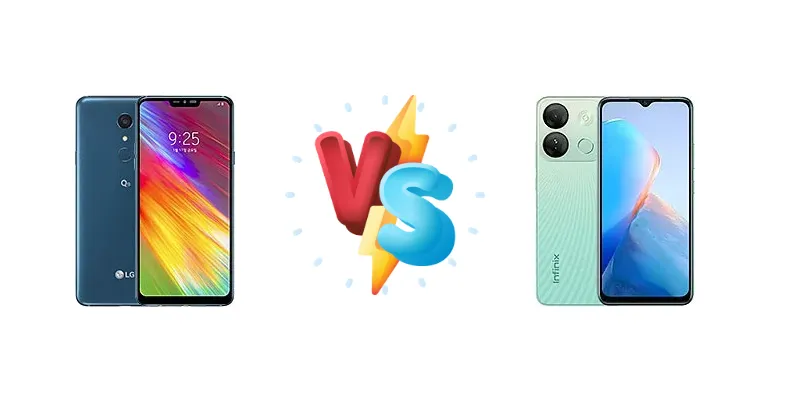
The LG Q9, released with a flagship-tier Snapdragon 821, now finds itself competing in a vastly different market segment. We pit it against the Infinix Smart 7 HD, a modern budget offering, to determine if raw processing power still holds value against optimized efficiency and a lower price point.
🏆 Quick Verdict
For users prioritizing sustained performance and faster charging, the LG Q9 is the better choice, despite its age. However, the Infinix Smart 7 HD offers a compelling value proposition for those seeking a basic, reliable smartphone experience without breaking the bank.
| Network |
|---|
| 2G bands | GSM 850 / 900 / 1800 / 1900 | GSM 850 / 900 / 1800 / 1900 |
| 3G bands | HSDPA 850 / 900 / 1900 / 2100 | HSDPA 850 / 900 / 2100 |
| 4G bands | 1, 3, 5, 7, 8, 28, 38 | 1, 3, 5, 8, 38, 40, 41 |
| Speed | HSPA 42.2/5.76 Mbps, LTE (3CA) Cat11 600/50 Mbps | HSPA, LTE |
| Technology | GSM / HSPA / LTE | GSM / HSPA / LTE |
| | - | 1, 2, 3, 4, 5, 7, 8, 20, 28, 38, 40, 41 |
| Launch |
|---|
| Announced | 2019, January. Released 2019, July | 2023, April 14 |
| Status | Discontinued | Available. Released 2023, April 14 |
| Body |
|---|
| Build | - | Glass front, plastic back, plastic frame |
| Dimensions | 153.2 x 71.9 x 7.9 mm (6.03 x 2.83 x 0.31 in) | 163.9 x 75.5 x 8.7 mm (6.45 x 2.97 x 0.34 in) |
| SIM | · Nano-SIM· Nano-SIM + Nano-SIM | Nano-SIM + Nano-SIM |
| Weight | 159 g (5.61 oz) | 196.5 g (6.95 oz) |
| | IP68 dust/water resistant (up to 1.5m for 30 mins)
MIL-STD-810G compliant*
*does not guarantee ruggedness or use in extreme conditions | - |
| Display |
|---|
| Resolution | 1440 x 3120 pixels, 19.5:9 ratio (~564 ppi density) | 720 x 1612 pixels, 20:9 ratio (~267 ppi density) |
| Size | 6.1 inches, 91.0 cm2 (~82.6% screen-to-body ratio) | 6.6 inches, 104.6 cm2 (~84.6% screen-to-body ratio) |
| Type | IPS LCD, HDR10 | IPS LCD, 500 nits |
| | Always-on display | - |
| Platform |
|---|
| CPU | Quad-core (2x2.15 GHz Kryo & 2x1.6 GHz Kryo) | Octa-core 1.6 GHz |
| Chipset | Qualcomm MSM8996 Snapdragon 821 (14 nm) | - |
| GPU | Adreno 530 | - |
| OS | Android 8.1 (Oreo) | Android 12 (Go edition) |
| Memory |
|---|
| Card slot | microSDXC (dedicated slot) | microSDXC (dedicated slot) |
| Internal | 64GB 4GB RAM | 64GB 2GB RAM |
| | UFS 2.0 | UFS 2.1 |
| Main Camera |
|---|
| Dual | - | 8 MP, f/2.0
0.08 MP, (depth) |
| Features | LED flash, HDR, panorama | Dual-LED flash, HDR, panorama |
| Single | 16 MP, f/2.2, 28mm (wide), PDAF | 8 MP, f/2.0
Auxiliary lens |
| Video | 4K@30fps | 1080p@30fps |
| Selfie camera |
|---|
| Features | HDR | LED flash |
| Single | 8 MP, f/1.9, 26mm (wide) | 5 MP, f/2.0 |
| Video | 1080p@30fps | 720p@30fps |
| Sound |
|---|
| 3.5mm jack | Yes | Yes |
| 35mm jack | Yes | Yes |
| Loudspeaker | Yes | Yes |
| | 32-bit/192kHz audio | - |
| Comms |
|---|
| Bluetooth | 5.0, A2DP, LE | 5.0, A2DP, LE |
| NFC | Yes | No |
| Positioning | GPS, GLONASS, BDS | GPS |
| Radio | FM radio | FM radio |
| USB | USB Type-C 3.1, OTG | microUSB 2.0, OTG |
| WLAN | Wi-Fi 802.11 a/b/g/n/ac, dual-band, Wi-Fi Direct, DLNA | Wi-Fi 802.11 b/g/n |
| Features |
|---|
| Sensors | Fingerprint (rear-mounted), accelerometer, gyro, proximity, compass | Fingerprint (rear-mounted), accelerometer, proximity |
| Battery |
|---|
| Charging | 18W wired, QC3 | 10W wired |
| Type | Li-Ion 3000 mAh, non-removable | 5000 mAh |
| Misc |
|---|
| Colors | Carmine Red, New Aurora Black, New Moroccan Blue | Ink Black, Silk Blue, Jade White, Green Apple |
| Models | LM-Q925S, LM-Q925L, LM-Q925K | X6516 |
| Price | About 400 EUR | About 110 EUR |
LG Q9
- Significantly faster processor for demanding tasks
- Quick Charge 3.0 support for rapid charging
- Likely superior display quality
- Potentially better camera performance
- Older chipset architecture
- Potentially shorter battery life per charge (depending on capacity)
- May lack modern software features
Infinix Smart 7 HD
- More affordable price point
- Potentially longer battery life for basic usage
- Modern Android experience
- Octa-core processor for multitasking
- Slower processor for demanding tasks
- Slower 10W charging
- Likely lower display quality
- Potentially inferior camera performance
Display Comparison
Display specifications are not provided for either device. However, given the Q9's original positioning, it likely features a higher-quality panel with better color accuracy and brightness compared to the Smart 7 HD, which is targeted at the entry-level market. The Q9 likely benefits from LG's display expertise, while the Smart 7 HD will focus on cost reduction.
Camera Comparison
Camera details are limited. It's safe to assume the LG Q9, originating from a higher price bracket, likely features a more capable camera sensor and image processing pipeline. The Smart 7 HD will likely prioritize affordability, resulting in a simpler camera system. Without sensor size or aperture information, a direct comparison is difficult, but the Q9's image quality is expected to be superior in most lighting conditions.
Performance
The LG Q9's Qualcomm MSM8996 Snapdragon 821, a quad-core processor built on a 14nm process, represents a significant performance advantage over the Infinix Smart 7 HD's octa-core 1.6 GHz CPU. While the Smart 7 HD boasts more cores, the Snapdragon 821's Kryo cores – with their 2.15 GHz peak clock speed – offer superior single-core performance, crucial for responsive app loading and smoother multitasking. The 14nm process, while older, still provides a reasonable balance between power and efficiency. The Smart 7 HD's processor, lacking specific architectural details, likely relies on a more generic ARM design, prioritizing power efficiency over raw speed. This translates to a noticeable difference in demanding tasks like gaming or video editing.
Battery Life
Battery capacity is not specified for either device. However, the LG Q9's 18W wired charging with Quick Charge 3.0 support provides a significant advantage over the Infinix Smart 7 HD's 10W charging. This means the Q9 can replenish its battery much faster, minimizing downtime. While the Smart 7 HD may offer longer battery life *per charge* due to its less powerful processor, the Q9's faster charging mitigates this advantage for users who frequently top up their devices.
Buying Guide
Buy the LG Q9 if you need a phone capable of handling demanding applications, older but still capable gaming, and appreciate the convenience of Quick Charge 3.0. Buy the Infinix Smart 7 HD if you prioritize affordability, long battery life for basic tasks, and a modern Android experience without the premium price tag. The Q9 is for the power user on a budget, while the Smart 7 HD is for the essential smartphone user.
Frequently Asked Questions
❓ Will the LG Q9 struggle with modern apps and games?
While the Snapdragon 821 was a flagship processor in its time, modern apps and games are increasingly demanding. The LG Q9 will likely handle most tasks adequately, but may exhibit slowdowns or require reduced graphics settings in newer, more intensive games. It's a capable performer, but not on par with current-generation chipsets.
❓ Is the 10W charging on the Infinix Smart 7 HD painfully slow?
10W charging is relatively slow by today's standards. Expect a full charge to take several hours. However, for users who primarily charge their phones overnight or don't heavily use them throughout the day, it may not be a significant inconvenience. The Smart 7 HD prioritizes affordability over fast charging.
❓ Does the LG Q9 support software updates?
Given its age, the LG Q9 is unlikely to receive major Android version updates. Security patches may be limited or unavailable. This is a key consideration for users concerned about software security and features.
❓ How does the octa-core processor in the Infinix Smart 7 HD compare to the quad-core Snapdragon 821 in real-world use?
While the Smart 7 HD has more cores, the Snapdragon 821's superior single-core performance and architectural efficiency translate to a smoother and more responsive experience in most everyday tasks. The Smart 7 HD will be adequate for basic use, but the Q9 will handle multitasking and demanding apps more effectively.