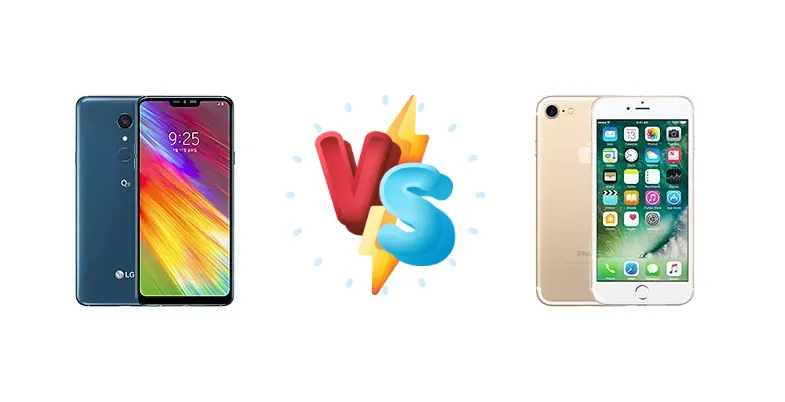
The LG Q9 and Apple iPhone 7 represent distinct approaches to the flagship smartphone experience of the mid-2010s. While the iPhone 7 continues to hold value due to Apple’s software support, the LG Q9, powered by the Snapdragon 821, offers a compelling alternative for users prioritizing fast charging and a more open ecosystem. This comparison revisits these devices in 2024, assessing their strengths and weaknesses.
🏆 Quick Verdict
For the average user in 2024, the Apple iPhone 7 edges out the LG Q9. Its exceptional 61-hour endurance rating and continued software support provide a more reliable long-term experience, despite the Q9’s faster charging capabilities. However, Android enthusiasts will find the Q9 a capable and affordable option.
| Network |
|---|
| 2G bands | GSM 850 / 900 / 1800 / 1900 | GSM 850 / 900 / 1800 / 1900 - A1660, A1778 |
| 3G bands | HSDPA 850 / 900 / 1900 / 2100 | HSDPA 850 / 900 / 1700(AWS) / 1900 / 2100 - A1660, A1778 |
| 4G bands | 1, 3, 5, 7, 8, 28, 38 | 1, 2, 3, 4, 5, 7, 8, 12, 13, 17, 18, 19, 20, 25, 26, 27, 28, 29, 30, 38, 39, 40, 41 - A1660, A1778 |
| Speed | HSPA 42.2/5.76 Mbps, LTE (3CA) Cat11 600/50 Mbps | HSPA 42.2/5.76 Mbps, LTE (3CA) Cat9 450/50 Mbps, EV-DO Rev.A 3.1 Mbps |
| Technology | GSM / HSPA / LTE | GSM / CDMA / HSPA / EVDO / LTE |
| | - | CDMA2000 1xEV-DO & TD-SCDMA - A1660 |
| Launch |
|---|
| Announced | 2019, January. Released 2019, July | 2016, September 07. Released 2016, September 16 |
| Status | Discontinued | Discontinued |
| Body |
|---|
| Build | - | Glass front (Corning-made glass), aluminum back, aluminum frame |
| Dimensions | 153.2 x 71.9 x 7.9 mm (6.03 x 2.83 x 0.31 in) | 138.3 x 67.1 x 7.1 mm (5.44 x 2.64 x 0.28 in) |
| SIM | · Nano-SIM· Nano-SIM + Nano-SIM | Nano-SIM |
| Weight | 159 g (5.61 oz) | 138 g (4.87 oz) |
| | IP68 dust/water resistant (up to 1.5m for 30 mins)
MIL-STD-810G compliant*
*does not guarantee ruggedness or use in extreme conditions | IP67 dust/water resistant (up to 1m for 30 min)
Apple Pay (Visa, MasterCard, AMEX certified) |
| Display |
|---|
| Protection | - | Ion-strengthened glass |
| Resolution | 1440 x 3120 pixels, 19.5:9 ratio (~564 ppi density) | 750 x 1334 pixels, 16:9 ratio (~326 ppi density) |
| Size | 6.1 inches, 91.0 cm2 (~82.6% screen-to-body ratio) | 4.7 inches, 60.9 cm2 (~65.6% screen-to-body ratio) |
| Type | IPS LCD, HDR10 | Retina IPS LCD, 625 nits (typ) |
| | Always-on display | 3D Touch display & home button |
| Platform |
|---|
| CPU | Quad-core (2x2.15 GHz Kryo & 2x1.6 GHz Kryo) | Quad-core 2.34 GHz (2x Hurricane + 2x Zephyr) |
| Chipset | Qualcomm MSM8996 Snapdragon 821 (14 nm) | Apple A10 Fusion (16 nm) |
| GPU | Adreno 530 | PowerVR Series7XT Plus (six-core graphics) |
| OS | Android 8.1 (Oreo) | iOS 10.0.1, upgradable to iOS 15.8.5 |
| Memory |
|---|
| Card slot | microSDXC (dedicated slot) | No |
| Internal | 64GB 4GB RAM | 32GB 2GB RAM, 128GB 2GB RAM, 256GB 2GB RAM |
| | UFS 2.0 | NVMe |
| Main Camera |
|---|
| Features | LED flash, HDR, panorama | Quad-LED dual-tone flash, HDR |
| Single | 16 MP, f/2.2, 28mm (wide), PDAF | 12 MP, f/1.8, 28mm (wide), 1/3.0", PDAF, OIS |
| Video | 4K@30fps | 4K@30fps, 1080p@30/60/120fps, 720p@240fps |
| Selfie camera |
|---|
| Features | HDR | Face detection, HDR, panorama |
| Single | 8 MP, f/1.9, 26mm (wide) | 7 MP, f/2.2, 32mm (standard) |
| Video | 1080p@30fps | 1080p@30fps |
| Sound |
|---|
| 3.5mm jack | Yes | No |
| 35mm jack | Yes | No |
| Loudspeaker | Yes | Yes, with stereo speakers |
| | 32-bit/192kHz audio | - |
| Comms |
|---|
| Bluetooth | 5.0, A2DP, LE | 4.2, A2DP, LE |
| NFC | Yes | Yes |
| Positioning | GPS, GLONASS, BDS | GPS, GLONASS, GALILEO, QZSS |
| Radio | FM radio | No |
| USB | USB Type-C 3.1, OTG | Lightning, USB 2.0 |
| WLAN | Wi-Fi 802.11 a/b/g/n/ac, dual-band, Wi-Fi Direct, DLNA | Wi-Fi 802.11 a/b/g/n/ac, dual-band, hotspot |
| Features |
|---|
| Sensors | Fingerprint (rear-mounted), accelerometer, gyro, proximity, compass | Fingerprint (front-mounted), accelerometer, gyro, proximity, compass, barometer |
| Battery |
|---|
| Charging | 18W wired, QC3 | - |
| Talk time | - | Up to 14 h (3G) |
| Type | Li-Ion 3000 mAh, non-removable | Li-Ion 1960 mAh, non-removable (7.45 Wh) |
| Misc |
|---|
| Colors | Carmine Red, New Aurora Black, New Moroccan Blue | Jet Black, Black, Silver, Gold, Rose Gold, Red |
| Models | LM-Q925S, LM-Q925L, LM-Q925K | A1660, A1778, A1779, A1780, A1853, A1866, iPhone9,1, iPhone9,3 |
| Price | About 400 EUR | About 180 EUR |
| SAR | - | 1.19 W/kg (head) 1.19 W/kg (body) |
| SAR EU | - | 1.38 W/kg (head) 1.34 W/kg (body) |
| Tests |
|---|
| Audio quality | - |
Noise -92.4dB / Crosstalk -80.9dB |
| Battery life | - |
Endurance rating 61h
|
| Camera | - |
Photo / Video |
| Display | - |
Contrast ratio: 1603:1 (nominal), 3.964 (sunlight) |
| Loudspeaker | - |
Voice 67dB / Noise 73dB / Ring 75dB
|
| Performance | - |
Basemark OS II 2.0: 3416 |
LG Q9
- Faster charging with Quick Charge 3.0
- Android operating system offers greater customization
- Snapdragon 821 provides solid performance
- Likely shorter battery life compared to iPhone 7
- Software support may be limited
- Camera performance likely inferior to iPhone 7
Apple iPhone 7
- Exceptional battery endurance (61h)
- Continued software support from Apple
- Strong camera performance and video recording
- Slower charging speeds
- Less customization options with iOS
- Apple ecosystem lock-in
Display Comparison
Both the LG Q9 and iPhone 7 feature displays with a nominal contrast ratio of 1603:1 and a sunlight contrast ratio of 3.964. This suggests similar outdoor visibility. However, the context data lacks specifics on panel technology (IPS vs OLED) or resolution. Given the iPhone 7’s reputation for color accuracy, it likely benefits from Apple’s display calibration. The Q9’s display quality is likely good, but without further data, it’s difficult to assess its advantage or disadvantage.
Camera Comparison
Both devices are listed as having 'Photo / Video' capabilities, but lack specific details. The iPhone 7 is known for its image processing and consistently good results in various lighting conditions. Without sensor size or aperture information for the LG Q9, it’s difficult to assess its camera performance. The iPhone 7’s video recording capabilities were also highly regarded for their time, offering stabilization and dynamic range. The Q9’s camera is likely competent, but the iPhone 7 likely holds an advantage in overall image quality and video recording.
Performance
The Apple A10 Fusion (16nm) and Qualcomm MSM8996 Snapdragon 821 (14nm) represent competing approaches to mobile processing. While the A10 Fusion’s 2.34 GHz Hurricane cores offer a clock speed advantage, the Snapdragon 821 utilizes Qualcomm’s Kryo cores, designed for efficiency. The 14nm process node of the Snapdragon 821 *should* offer slightly better thermal efficiency than the A10 Fusion’s 16nm process, potentially leading to less throttling under sustained load. However, Apple’s tight hardware-software integration often mitigates thermal concerns. Real-world performance will likely be comparable for most tasks, but the A10 Fusion may have a slight edge in demanding applications.
Battery Life
The iPhone 7’s endurance rating of 61 hours is a significant advantage. This suggests excellent power efficiency despite a likely smaller battery capacity compared to the LG Q9 (capacity not specified). The LG Q9 compensates with 18W wired charging and Quick Charge 3.0 support, allowing for significantly faster charging times. While the iPhone 7 charges at a slower rate, its superior endurance means users may not need to charge as frequently. The Q9’s QC3 support benefits users who prioritize quick top-ups, while the iPhone 7’s endurance suits those who prefer less frequent charging.
Buying Guide
Buy the LG Q9 if you need a capable Android phone with fast charging (QC3) and prefer the flexibility of the Android operating system. It’s ideal for users who frequently use their phone throughout the day and appreciate the convenience of quick top-ups. Buy the Apple iPhone 7 if you prioritize long battery life, a polished user experience, and continued software updates from Apple. It’s the better choice for users deeply embedded in the Apple ecosystem and those seeking a reliable, secure device.
Frequently Asked Questions
❓ Is the Snapdragon 821 in the LG Q9 still capable of running modern apps in 2024?
While not as powerful as current-generation chips, the Snapdragon 821 remains a capable processor. It can handle most everyday tasks and many popular apps. However, demanding games or resource-intensive applications may experience some slowdown or require reduced graphics settings.
❓ How does the iPhone 7's battery hold up after years of use?
The iPhone 7's battery, even with its excellent initial endurance, will have degraded over time. Expect reduced capacity and shorter runtimes. Apple offers battery replacement services, which can restore much of the original battery life. However, the cost of replacement should be factored into the overall ownership experience.
❓ Does the LG Q9 support software updates in 2024?
Software support for the LG Q9 is likely limited or non-existent at this point. This means it may not receive security patches or new features, potentially making it vulnerable to security threats. Users should exercise caution when using the device for sensitive tasks.