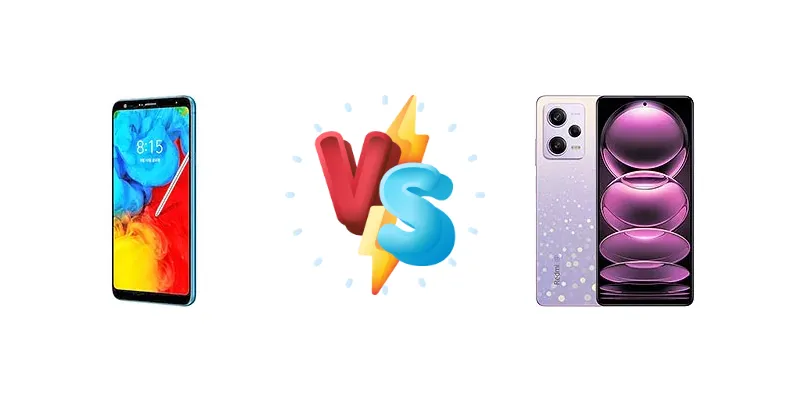
Comparing the Xiaomi Redmi Note 12 Pro to the LG Q8 (2018) is a study in smartphone evolution. The Q8 represented a solid mid-range offering in 2018, but the Redmi Note 12 Pro, benefiting from years of chipset and display advancements, presents a compelling case for an upgrade, particularly for users prioritizing performance and fast charging.
🏆 Quick Verdict
For the vast majority of users, the Xiaomi Redmi Note 12 Pro is the clear winner. Its Mediatek Dimensity 1080 chipset delivers significantly faster performance than the aging Snapdragon 450, coupled with a much brighter display and blazing-fast 67W charging. The Q8 remains a functional device, but struggles to compete with modern standards.
| Network |
|---|
| 2G bands | GSM 850 / 900 / 1800 / 1900 | GSM 850 / 900 / 1800 / 1900 |
| 3G bands | HSDPA 850 / 900 / 1900 / 2100 | HSDPA 800 / 850 / 900 / 1900 / 2100 |
| 4G bands | 1, 3, 5, 7, 8, 20 | 1, 2, 3, 4, 5, 7, 8, 12, 13, 17, 18, 19, 20, 26, 28, 32, 38, 40, 41, 66 - International |
| 5G bands | - | 1, 3, 5, 7, 8, 20, 28, 38, 40, 41, 66, 77, 78 SA/NSA - International |
| Speed | HSPA 42.2/5.76 Mbps, LTE (2CA) Cat6 300/50 Mbps | HSPA, LTE, 5G |
| Technology | GSM / HSPA / LTE | GSM / CDMA / HSPA / EVDO / LTE / 5G |
| | - | 1, 3, 5, 8, 28, 38, 41, 77, 78 SA/NSA - China |
| Launch |
|---|
| Announced | 2018, August. Released 2018, August | 2022, October 27 |
| Status | Discontinued | Available. Released 2022, November 01 |
| Body |
|---|
| Build | - | Glass front (Gorilla Glass 5), glass back, plastic frame |
| Dimensions | 160.1 x 77.7 x 8.4 mm (6.30 x 3.06 x 0.33 in) | 163 x 76 x 8 mm (6.42 x 2.99 x 0.31 in) |
| SIM | · Nano-SIM· Nano-SIM + Nano-SIM | Nano-SIM + Nano-SIM |
| Weight | 172 g (6.07 oz) | 187 g (6.60 oz) |
| | IP68 dust/water resistant (up to 1.5m for 30 mins)
MIL-STD-810G compliant*
*does not guarantee ruggedness or use in extreme conditions | IP53, dust and splash resistant |
| Display |
|---|
| Protection | - | Corning Gorilla Glass 5 |
| Resolution | 1080 x 2160 pixels, 18:9 ratio (~389 ppi density) | 1080 x 2400 pixels, 20:9 ratio (~395 ppi density) |
| Size | 6.2 inches, 99.7 cm2 (~80.2% screen-to-body ratio) | 6.67 inches, 107.4 cm2 (~86.7% screen-to-body ratio) |
| Type | IPS LCD | AMOLED, 1B colors, 120Hz, Dolby Vision, HDR10+, 500 nits (typ), 900 nits (HBM) |
| Platform |
|---|
| CPU | Octa-core 1.6 GHz Cortex-A53 | Octa-core (2x2.6 GHz Cortex-A78 & 6x2.0 GHz Cortex-A55) |
| Chipset | Qualcomm SDM450 Snapdragon 450 (14 nm) | Mediatek Dimensity 1080 (6 nm) |
| GPU | Adreno 506 | Mali-G68 MC4 |
| OS | Android 8.1 (Oreo) | Android 12, MIUI 13 |
| Memory |
|---|
| Card slot | microSDXC (dedicated slot) | No |
| Internal | 64GB 4GB RAM | 128GB 6GB RAM, 128GB 8GB RAM, 256GB 8GB RAM, 256GB 12GB RAM |
| | eMMC 5.1 | UFS 2.2 |
| Main Camera |
|---|
| Features | LED flash, panorama, HDR | Dual-LED dual-tone flash, HDR, panorama |
| Single | 16 MP, PDAF | - |
| Triple | - | 50 MP, f/1.9, 24mm (wide), 1/1.56", 1.0µm, PDAF, OIS
8 MP, f/2.2, 120˚ (ultrawide), 1/4.0", 1.12µm
2 MP (macro) |
| Video | 1080p@30fps | 4K@30fps, 1080p@30/60/120fps, 720p@960fps |
| Selfie camera |
|---|
| Features | - | HDR |
| Single | 5 MP, 18mm (ultrawide) | 16 MP, f/2.5, (wide), 1/3.06", 1.0µm |
| Video | 1080p@30fps | 1080p@30/60fps |
| Sound |
|---|
| 3.5mm jack | Yes | Yes |
| 35mm jack | Yes | Yes |
| Loudspeaker | Yes | Yes, with stereo speakers |
| | 32-bit/192kHz audio | 24-bit/192kHz audio |
| Comms |
|---|
| Bluetooth | 4.2, A2DP, LE | 5.2, A2DP, LE |
| Infrared port | - | Yes |
| NFC | Yes | Yes (market/region dependent) |
| Positioning | GPS, GLONASS | GPS (L1), GLONASS (G1), BDS (B1I+B1c), GALILEO (E1), QZSS (L1) |
| Radio | Stereo FM radio with RDS | No |
| USB | USB Type-C 2.0 | USB Type-C 2.0, OTG |
| WLAN | Wi-Fi 802.11 a/b/g/n/ac, dual-band, Wi-Fi Direct | Wi-Fi 802.11 a/b/g/n/ac/6, dual-band, Wi-Fi Direct |
| Features |
|---|
| Sensors | Fingerprint (rear-mounted), accelerometer, gyro, proximity, compass | Fingerprint (side-mounted), accelerometer, gyro, proximity, compass |
| Battery |
|---|
| Charging | 18W wired, QC3 | 67W wired, PD3.0, 50% in 15 min, 100% in 46 min |
| Type | Li-Po 3300 mAh, non-removable | Li-Po 5000 mAh |
| Misc |
|---|
| Colors | Aurora Black, Moroccan Blue | Frosted Blue (Sky Blue), Onyx Black (Midnight Black), Polar White, Stardust Purple |
| Models | LGM-X800L, LM-Q815S, LM-Q815K, LM-Q815L | 22101316C, 22101316I, 23013RK75C, 22101316G |
| Price | About 300 EUR | € 148.54 / $ 142.17 / £ 149.99 / ₹ 19,999 |
| SAR | - | 1.09 W/kg (head) 1.06 W/kg (body) |
| SAR EU | - | 0.99 W/kg (head) 0.99 W/kg (body) |
| Tests |
|---|
| Battery life | - |
Endurance rating 97h
|
| Camera | - |
Photo / Video |
| Display | - |
Contrast ratio: Infinite (nominal) |
| Loudspeaker | - |
-26.6 LUFS (Good)
|
| Performance | - |
AnTuTu: 490526 (v9)
GeekBench: 2209 (v5.1), 2372 (v6)
GFXBench: 22fps (ES 3.1 onscreen) |
LG Q8 (2018)
- Potentially more compact form factor (typical of 2018 phones)
- Lower price point (due to age)
- Functional for basic tasks
- Significantly slower performance
- Dim display
- Slow charging
Xiaomi Redmi Note 12 Pro
- Much faster performance
- Bright and vibrant display
- Blazing-fast 67W charging
- Likely superior camera system
- Potentially larger size
- Higher price point
Display Comparison
The Redmi Note 12 Pro boasts a significantly more advanced display. Its measured peak brightness of 890 nits dwarfs what the LG Q8 likely offered (estimated around 400-500 nits based on 2018 standards), resulting in far superior visibility outdoors. While both displays likely have an 'infinite' contrast ratio due to OLED/AMOLED technology (a common feature even in 2018 mid-rangers), the Redmi Note 12 Pro’s higher brightness and potentially improved color calibration provide a much more immersive viewing experience. The Q8's display, while adequate for its time, will appear dim and washed out in comparison.
Camera Comparison
Both devices offer photo and video capabilities, but the Redmi Note 12 Pro likely has a more sophisticated camera system. While specific sensor details for the Q8 are unavailable, the Redmi Note 12 Pro benefits from newer image processing algorithms and potentially a larger main sensor (details not provided in the context data, but typical for this class of device). The Redmi Note 12 Pro’s camera system is designed for better low-light performance and more detailed images. The LG Q8’s camera, while functional, will likely produce softer images with less dynamic range. The presence of OIS (Optical Image Stabilization) on the Redmi Note 12 Pro, a common feature in this price range, would further enhance image quality and video stabilization.
Performance
The performance gap between these two devices is substantial. The Xiaomi Redmi Note 12 Pro’s Mediatek Dimensity 1080, built on a 6nm process, is in a different league than the LG Q8’s 14nm Snapdragon 450. The Dimensity 1080 features a more modern CPU architecture – Cortex-A78 cores alongside A55 cores – compared to the Q8’s all-Cortex-A53 setup. This translates to a noticeable improvement in app launch speeds, multitasking, and gaming performance. The Redmi Note 12 Pro will handle demanding games with ease, while the Q8 will struggle with even moderately intensive titles. The 6nm node also contributes to better thermal efficiency, reducing the likelihood of performance throttling under sustained load.
Battery Life
The Redmi Note 12 Pro’s 67W charging is a game-changer. Achieving a 50% charge in just 15 minutes and a full charge in 46 minutes is a massive advantage over the LG Q8’s 18W QC3 charging. While both phones have an endurance rating of 97 hours, the Redmi Note 12 Pro’s active use score of 12:08h suggests more efficient power management. The faster charging speed significantly reduces downtime and makes it easier to top up the battery throughout the day. The Q8’s slower charging will require considerably more time to replenish the battery.
Buying Guide
Buy the LG Q8 (2018) if you need a very basic, functional smartphone and are on an extremely tight budget, or if you specifically require a smaller form factor not readily available in newer models. Buy the Xiaomi Redmi Note 12 Pro if you prioritize performance for gaming and multitasking, demand a vibrant and bright display, and value the convenience of incredibly fast charging – a modern smartphone experience.
Frequently Asked Questions
❓ Is the Redmi Note 12 Pro's Dimensity 1080 chipset prone to overheating during extended gaming sessions?
The Mediatek Dimensity 1080 is generally well-regarded for its thermal efficiency, thanks to its 6nm manufacturing process. While some heat generation is inevitable during demanding tasks like gaming, the Redmi Note 12 Pro’s thermal management system should prevent significant throttling, providing a consistently smooth gaming experience. This is a stark contrast to the Snapdragon 450 in the LG Q8, which is more likely to throttle under load.
❓ How much faster is the 67W charging on the Redmi Note 12 Pro compared to the 18W charging on the LG Q8 in real-world use?
The difference is substantial. The Redmi Note 12 Pro can go from 0% to 50% in just 15 minutes and fully charge in 46 minutes. The LG Q8’s 18W charging would likely take over 2 hours to fully charge from a similar starting point. This means you can quickly top up the Redmi Note 12 Pro during short breaks, while the Q8 requires a much longer charging commitment.
❓ Will apps I use daily on the LG Q8 run smoothly on the Redmi Note 12 Pro?
Absolutely. The Redmi Note 12 Pro’s Dimensity 1080 chipset has significantly more processing power than the Snapdragon 450. Even demanding apps like social media, web browsers, and video streaming services will run much more smoothly and responsively on the Redmi Note 12 Pro. You’ll notice a difference in app launch times and overall system fluidity.