
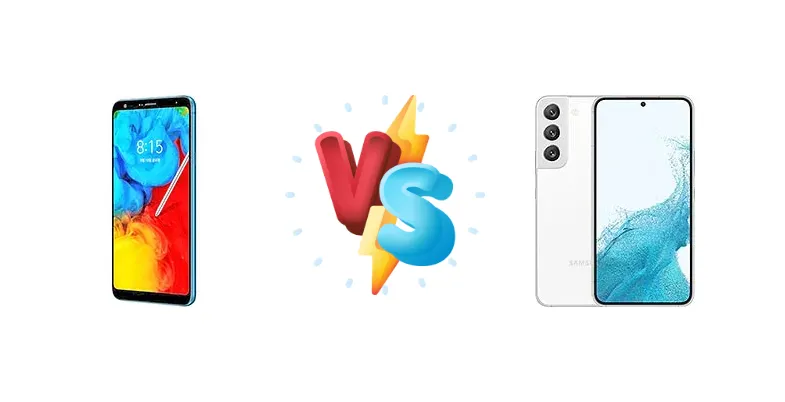
LG Q8 (2018) vs Samsung Galaxy S22 5G: A Generational Leap in Mobile Technology
| Phones Images | |||||
|---|---|---|---|---|---|
|
🏆 Quick Verdict
For the average user in 2024, the Samsung Galaxy S22 5G is the clear winner. Its vastly superior processing power, significantly brighter display, and modern features like 5G connectivity and wireless charging outweigh the Q8’s lower cost. However, the Q8 remains a functional device for basic tasks.
| PHONES | ||
|---|---|---|
| Phone Names | LG Q8 (2018) | Samsung Galaxy S22 5G |
| Network | ||
|---|---|---|
| 2G bands | GSM 850 / 900 / 1800 / 1900 | GSM 850 / 900 / 1800 / 1900 |
| 3G bands | HSDPA 850 / 900 / 1900 / 2100 | HSDPA 850 / 900 / 1700(AWS) / 1900 / 2100 |
| 4G bands | 1, 3, 5, 7, 8, 20 | 1, 2, 3, 4, 5, 7, 8, 12, 13, 17, 18, 19, 20, 25, 26, 28, 32, 38, 39, 40, 41, 66 - International |
| 5G bands | - | 1, 2, 3, 5, 7, 8, 12, 20, 25, 28, 38, 40, 41, 66, 75, 77, 78 SA/NSA/Sub6 - International |
| Speed | HSPA 42.2/5.76 Mbps, LTE (2CA) Cat6 300/50 Mbps | HSPA 42.2/5.76 Mbps, LTE (7CA) Cat20 2000/200 Mbps, 5G (5+ Gbps DL) |
| Technology | GSM / HSPA / LTE | GSM / CDMA / HSPA / EVDO / LTE / 5G |
| - | 1, 3, 5, 7, 8, 20, 28, 38, 41, 66, 71, 260, 261 SA/NSA/Sub6/mmWave - USA | |
| Launch | ||
|---|---|---|
| Announced | 2018, August. Released 2018, August | 2022, February 09 |
| Status | Discontinued | Available. Released 2022, February 25 |
| Body | ||
|---|---|---|
| Build | - | Glass front (Gorilla Glass Victus+), glass back (Gorilla Glass Victus+), aluminum frame |
| Dimensions | 160.1 x 77.7 x 8.4 mm (6.30 x 3.06 x 0.33 in) | 146 x 70.6 x 7.6 mm (5.75 x 2.78 x 0.30 in) |
| SIM | · Nano-SIM· Nano-SIM + Nano-SIM | Nano-SIM + eSIM· Nano-SIM + Nano-SIM + eSIM (max 2 at a time) |
| Weight | 172 g (6.07 oz) | 167 g / 168 g (mmWave) (5.89 oz) |
| IP68 dust/water resistant (up to 1.5m for 30 mins) MIL-STD-810G compliant* *does not guarantee ruggedness or use in extreme conditions | IP68 dust/water resistant (up to 1.5m for 30 min) Armor aluminum frame with tougher drop and scratch resistance (advertised) | |
| Display | ||
|---|---|---|
| Protection | - | Corning Gorilla Glass Victus+ |
| Resolution | 1080 x 2160 pixels, 18:9 ratio (~389 ppi density) | 1080 x 2340 pixels, 19.5:9 ratio (~425 ppi density) |
| Size | 6.2 inches, 99.7 cm2 (~80.2% screen-to-body ratio) | 6.1 inches, 90.1 cm2 (~87.4% screen-to-body ratio) |
| Type | IPS LCD | Dynamic AMOLED 2X, 120Hz, HDR10+, 1300 nits (peak) |
| - | Always-on display | |
| Platform | ||
|---|---|---|
| CPU | Octa-core 1.6 GHz Cortex-A53 | Octa-core (1x2.8 GHz Cortex-X2 & 3x2.50 GHz Cortex-A710 & 4x1.8 GHz Cortex-A510) - EuropeOcta-core (1x3.00 GHz Cortex-X2 & 3x2.50 GHz Cortex-A710 & 4x1.80 GHz Cortex-A510) - ROW |
| Chipset | Qualcomm SDM450 Snapdragon 450 (14 nm) | Exynos 2200 (4 nm) - EuropeQualcomm SM8450 Snapdragon 8 Gen 1 (4 nm) - ROW |
| GPU | Adreno 506 | Xclipse 920 - EuropeAdreno 730 - ROW |
| OS | Android 8.1 (Oreo) | Android 12, up to 4 major Android upgrades, One UI 8 |
| Memory | ||
|---|---|---|
| Card slot | microSDXC (dedicated slot) | No |
| Internal | 64GB 4GB RAM | 128GB 8GB RAM, 256GB 8GB RAM |
| eMMC 5.1 | UFS 3.1 | |
| Main Camera | ||
|---|---|---|
| Features | LED flash, panorama, HDR | LED flash, auto-HDR, panorama |
| Single | 16 MP, PDAF | 10 MP, f/2.2, 26mm (wide), 1/3.24", 1.22µm, Dual Pixel PDAF |
| Triple | - | 50 MP, f/1.8, 23mm (wide), 1/1.56", 1.0µm, dual pixel PDAF, OIS 10 MP, f/2.4, 70mm (telephoto), 1/3.94", 1.0µm, PDAF, OIS, 3x optical zoom 12 MP, f/2.2, 13mm, 120˚ (ultrawide), 1/2.55" 1.4µm, Super Steady video |
| Video | 1080p@30fps | 8K@24fps, 4K@30/60fps, 1080p@30/60/120/240fps, HDR10+, stereo sound rec., gyro-EIS |
| Selfie camera | ||
|---|---|---|
| Features | - | HDR |
| Single | 5 MP, 18mm (ultrawide) | 10 MP, f/2.2, 26mm (wide), 1/3.24", 1.22µm, dual pixel PDAF |
| Video | 1080p@30fps | 4K@30/60fps, 1080p@30fps |
| Sound | ||
|---|---|---|
| 3.5mm jack | Yes | No |
| 35mm jack | Yes | No |
| Loudspeaker | Yes | Yes, with stereo speakers |
| 32-bit/192kHz audio | 32-bit/384kHz audio Tuned by AKG | |
| Comms | ||
|---|---|---|
| Bluetooth | 4.2, A2DP, LE | 5.2, A2DP, LE |
| NFC | Yes | Yes |
| Positioning | GPS, GLONASS | GPS, GLONASS, BDS, GALILEO |
| Radio | Stereo FM radio with RDS | No |
| USB | USB Type-C 2.0 | USB Type-C 3.2, OTG |
| WLAN | Wi-Fi 802.11 a/b/g/n/ac, dual-band, Wi-Fi Direct | Wi-Fi 802.11 a/b/g/n/ac/6, dual-band, Wi-Fi Direct |
| Features | ||
|---|---|---|
| Sensors | Fingerprint (rear-mounted), accelerometer, gyro, proximity, compass | Fingerprint (under display, ultrasonic), accelerometer, gyro, proximity, compass, barometer |
| - | Samsung DeX, Samsung Wireless DeX (desktop experience support) Bixby natural language commands and dictation Samsung Pay (Visa, MasterCard certified) | |
| Battery | ||
|---|---|---|
| Charging | 18W wired, QC3 | 25W wired, PD3.0 15W wireless (Qi) 4.5W reverse wireless |
| Type | Li-Po 3300 mAh, non-removable | Li-Ion 3700 mAh |
| Misc | ||
|---|---|---|
| Colors | Aurora Black, Moroccan Blue | Phantom Black, White, Pink Gold, Green, Graphite, Sky Blue, Violet, Cream, Bora Purple |
| Models | LGM-X800L, LM-Q815S, LM-Q815K, LM-Q815L | SM-S901B, SM-S901B/DS, SM-S901U, SM-S901U1, SM-S901W, SM-S901N, SM-S9010, SM-S901E, SM-S901E/DS |
| Price | About 300 EUR | $ 172.63 / C$ 304.00 / £ 186.11 / € 198.01 |
| SAR | - | 1.03 W/kg (head) 1.15 W/kg (body) |
| SAR EU | - | 1.21 W/kg (head) 1.59 W/kg (body) |
| Tests | ||
|---|---|---|
| Battery life | - | Endurance rating 85h |
| Camera | - | Photo / Video |
| Display | - | Contrast ratio: Infinite (nominal) |
| Loudspeaker | - | -26.4 LUFS (Good) |
| Performance | - | AnTuTu: 745496 (v8), 881428 (v9) GeekBench: 3682 (v5.1) GFXBench: 69fps (ES 3.1 onscreen) |
LG Q8 (2018)
- Significantly lower price point
- Functional for basic smartphone tasks
- Headphone jack (likely, based on LG's historical design)
- Outdated chipset and slow performance
- Inferior display quality
- Limited software support and security updates
Samsung Galaxy S22 5G
- Exceptional performance with Exynos 2200/Snapdragon 8 Gen 1
- Bright and vibrant display
- Versatile camera system with advanced features
- Higher price
- Potential for thermal throttling under sustained load (Exynos variant)
- Battery life, while good, isn't exceptional
Display Comparison
The Samsung Galaxy S22 boasts a significantly more advanced display. While both lack detailed panel information beyond brightness, the S22’s measured 982 nits peak brightness dwarfs what the Q8 likely offered. The S22’s ‘Infinite’ contrast ratio (nominal) suggests a superior OLED panel, delivering deeper blacks and more vivid colors. The Q8, being an older LCD, will struggle in direct sunlight and lack the color accuracy of the S22. The S22’s potential for higher refresh rates (not specified, but common in flagships) further enhances the viewing experience.
Camera Comparison
Both phones feature 'Photo / Video' capabilities, but the underlying technology differs drastically. The S22 benefits from a modern image signal processor (ISP) within the Exynos 2200/Snapdragon 8 Gen 1, enabling advanced features like improved low-light performance, HDR processing, and computational photography. While sensor sizes aren’t specified, the S22’s flagship status implies a larger, more capable main sensor with optical image stabilization (OIS). The Q8’s camera system, while adequate for its time, will struggle to match the S22’s detail, dynamic range, and overall image quality. Ignoring the likely 2MP macro lens on both, the S22 offers a far more versatile and capable camera experience.
Performance
The performance gap is immense. The LG Q8’s Qualcomm Snapdragon 450, with its Cortex-A53 cores clocked at 1.6 GHz, is designed for efficiency, not speed. The Galaxy S22, depending on the region, features either the Exynos 2200 or Snapdragon 8 Gen 1, both built on a 4nm process. These chips utilize cutting-edge CPU architectures – Cortex-X2, A710, and A510 – offering a massive leap in processing power and efficiency. The S22’s LPDDR5x RAM (implied by its flagship status) further accelerates performance compared to the Q8’s likely LPDDR3. This translates to significantly faster app loading, smoother multitasking, and the ability to handle demanding games.
Battery Life
Both devices share an endurance rating of 85 hours, but this doesn’t tell the whole story. The S22’s 25W wired charging with Power Delivery 3.0 (PD3.0) is significantly faster than the Q8’s 18W Quick Charge 3.0 (QC3). The S22 also adds 15W wireless charging and 4.5W reverse wireless charging, features absent on the Q8. The 4nm process of the S22’s chipset contributes to better power efficiency, meaning it can deliver comparable battery life despite potentially having a smaller battery capacity. The S22’s faster charging speeds minimize downtime.
Buying Guide
Buy the LG Q8 (2018) if you need a very affordable, basic smartphone for calls, texts, and light web browsing, and are comfortable with a significantly older device and limited software support. Buy the Samsung Galaxy S22 5G if you prioritize performance for gaming and demanding apps, a vibrant and bright display, a versatile camera system, and future-proof 5G connectivity.