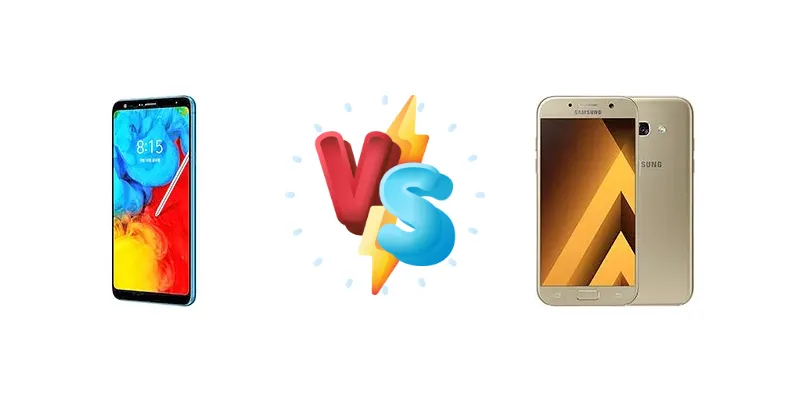
Released a year apart, the LG Q8 (2018) and Samsung Galaxy A5 (2017) represent compelling options in the mid-range smartphone market, particularly as their prices have fallen. This comparison dissects their core components – from chipsets to cameras – to determine which device delivers the best value for today’s user, focusing on the trade-offs between processing power and established brand features.
🏆 Quick Verdict
For the average user prioritizing consistent performance and a slightly more modern chipset, the LG Q8 (2018) emerges as the better choice. While both phones boast identical 18W charging and impressive 95-hour endurance ratings, the Snapdragon 450 offers a modest performance edge over the Exynos 7880, making it better suited for multitasking and light gaming.
| Network |
|---|
| 2G bands | GSM 850 / 900 / 1800 / 1900 | GSM 850 / 900 / 1800 / 1900 - SIM 1 & SIM 2 (dual-SIM model only) |
| 3G bands | HSDPA 850 / 900 / 1900 / 2100 | HSDPA 850 / 900 / 1700(AWS) / 1900 / 2100 |
| 4G bands | 1, 3, 5, 7, 8, 20 | 1, 2, 3, 4, 5, 7, 8, 17, 20, 28, 38, 40, 41 |
| Speed | HSPA 42.2/5.76 Mbps, LTE (2CA) Cat6 300/50 Mbps | HSPA 42.2/5.76 Mbps, LTE (2CA) Cat6 300/50 Mbps |
| Technology | GSM / HSPA / LTE | GSM / HSPA / LTE |
| Launch |
|---|
| Announced | 2018, August. Released 2018, August | 2017, January. Released 2017, January |
| Status | Discontinued | Discontinued |
| Body |
|---|
| Build | - | Glass front (Gorilla Glass 4), glass back, aluminum frame |
| Dimensions | 160.1 x 77.7 x 8.4 mm (6.30 x 3.06 x 0.33 in) | 146.1 x 71.4 x 7.9 mm (5.75 x 2.81 x 0.31 in) |
| SIM | · Nano-SIM· Nano-SIM + Nano-SIM | · Nano-SIM· Nano-SIM + Nano-SIM |
| Weight | 172 g (6.07 oz) | 157 g (5.54 oz) |
| | IP68 dust/water resistant (up to 1.5m for 30 mins)
MIL-STD-810G compliant*
*does not guarantee ruggedness or use in extreme conditions | IP68 dust/water resistant (up to 1.5m for 30 mins) |
| Display |
|---|
| Protection | - | Corning Gorilla Glass 4 |
| Resolution | 1080 x 2160 pixels, 18:9 ratio (~389 ppi density) | 1080 x 1920 pixels, 16:9 ratio (~424 ppi density) |
| Size | 6.2 inches, 99.7 cm2 (~80.2% screen-to-body ratio) | 5.2 inches, 74.5 cm2 (~71.5% screen-to-body ratio) |
| Type | IPS LCD | Super AMOLED |
| | - | Always-on display |
| Platform |
|---|
| CPU | Octa-core 1.6 GHz Cortex-A53 | Octa-core 1.9 GHz Cortex-A53 |
| Chipset | Qualcomm SDM450 Snapdragon 450 (14 nm) | Exynos 7880 (14 nm) |
| GPU | Adreno 506 | Mali-T830MP3 |
| OS | Android 8.1 (Oreo) | Android 6.0.1 (Marshmallow), upgradable to Android 8.0 (Oreo) |
| Memory |
|---|
| Card slot | microSDXC (dedicated slot) | microSDXC (dedicated slot) |
| Internal | 64GB 4GB RAM | 32GB 3GB RAM, 64GB 3GB RAM |
| | eMMC 5.1 | eMMC 5.1 |
| Main Camera |
|---|
| Features | LED flash, panorama, HDR | LED flash, panorama, HDR |
| Single | 16 MP, PDAF | 16 MP, f/1.9, 27mm (wide), AF |
| Video | 1080p@30fps | 1080p@30fps |
| Selfie camera |
|---|
| Single | 5 MP, 18mm (ultrawide) | 16 MP, f/1.9, 26mm (wide), 1/3.06", 1.0µm |
| Video | 1080p@30fps | 1080p@30fps |
| Sound |
|---|
| 3.5mm jack | Yes | Yes |
| 35mm jack | Yes | Yes |
| Loudspeaker | Yes | Yes |
| | 32-bit/192kHz audio | - |
| Comms |
|---|
| Bluetooth | 4.2, A2DP, LE | 4.2, A2DP, EDR, LE |
| NFC | Yes | Yes |
| Positioning | GPS, GLONASS | GPS, GLONASS, BDS |
| Radio | Stereo FM radio with RDS | FM radio |
| USB | USB Type-C 2.0 | USB Type-C 2.0 |
| WLAN | Wi-Fi 802.11 a/b/g/n/ac, dual-band, Wi-Fi Direct | Wi-Fi 802.11 a/b/g/n/ac, dual-band, Wi-Fi Direct |
| Features |
|---|
| Sensors | Fingerprint (rear-mounted), accelerometer, gyro, proximity, compass | Fingerprint (front-mounted), accelerometer, gyro, proximity, compass, barometer |
| | - | ANT+
Samsung Pay |
| Battery |
|---|
| Charging | 18W wired, QC3 | 18W wired |
| Music play | - | Up to 53 h |
| Talk time | - | Up to 16 h (3G) |
| Type | Li-Po 3300 mAh, non-removable | Li-Ion 3000 mAh, non-removable |
| Misc |
|---|
| Colors | Aurora Black, Moroccan Blue | Black Sky, Gold Sand, Blue Mist, Peach Cloud |
| Models | LGM-X800L, LM-Q815S, LM-Q815K, LM-Q815L | SM-A520F, SM-A520F, SM-A520K, SM-A520L, SM-A520S, SM-A520W, SM-A520FD |
| Price | About 300 EUR | About 190 EUR |
| SAR | - | 0.88 W/kg (head) 0.55 W/kg (body) |
| SAR EU | - | 0.52 W/kg (head) 1.39 W/kg (body) |
| Tests |
|---|
| Audio quality | - |
Noise -93.1dB / Crosstalk -90.2dB |
| Battery life | - | Endurance rating 95h |
| Camera | - |
Photo / Video |
| Display | - |
Contrast ratio: Infinite (nominal), 3.804 (sunlight) |
| Loudspeaker | - |
Voice 66dB / Noise 66dB / Ring 78dB |
| Performance | - |
GFXBench: 5.2fps (ES 3.1 onscreen) |
LG Q8 (2018)
- More modern chipset (Snapdragon 450)
- Potentially better sustained performance
- Likely better software support long-term
- Less established brand recognition than Samsung
- Camera specifications are unknown
Samsung Galaxy A5 (2017)
- Strong brand recognition (Samsung)
- Excellent battery life (95h endurance)
- Good display contrast ratio
- Older chipset (Exynos 7880)
- Potentially more thermal throttling
- Software updates may be limited
Display Comparison
Both the LG Q8 (2018) and Samsung Galaxy A5 (2017) share an identical display specification: a contrast ratio of Infinite (nominal) and 3.804 under sunlight. This suggests both utilize AMOLED panels, offering vibrant colors and good outdoor visibility. However, without knowing the peak brightness in nits for either device, it’s difficult to definitively say which offers a superior viewing experience. The absence of information regarding refresh rates suggests both operate at the standard 60Hz.
Camera Comparison
Both devices are listed as having 'Photo / Video' capabilities, but lack specific details regarding sensor size, aperture, or features like Optical Image Stabilization (OIS). Given the market positioning of both phones, it’s reasonable to assume they feature similar camera setups focused on everyday photography. Without further information, it’s impossible to determine which device captures better images. The presence of a 2MP macro camera on either device is likely a marketing feature with limited practical benefit due to the small sensor size.
Performance
The core difference lies in the chipsets. The LG Q8 (2018) utilizes the Qualcomm Snapdragon 450, an octa-core processor clocked at 1.6 GHz, built on a 14nm process. The Samsung Galaxy A5 (2017) features the Exynos 7880, also a 14nm octa-core chip, but with a slightly higher clock speed of 1.9 GHz. While the Exynos has a clock speed advantage, the Snapdragon 450’s architecture and Qualcomm’s optimizations often translate to better sustained performance and efficiency. This means the Q8 may experience less throttling during prolonged use, offering a smoother experience for tasks like video streaming or light gaming. Both devices likely feature similar RAM configurations, impacting multitasking capabilities.
Battery Life
Remarkably, both the LG Q8 (2018) and Samsung Galaxy A5 (2017) achieve an impressive endurance rating of 95 hours, according to the provided data. Both also support 18W wired charging. This suggests similar battery capacities and power management efficiency. While the charging wattage is identical, the Snapdragon 450’s potentially better power efficiency in the Q8 could translate to slightly faster real-world charging times, though the difference is likely minimal.
Buying Guide
Buy the LG Q8 (2018) if you need a phone that can handle everyday tasks with a bit more responsiveness and potentially benefit from future software optimizations. Buy the Samsung Galaxy A5 (2017) if you prefer Samsung’s established software ecosystem, a potentially wider range of accessories, and value the brand recognition, even if it means a slight compromise in raw processing power.
Frequently Asked Questions
❓ Does the Exynos 7880 in the Galaxy A5 (2017) overheat during extended gaming sessions?
The Exynos 7880 is known to exhibit some thermal throttling under sustained load. While it can handle casual gaming, demanding titles may lead to reduced performance after prolonged play. The Snapdragon 450 in the LG Q8 (2018) is generally more efficient and may handle heat better, offering a more consistent gaming experience.
❓ Is the 18W charging on both phones truly fast, or is it just a marketing claim?
18W charging was considered relatively fast for phones in this price range at the time of release. While not comparable to modern 45W or 65W charging, it should still allow you to charge the phone from 0-100% in approximately 2-3 hours. The actual charging time will depend on the charger and cable used.
❓ How does the software experience differ between the LG Q8 (2018) and the Samsung Galaxy A5 (2017)?
The Samsung Galaxy A5 (2017) originally shipped with Android 6.0 Marshmallow and received updates to Android 8.0 Oreo with Samsung's Experience UI. The LG Q8 (2018) launched with Android 8.0 Oreo. While both have received updates, Samsung generally provides more consistent and longer-term software support. However, the LG Q8's newer chipset may be better suited for future Android versions.