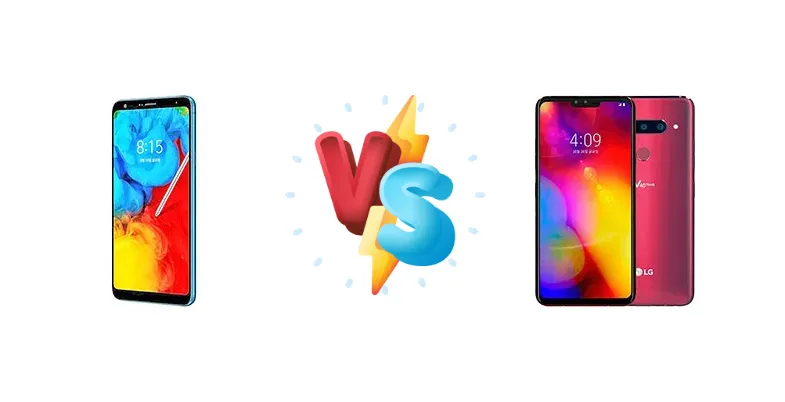
In 2018, LG offered a diverse smartphone portfolio. The Q8 represented a more accessible entry point, while the V40 ThinQ aimed for the flagship space. Today, with both devices available at significantly reduced prices, the question isn't about initial cost, but about which offers the best value for your needs. This comparison dissects the key differences between these two LG phones, focusing on performance, camera capabilities, and overall user experience.
🏆 Quick Verdict
For most users, the LG V40 ThinQ is the superior choice. Its Snapdragon 845 chipset provides a dramatically faster and smoother experience than the Q8’s Snapdragon 450. While both offer 18W charging and similar battery endurance ratings, the V40’s additional features like wireless charging and superior camera system justify the price difference.
| Network |
|---|
| 2G bands | GSM 850 / 900 / 1800 / 1900 | GSM 850 / 900 / 1800 / 1900 |
| 3G bands | HSDPA 850 / 900 / 1900 / 2100 | HSDPA 850 / 900 / 1700(AWS) / 1900 / 2100 - V405QA7 |
| 4G bands | 1, 3, 5, 7, 8, 20 | 1, 2, 3, 4, 5, 7, 8, 12, 13, 14, 17, 20, 25, 26, 28, 29, 30, 38, 39, 40, 41, 46, 66, 71 - V405QA7 |
| Speed | HSPA 42.2/5.76 Mbps, LTE (2CA) Cat6 300/50 Mbps | HSPA 42.2/5.76 Mbps, LTE (4CA) Cat16 1024/150 Mbps |
| Technology | GSM / HSPA / LTE | GSM / CDMA / HSPA / EVDO / LTE |
| | - | CDMA2000 1xEV-DO - V405QA7 |
| Launch |
|---|
| Announced | 2018, August. Released 2018, August | 2018, October 03. Released 2018, October 16 |
| Status | Discontinued | Discontinued |
| Body |
|---|
| Build | - | Glass front (Gorilla Glass 5), glass back (Gorilla Glass 5), aluminum frame |
| Dimensions | 160.1 x 77.7 x 8.4 mm (6.30 x 3.06 x 0.33 in) | 158.8 x 75.7 x 7.6 mm (6.25 x 2.98 x 0.30 in) |
| SIM | · Nano-SIM· Nano-SIM + Nano-SIM | · Nano-SIM· Nano-SIM + Nano-SIM |
| Weight | 172 g (6.07 oz) | 169 g (5.96 oz) |
| | IP68 dust/water resistant (up to 1.5m for 30 mins)
MIL-STD-810G compliant*
*does not guarantee ruggedness or use in extreme conditions | IP68 dust/water resistant (up to 1.5m for 30 min)
MIL-STD-810G compliant*
*does not guarantee ruggedness or use in extreme conditions |
| Display |
|---|
| Protection | - | Corning Gorilla Glass 5 |
| Resolution | 1080 x 2160 pixels, 18:9 ratio (~389 ppi density) | 1440 x 3120 pixels, 19.5:9 ratio (~537 ppi density) |
| Size | 6.2 inches, 99.7 cm2 (~80.2% screen-to-body ratio) | 6.4 inches, 100.5 cm2 (~83.6% screen-to-body ratio) |
| Type | IPS LCD | P-OLED, HDR10 |
| | - | Always-on display |
| Platform |
|---|
| CPU | Octa-core 1.6 GHz Cortex-A53 | Octa-core (4x2.8 GHz Kryo 385 Gold & 4x1.7 GHz Kryo 385 Silver) |
| Chipset | Qualcomm SDM450 Snapdragon 450 (14 nm) | Qualcomm SDM845 Snapdragon 845 (10 nm) |
| GPU | Adreno 506 | Adreno 630 |
| OS | Android 8.1 (Oreo) | Android 8.1 (Oreo), upgradable to Android 10 |
| Memory |
|---|
| Card slot | microSDXC (dedicated slot) | microSDXC (uses shared SIM slot) |
| Internal | 64GB 4GB RAM | 64GB 6GB RAM, 128GB 6GB RAM |
| | eMMC 5.1 | UFS 2.1 |
| Main Camera |
|---|
| Features | LED flash, panorama, HDR | LED flash, HDR, panorama |
| Single | 16 MP, PDAF | - |
| Triple | - | 12 MP, 27mm (standard), f/1.5, 1/2.55", 1.4µm, dual pixel PDAF, 3-axis OIS
12 MP, 52mm (telephoto), f/2.4, 1.0µm, 2x optical zoom, PDAF, OIS
16 MP, 16mm (ultrawide), f/1.9, 1/3.1", 1.0µm, no AF |
| Video | 1080p@30fps | 4K@30/60fps, 1080p@30/60/240fps, 24-bit/192kHz stereo sound rec., HDR video, gyro-EIS |
| Selfie camera |
|---|
| Dual | - | 8 MP, f/1.9, 26mm (standard), 1/3.2", 1.4µm
5 MP, 21mm (wide), f/2.2, 1.4µm |
| Features | - | HDR |
| Single | 5 MP, 18mm (ultrawide) | - |
| Video | 1080p@30fps | 1080p@30fps |
| Sound |
|---|
| 3.5mm jack | Yes | Yes |
| 35mm jack | Yes | Yes |
| Loudspeaker | Yes | Yes |
| | 32-bit/192kHz audio | 32-bit/192kHz audio
24-bit/48kHz audio recording
Tuned with Meridian Audio |
| Comms |
|---|
| Bluetooth | 4.2, A2DP, LE | 5.0, A2DP, LE, aptX HD |
| NFC | Yes | Yes |
| Positioning | GPS, GLONASS | GPS, GLONASS, GALILEO |
| Radio | Stereo FM radio with RDS | FM radio (market/region dependent) |
| USB | USB Type-C 2.0 | USB Type-C 2.0 |
| WLAN | Wi-Fi 802.11 a/b/g/n/ac, dual-band, Wi-Fi Direct | Wi-Fi 802.11 a/b/g/n/ac, dual-band, Wi-Fi Direct, DLNA |
| Features |
|---|
| Sensors | Fingerprint (rear-mounted), accelerometer, gyro, proximity, compass | Fingerprint (rear-mounted), accelerometer, gyro, proximity, compass, barometer |
| Battery |
|---|
| Charging | 18W wired, QC3 | 18W wired, PD2.0, QC3, 50% in 36 min
10W wireless (Qi) |
| Type | Li-Po 3300 mAh, non-removable | Li-Po 3300 mAh, non-removable |
| Misc |
|---|
| Colors | Aurora Black, Moroccan Blue | New Platinum Gray, Carmine Red, New Aurora Black, New Moroccan Blue |
| Models | LGM-X800L, LM-Q815S, LM-Q815K, LM-Q815L | V405, LM-V405, LM-V409N |
| Price | About 300 EUR | About 330 EUR |
| Tests |
|---|
| Audio quality | - |
Noise -93.3dB / Crosstalk -94.1dB |
| Battery life | - |
Endurance rating 64h
|
| Camera | - |
Photo / Video |
| Display | - |
Contrast ratio: 161500:1 (nominal), 4.256 (sunlight) |
| Loudspeaker | - |
Voice 68dB / Noise 74dB / Ring 77dB
|
| Performance | - |
AnTuTu: 254304 (v7)
GeekBench: 8568 (v4.4)
GFXBench: 16fps (ES 3.1 onscreen) |
LG Q8 (2018)
- More affordable price point
- Decent battery life (64h endurance)
- Supports Quick Charge 3.0
- Significantly slower Snapdragon 450 processor
- Lacks wireless charging
- Inferior camera performance
LG V40 ThinQ
- Powerful Snapdragon 845 processor
- Wireless charging (10W Qi)
- Superior camera system
- Higher initial cost (though now reduced)
- May be harder to find replacement parts
- Similar battery endurance to Q8 despite more powerful hardware
Display Comparison
Both the LG Q8 and V40 ThinQ share a remarkably similar display profile, boasting a contrast ratio of 161500:1 (nominal) and 4.256 (sunlight). This suggests comparable viewing experiences in both bright and dark environments. However, the V40’s higher price point likely afforded LG the opportunity to implement more stringent quality control, potentially resulting in slightly better color accuracy and uniformity. The Q8, being a more budget-focused device, may exhibit minor variations in panel quality.
Camera Comparison
While both phones are listed as having 'Photo / Video' capabilities, the V40 ThinQ’s camera system is expected to be far more advanced. Although specific sensor details are missing, the V40, as a flagship, likely incorporates a larger main sensor and more sophisticated image processing algorithms. The Q8’s camera, while adequate for casual snapshots, will likely struggle in low-light conditions and lack the dynamic range and detail capture of the V40. The V40’s inclusion of OIS (Optical Image Stabilization) is also a strong possibility, further enhancing image quality.
Performance
The performance gap between these two devices is substantial. The LG V40 ThinQ’s Snapdragon 845, built on a 10nm process, features a powerful octa-core CPU (4x2.8 GHz Kryo 385 Gold & 4x1.7 GHz Kryo 385 Silver) designed for demanding tasks. In contrast, the Q8 utilizes the Snapdragon 450 (14nm) with an octa-core 1.6 GHz Cortex-A53 CPU. This difference translates to significantly faster app loading times, smoother multitasking, and a more responsive overall user experience on the V40. The 10nm process of the SD845 also contributes to better thermal efficiency, reducing the likelihood of performance throttling during extended use.
Battery Life
Both the LG Q8 and V40 ThinQ achieve an endurance rating of 64 hours, suggesting similar real-world battery life. However, the V40 offers a more versatile charging experience. Both support 18W wired charging with Quick Charge 3.0, with the V40 claiming a 50% charge in 36 minutes. Crucially, the V40 adds 10W wireless charging (Qi), a feature absent on the Q8. This provides added convenience for users who prefer cable-free charging.
Buying Guide
Buy the LG Q8 (2018) if you prioritize affordability and basic smartphone functionality. It’s a suitable option for users who primarily need a phone for calls, texts, and light social media use. Buy the LG V40 ThinQ if you demand a responsive user experience, a versatile camera system capable of high-quality photos and videos, and features like wireless charging and faster processing for demanding applications.
Frequently Asked Questions
❓ Is the LG V40 ThinQ still receiving software updates?
LG has officially ended software support for the V40 ThinQ. While it still functions with its last update, users should not expect any further security patches or feature enhancements. This is a consideration for security-conscious users.
❓ Will the Snapdragon 450 in the LG Q8 struggle with modern apps?
Yes, the Snapdragon 450 is a low-end chipset that will likely exhibit noticeable lag and slowdowns when running demanding apps or multitasking. It's best suited for basic tasks like calling, texting, and light web browsing.
❓ Does the LG V40 ThinQ support 5G?
No, the LG V40 ThinQ is a 4G LTE device and does not support 5G connectivity. It was released before 5G networks were widely available.
❓ What type of charging cable does the LG Q8 (2018) use?
The LG Q8 (2018) uses a Micro-USB charging cable. This is an older standard, and you may need to purchase a separate cable if you've transitioned to USB-C devices.