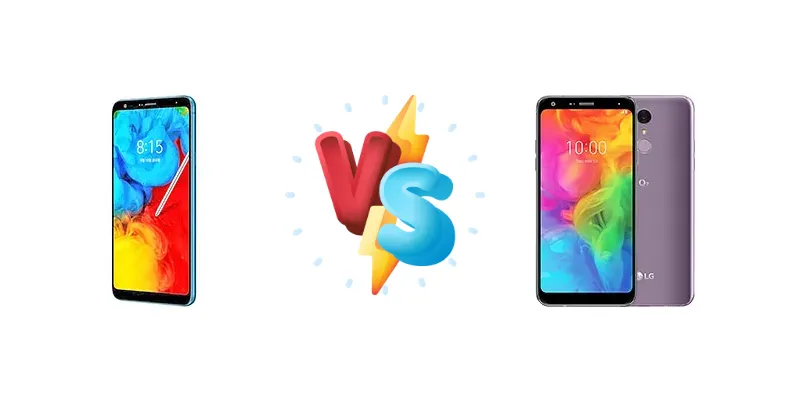
The LG Q8 (2018) and LG Q7 represent LG's attempt to deliver solid smartphone experiences at accessible price points. While both phones share a similar aesthetic, significant differences lie beneath the surface, particularly in their chipsets. This comparison dissects those differences, focusing on performance, efficiency, and real-world usability to determine which device offers the best value.
🏆 Quick Verdict
For most users, the LG Q8 (2018) is the superior choice. Its Snapdragon 450 chipset, built on a more efficient 14nm process, provides a smoother experience and better long-term performance compared to the Q7’s Mediatek MT6750S. While the Q7 offers a slightly faster CPU burst speed, the Q8’s overall efficiency and Qualcomm’s software optimization give it the edge.
| Network |
|---|
| 2G bands | GSM 850 / 900 / 1800 / 1900 | GSM 850 / 900 / 1800 / 1900 |
| 3G bands | HSDPA 850 / 900 / 1900 / 2100 | HSDPA 850 / 900 / 1900 / 2100 |
| 4G bands | 1, 3, 5, 7, 8, 20 | 1, 3, 5, 7, 8, 28, 38, 40, 41 |
| Speed | HSPA 42.2/5.76 Mbps, LTE (2CA) Cat6 300/50 Mbps | HSPA 42.2/5.76 Mbps, LTE (2CA) Cat6 300/50 Mbps |
| Technology | GSM / HSPA / LTE | GSM / HSPA / LTE |
| Launch |
|---|
| Announced | 2018, August. Released 2018, August | 2018, May. Released 2018, June |
| Status | Discontinued | Discontinued |
| Body |
|---|
| Dimensions | 160.1 x 77.7 x 8.4 mm (6.30 x 3.06 x 0.33 in) | 143.8 x 69.3 x 8.4 mm (5.66 x 2.73 x 0.33 in) |
| SIM | · Nano-SIM· Nano-SIM + Nano-SIM | · Nano-SIM· Nano-SIM + Nano-SIM |
| Weight | 172 g (6.07 oz) | 145 g (5.11 oz) |
| | IP68 dust/water resistant (up to 1.5m for 30 mins)
MIL-STD-810G compliant*
*does not guarantee ruggedness or use in extreme conditions | IP68 dust/water resistant (up to 1.5m for 30 mins)
MIL-STD-810G compliant*
*does not guarantee ruggedness or use in extreme conditions |
| Display |
|---|
| Resolution | 1080 x 2160 pixels, 18:9 ratio (~389 ppi density) | 1080 x 2160 pixels, 18:9 ratio (~442 ppi density) |
| Size | 6.2 inches, 99.7 cm2 (~80.2% screen-to-body ratio) | 5.5 inches, 77.0 cm2 (~77.3% screen-to-body ratio) |
| Type | IPS LCD | IPS LCD |
| Platform |
|---|
| CPU | Octa-core 1.6 GHz Cortex-A53 | Octa-core (4x1.5 GHz Cortex-A53 & 4x1.0 GHz Cortex-A53) - Q7, Q7αOcta-core 1.8 GHz Cortex-A53 - Q7+ |
| Chipset | Qualcomm SDM450 Snapdragon 450 (14 nm) | Mediatek MT6750S (28 nm) - Q7, Q7αQualcomm SDM450 Snapdragon 450 (14 nm) - Q7+ |
| GPU | Adreno 506 | Mali-T860MP2 - Q7, Q7αAdreno 506 - Q7+ |
| OS | Android 8.1 (Oreo) | Android 8.1 (Oreo), upgradable to Android 9.0 (Pie) |
| Memory |
|---|
| Card slot | microSDXC (dedicated slot) | microSDXC (dedicated slot) |
| Internal | 64GB 4GB RAM | 32GB 3GB RAM, 64GB 4GB RAM |
| | eMMC 5.1 | eMMC 5.1 |
| Main Camera |
|---|
| Features | LED flash, panorama, HDR | LED flash, panorama, HDR |
| Single | 16 MP, PDAF | 13 MP, f/2.2, 1/3.1", 1.12µm, PDAF (Q7, Q7α)
16 MP, PDAF (Q7+) |
| Video | 1080p@30fps | 1080p@30fps (gyro-EIS) |
| Selfie camera |
|---|
| Single | 5 MP, 18mm (ultrawide) | 5 MP (Q7α)
8 MP, f/1.9, 1/4.0", 1.12µm (Q7, Q7+) |
| Video | 1080p@30fps | 1080p@30fps |
| Sound |
|---|
| 3.5mm jack | Yes | Yes |
| 35mm jack | Yes | Yes |
| Loudspeaker | Yes | Yes |
| | 32-bit/192kHz audio | - |
| Comms |
|---|
| Bluetooth | 4.2, A2DP, LE | 4.2, A2DP, LE |
| NFC | Yes | Yes |
| Positioning | GPS, GLONASS | GPS, GLONASS |
| Radio | Stereo FM radio with RDS | Stereo FM radio with RDS |
| USB | USB Type-C 2.0 | USB Type-C 2.0, OTG |
| WLAN | Wi-Fi 802.11 a/b/g/n/ac, dual-band, Wi-Fi Direct | Wi-Fi 802.11 b/g/n, Wi-Fi Direct, DLNA |
| Features |
|---|
| Sensors | Fingerprint (rear-mounted), accelerometer, gyro, proximity, compass | Fingerprint (rear-mounted), accelerometer, gyro, proximity, compass |
| Battery |
|---|
| Charging | 18W wired, QC3 | 15W wired |
| Type | Li-Po 3300 mAh, non-removable | Li-Po 3000 mAh, non-removable |
| Misc |
|---|
| Colors | Aurora Black, Moroccan Blue | Aurora Black, Moroccan Blue, Lavender Violet |
| Models | LGM-X800L, LM-Q815S, LM-Q815K, LM-Q815L | LM-Q610, LM-Q610.FG, LM-Q610.FGN, LM-Q610(FGN), LM-Q610.YN, LM-Q725L, LM-Q725K, LM-Q725S |
| Price | About 300 EUR | About 150 EUR |
LG Q8 (2018)
- More efficient Snapdragon 450 chipset
- Faster 18W Quick Charge 3.0 support
- Potentially better image processing with Qualcomm ISP
- Uniform CPU clock speed may not appeal to benchmark enthusiasts
- Limited information available on display quality
LG Q7
- Potentially lower price point
- Higher CPU burst speeds (Q7/Q7α)
- Acceptable performance for basic tasks
- Less efficient Mediatek MT6750S chipset
- Slower 15W charging
- Potential for throttling under sustained load
Display Comparison
Both the LG Q8 and Q7 likely feature IPS LCD panels, typical for their price bracket. However, detailed specifications regarding resolution, brightness, and color gamut are unavailable. Given the Q8’s slightly higher positioning, it *may* have benefitted from a marginally better panel, but without concrete data, this remains speculative. The focus here is on the internal hardware impacting the user experience, not display quality.
Camera Comparison
Without detailed camera sensor information, a direct comparison is difficult. Both phones likely feature similar camera setups geared towards casual photography. The absence of information regarding sensor size and aperture suggests neither phone excels in low-light conditions. Focusing on the chipset, the Snapdragon 450 in the Q8 benefits from Qualcomm’s image signal processor (ISP), which generally provides better image processing and faster capture speeds compared to the ISP found in the Mediatek MT6750S. This translates to potentially sharper images and more accurate colors, even with similar sensors.
Performance
The core difference lies in the chipsets. The LG Q8 (2018) utilizes the Qualcomm Snapdragon 450 (14nm), an octa-core processor clocked at 1.6 GHz. This is a significant advantage over the LG Q7’s Mediatek MT6750S (28nm). The 28nm process of the MT6750S is considerably less efficient, leading to more heat generation and potential throttling under sustained load. While the Q7 boasts a CPU configuration with faster cores (4x1.5 GHz & 4x1.0 GHz) compared to the Q8’s uniform 1.6 GHz, the Snapdragon 450’s architecture and Qualcomm’s software optimizations generally result in a more responsive and stable experience. The Q7+ variant, equipped with the Snapdragon 450, directly addresses this performance gap, effectively matching the Q8.
Battery Life
The LG Q7 has 15W wired charging, while the Q8 supports 18W Quick Charge 3.0. While the difference isn’t massive, the Q8’s faster charging will reduce downtime. The Mediatek MT6750S’s less efficient 28nm process will likely result in higher power consumption, potentially negating any advantage from a larger battery (if present – battery capacity is not specified in the provided data). The Snapdragon 450’s efficiency gives the Q8 a better chance of delivering all-day battery life, even with moderate usage.
Buying Guide
Buy the LG Q8 (2018) if you prioritize consistent performance, smoother multitasking, and a more future-proof experience, even if it means sacrificing a small amount of peak CPU speed. Buy the LG Q7 if you are looking for the absolute lowest price and are willing to accept potential performance hiccups and reduced efficiency, particularly if your usage is primarily limited to basic tasks like calls, texts, and light social media.
Frequently Asked Questions
❓ Will the Mediatek MT6750S in the LG Q7 struggle with demanding apps like PUBG Mobile?
The Mediatek MT6750S is likely to exhibit performance limitations when running graphically intensive games like PUBG Mobile, especially at higher settings. Expect lower frame rates and potential stuttering. The Snapdragon 450 in the Q8 will provide a smoother, more consistent gaming experience, though neither phone is designed for high-end gaming.
❓ Does the LG Q8 (2018) support software updates beyond Android 8.0 (likely its launch version)?
Given the age of the LG Q8 (2018), significant software updates are unlikely. LG has historically provided limited long-term support for its budget and mid-range devices. Expect security patches to cease after a few years. The Q7’s update situation is likely similar.
❓ Is the difference in charging speed (15W vs 18W) between the Q7 and Q8 noticeable in everyday use?
Yes, the 18W Quick Charge 3.0 support in the Q8 will result in noticeably faster charging times. While not a dramatic difference, it can shave off 15-30 minutes from a full charge, which is beneficial for users who frequently need to top up their battery.