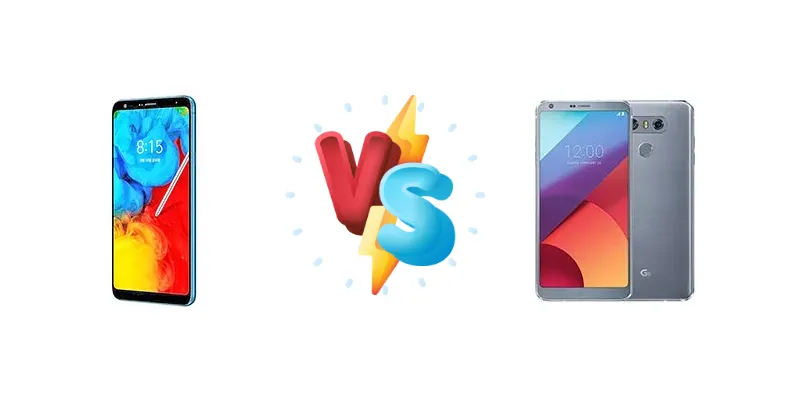
Released a year apart, the LG G6 and LG Q8 (2018) represent different approaches to the smartphone market. The G6 was LG’s 2017 flagship, boasting a premium build and powerful processor. The Q8, launched in 2018, aimed for a more accessible price point, making compromises in processing power to achieve affordability. This comparison dissects those trade-offs to help you determine which device best suits your needs.
🏆 Quick Verdict
For most users, the LG G6 remains the superior choice. Its Snapdragon 821 chipset delivers a significantly smoother and more responsive experience than the Q8’s Snapdragon 450. While the Q8 offers a lower entry price, the G6’s performance advantage justifies the cost for anyone beyond very basic smartphone usage.
| Network |
|---|
| 2G bands | GSM 850 / 900 / 1800 / 1900 | GSM 850 / 900 / 1800 / 1900 - SIM 1 & SIM 2 (dual-SIM model only) |
| 3G bands | HSDPA 850 / 900 / 1900 / 2100 | HSDPA 850 / 900 / 1700(AWS) / 1900 / 2100 |
| 4G bands | 1, 3, 5, 7, 8, 20 | 1, 2, 3, 4, 5, 7, 8, 12, 13, 17, 20, 28, 38, 40 |
| Speed | HSPA 42.2/5.76 Mbps, LTE (2CA) Cat6 300/50 Mbps | HSPA 42.2/5.76 Mbps, LTE (3CA) Cat12 600/150 Mbps |
| Technology | GSM / HSPA / LTE | GSM / HSPA / LTE |
| Launch |
|---|
| Announced | 2018, August. Released 2018, August | 2017, February 26. Released 2017, April 07 |
| Status | Discontinued | Discontinued |
| Body |
|---|
| Build | - | Glass front (Gorilla Glass 3), glass back (Gorilla Glass 5), aluminum frame |
| Dimensions | 160.1 x 77.7 x 8.4 mm (6.30 x 3.06 x 0.33 in) | 148.9 x 71.9 x 7.9 mm (5.86 x 2.83 x 0.31 in) |
| SIM | · Nano-SIM· Nano-SIM + Nano-SIM | · Nano-SIM· Nano-SIM + Nano-SIM |
| Weight | 172 g (6.07 oz) | 163 g (5.75 oz) |
| | IP68 dust/water resistant (up to 1.5m for 30 mins)
MIL-STD-810G compliant*
*does not guarantee ruggedness or use in extreme conditions | IP68 dust/water resistant (up to 1.5m for 30 mins)
MIL-STD-810G compliant*
*does not guarantee ruggedness or use in extreme conditions |
| Display |
|---|
| Protection | - | Corning Gorilla Glass 3 |
| Resolution | 1080 x 2160 pixels, 18:9 ratio (~389 ppi density) | 1440 x 2880 pixels, 18:9 ratio (~564 ppi density) |
| Size | 6.2 inches, 99.7 cm2 (~80.2% screen-to-body ratio) | 5.7 inches, 84.1 cm2 (~78.6% screen-to-body ratio) |
| Type | IPS LCD | IPS LCD, HDR10, Dolby Vision |
| | - | Always-on display |
| Platform |
|---|
| CPU | Octa-core 1.6 GHz Cortex-A53 | Quad-core (2x2.35 GHz Kryo & 2x1.6 GHz Kryo) |
| Chipset | Qualcomm SDM450 Snapdragon 450 (14 nm) | Qualcomm MSM8996 Snapdragon 821 (14 nm) |
| GPU | Adreno 506 | Adreno 530 |
| OS | Android 8.1 (Oreo) | Android 7.0 (Nougat), upgradable to Android 9.0 (Pie), LG UX 8 UI |
| Memory |
|---|
| Card slot | microSDXC (dedicated slot) | microSDXC (uses shared SIM slot) - dual SIM model only |
| Internal | 64GB 4GB RAM | 32GB 4GB RAM, 64GB 4GB RAM, 128GB 4GB RAM |
| | eMMC 5.1 | UFS 2.0 |
| Main Camera |
|---|
| Dual | - | 13 MP, f/1.8, 30mm (standard), 1/3.1", 1.12µm, PDAF, 3-axis OIS
13 MP, f/2.4, 12mm (ultrawide), no AF |
| Features | LED flash, panorama, HDR | Dual-LED flash, HDR, panorama |
| Single | 16 MP, PDAF | - |
| Video | 1080p@30fps | 4K@30fps, 1080p@30/60fps, HDR, 24-bit/192kHz stereo sound rec. |
| Selfie camera |
|---|
| Single | 5 MP, 18mm (ultrawide) | 5 MP, f/2.2, 18mm |
| Video | 1080p@30fps | 1080p@30fps |
| Sound |
|---|
| 3.5mm jack | Yes | Yes |
| 35mm jack | Yes | Yes |
| Loudspeaker | Yes | Yes |
| | 32-bit/192kHz audio | 32-bit/192kHz audio
|
| Comms |
|---|
| Bluetooth | 4.2, A2DP, LE | 4.2, A2DP, LE, aptX HD |
| NFC | Yes | Yes |
| Positioning | GPS, GLONASS | GPS, GLONASS, BDS |
| Radio | Stereo FM radio with RDS | FM radio (market dependent) |
| USB | USB Type-C 2.0 | USB Type-C 3.1, OTG |
| WLAN | Wi-Fi 802.11 a/b/g/n/ac, dual-band, Wi-Fi Direct | Wi-Fi 802.11 a/b/g/n/ac, dual-band, Wi-Fi Direct, DLNA |
| Features |
|---|
| Sensors | Fingerprint (rear-mounted), accelerometer, gyro, proximity, compass | Fingerprint (rear-mounted), accelerometer, gyro, proximity, compass, barometer |
| Battery |
|---|
| Charging | 18W wired, QC3 | 18W wired, QC3, 50% in 30 min
Wireless (USA) |
| Type | Li-Po 3300 mAh, non-removable | Li-Po 3300 mAh, non-removable |
| Misc |
|---|
| Colors | Aurora Black, Moroccan Blue | Astro Black, Ice Platinum, Terra Gold, Marine Blue, Mystic White, Raspberry Rose, Moroccan Blue, Lavender Violet |
| Models | LGM-X800L, LM-Q815S, LM-Q815K, LM-Q815L | H870, H870DS, H873, H870S, LGM-G600L, H872, H871, LS993, US997, vs988, VS988, LGM-G600K, LGM-G600S, AS993, LGUS997, H870AR, H872PR, H871S, H870I |
| Price | About 300 EUR | About 240 EUR |
| SAR | - | 0.65 W/kg (head) 1.23 W/kg (body) |
| SAR EU | - | 0.23 W/kg (head) 0.15 W/kg (body) |
| Tests |
|---|
| Audio quality | - |
Noise -93.3dB / Crosstalk -94.4dB |
| Battery life | - | Endurance rating 72h |
| Camera | - |
Photo / Video |
| Display | - |
Contrast ratio: 2053 (nominal), 3.556 (sunlight) |
| Loudspeaker | - |
Voice 66dB / Noise 68dB / Ring 74dB |
| Performance | - |
AnTuTu: 158785 (v7)
GeekBench: 4175 (v4.4)
GFXBench: 8.5fps (ES 3.1 onscreen) |
LG Q8 (2018)
- Significantly faster processor (Snapdragon 821)
- Wireless charging support (USA models)
- Potentially superior camera performance
- Higher price point
- May be harder to find in good condition due to age
LG G6
- More affordable price
- Decent battery life (72h endurance)
- Supports Quick Charge 3.0
- Slow processor (Snapdragon 450)
- Lacks wireless charging
- Potentially lower camera quality
Display Comparison
Both the LG G6 and Q8 share a similar contrast ratio of 2053:1 (nominal) and 3.556:1 (sunlight), suggesting comparable viewing experiences in various lighting conditions. However, the G6’s display benefits from the more powerful image processing capabilities of the Snapdragon 821, potentially resulting in more accurate color reproduction. While specific panel technology isn't detailed, the G6’s flagship status likely afforded it a higher-quality panel overall. The Q8’s display, while adequate, is a cost-saving measure.
Camera Comparison
Both phones feature photo and video capabilities, but details are limited. The LG G6, as a flagship, likely benefits from more advanced image processing algorithms and potentially a larger sensor. While sensor size and aperture aren’t specified, the G6’s overall hardware advantage suggests superior image quality, particularly in low-light conditions. The Q8’s camera is likely sufficient for casual snapshots, but won’t match the G6’s detail and dynamic range. The absence of specific camera specs makes a definitive comparison difficult, but the G6’s position in LG’s lineup points to a more capable camera system.
Performance
The performance gap between these two devices is substantial. The LG G6’s Snapdragon 821, a quad-core processor with Kryo cores clocked up to 2.35 GHz, significantly outperforms the LG Q8’s Snapdragon 450, an octa-core processor clocked at 1.6 GHz. The 821’s architecture is designed for sustained performance, making it better suited for demanding tasks and gaming. The Q8’s Snapdragon 450 is adequate for basic use, but will struggle with resource-intensive applications. The G6’s superior GPU also translates to a smoother gaming experience.
Battery Life
Both the LG G6 and Q8 boast an endurance rating of 72 hours, suggesting similar battery life under typical usage. However, the G6’s faster processor could consume more power during intensive tasks. Both support 18W Quick Charge 3.0, with the G6 claiming a 50% charge in 30 minutes. The G6 also offered wireless charging (USA models), a feature absent on the Q8. While battery capacity isn’t specified, the G6’s more efficient power management and wireless charging capabilities give it a slight edge.
Buying Guide
Buy the LG Q8 (2018) if you prioritize extreme affordability and only need a phone for essential tasks like calls, texts, and light social media. Buy the LG G6 if you value performance for gaming, multitasking, or demanding applications, and appreciate a more refined user experience. The G6 is the better option for users who plan to keep their phone for several years.
Frequently Asked Questions
❓ Is the Snapdragon 450 in the LG Q8 sufficient for modern apps like TikTok and Instagram?
While the Snapdragon 450 can handle basic social media apps like TikTok and Instagram, you may experience lag or slowdowns when multitasking or using the apps for extended periods. The processor is designed for light usage, and demanding apps can push its limits.
❓ Does the LG G6 still receive software updates?
No, the LG G6 is no longer officially supported with software updates from LG. However, the Android community has developed custom ROMs that can provide updated security patches and features. Installing a custom ROM requires technical expertise and voids the warranty.
❓ What is the real-world difference in charging speed between the LG G6 and Q8?
Both phones support 18W Quick Charge 3.0, and LG claims 50% charge in 30 minutes for the G6. While the Q8 also supports QC3, the G6’s more efficient power delivery system may result in slightly faster charging times in practice. The G6 also has the added benefit of wireless charging.
❓ Which phone is better for playing mobile games?
The LG G6 is significantly better for gaming. Its Snapdragon 821 processor and more powerful GPU provide a much smoother and more responsive gaming experience compared to the LG Q8’s Snapdragon 450. The Q8 will struggle with graphically demanding games.