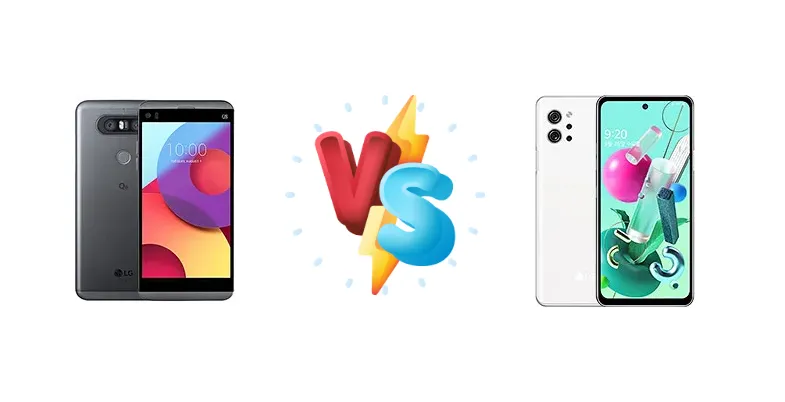
LG's smartphone lineup has seen changes over the years. The LG Q8 (2017) was a premium mid-ranger, while the LG Q92 5G aimed for a more modern 5G experience. But which phone holds up better today? Let's dive into a comprehensive comparison.
🏆 Quick Verdict
The LG Q92 5G ultimately wins due to its 5G connectivity, more modern chipset (Snapdragon 765G), and improved efficiency. While the Q8 boasts a slightly faster processor core, the Q92's overall package and future-proofing make it the better choice for most users.
| Network |
|---|
| 2G bands | GSM 850 / 900 / 1800 / 1900 - SIM 1 & SIM 2 (dual-SIM model only) | GSM 850 / 900 / 1800 / 1900 |
| 3G bands | HSDPA 850 / 900 / 1900 / 2100 | HSDPA 850 / 900 / 1900 / 2100 |
| 4G bands | LTE | LTE |
| 5G bands | - | SA/NSA |
| Speed | HSPA 42.2/5.76 Mbps, LTE (2CA) Cat6 300/50 Mbps | HSPA, LTE, 5G |
| Technology | GSM / HSPA / LTE | GSM / HSPA / LTE / 5G |
| Launch |
|---|
| Announced | 2017, July. Released 2017, August | 2020, August 24. Released 2020, August 26 |
| Status | Discontinued | Discontinued |
| Body |
|---|
| Build | Glass front (Gorilla Glass 4), aluminum/plastic back, aluminum frame | - |
| Dimensions | 149 x 71.9 x 8 mm (5.87 x 2.83 x 0.31 in) | 166.5 x 77.3 x 8.5 mm (6.56 x 3.04 x 0.33 in) |
| SIM | · Nano-SIM· Nano-SIM + Nano-SIM | Nano-SIM + Nano-SIM |
| Weight | 146 g (5.15 oz) | 193 g (6.81 oz) |
| | IP67 dust/water resistant (up to 1m for 30 min) | IP68 dust/water resistant (up to 1.5m for 30 mins)
MIL-STD-810G compliant*
*does not guarantee ruggedness or use in extreme conditions |
| Display |
|---|
| Protection | Corning Gorilla Glass 4 | - |
| Resolution | 1440 x 2560 pixels, 16:9 ratio (~564 ppi density) | 1080 x 2400 pixels, 20:9 ratio (~395 ppi density) |
| Size | 5.2 inches, 74.8 cm2 (~69.8% screen-to-body ratio) | 6.67 inches, 107.4 cm2 (~83.5% screen-to-body ratio) |
| Type | IPS LCD | IPS LCD |
| | Secondary display, 160 x 1040 pixels, 1.8 inches
Always-on display | - |
| Platform |
|---|
| CPU | Quad-core (2x2.15 GHz Kryo & 2x1.6 GHz Kryo) | Octa-core (1x2.4 GHz Kryo 475 Prime & 1x2.2 GHz Kryo 475 Gold & 6x1.8 GHz Kryo 475 Silver) |
| Chipset | Qualcomm MSM8996 Snapdragon 820 (14 nm) | Qualcomm SM7250 Snapdragon 765G 5G (7 nm) |
| GPU | Adreno 530 | Adreno 620 |
| OS | Android 7.0 (Nougat) | Android 10 |
| Memory |
|---|
| Card slot | microSDXC (dedicated slot) - single-SIM modelmicroSDXC (uses shared SIM slot) - dual-SIM model | microSDXC |
| Internal | 32GB 4GB RAM | 128GB 6GB RAM |
| Main Camera |
|---|
| Dual | 16 MP, f/1.8, 28mm (wide), 1/2.6", 3-axis OIS
8 MP, f/2.4, 10mm (ultrawide), 1/4.0" | - |
| Features | Laser AF, Dual-LED flash, panorama, HDR | LED flash, panorama, HDR |
| Quad | - | 48 MP, f/1.8, 26mm (wide), 1/2.0", 0.8µm, PDAF
8 MP, f/2.2, 120˚, 15mm (ultrawide), 1/4.0", 1.12µm
2 MP (macro)
Auxiliary lens |
| Triple | 13 MP, f/1.8, (wide), PDAF
2 MP, f/2.4, (macro)
2 MP, f/2.4, (depth) | - |
| Video | 4K@30fps, 1080p@30/60fps, 720p@120fps, 24-bit/48kHz stereo sound rec. | 4K@30fps, 1080p@30fps |
| Selfie camera |
|---|
| Features | - | HDR |
| Single | 5 MP, f/1.9, 1/5.0", 1.12µm | 32 MP, f/1.9, 26mm (wide), 1/2.8", 0.8µm |
| Video | 1080p@30fps | 1080p@30fps |
| Sound |
|---|
| 3.5mm jack | Yes | Yes |
| 35mm jack | Yes | Yes |
| Loudspeaker | Yes | Yes, with stereo speakers |
| | 32-bit/192kHz audio
24-bit/192kHz audio recording
| - |
| Comms |
|---|
| Bluetooth | 4.2, A2DP, LE | 5.0, A2DP, LE |
| Infrared port | Yes | - |
| NFC | Yes | Yes |
| Positioning | GPS, GLONASS | GPS, GLONASS, GALILEO, BDS |
| Radio | FM radio, RDS | No |
| USB | USB Type-C | USB Type-C 2.0 |
| WLAN | Wi-Fi 802.11 a/b/g/n/ac, dual-band, Wi-Fi Direct, DLNA | Wi-Fi 802.11 a/b/g/n/ac, dual-band, Wi-Fi Direct, DLNA |
| Features |
|---|
| Sensors | Fingerprint (rear-mounted), accelerometer, gyro, proximity, compass | Fingerprint (side-mounted), accelerometer, gyro, proximity, compass |
| Battery |
|---|
| Charging | 18W wired, QC3 | 15W wired |
| Type | Li-Ion 3000 mAh, non-removable | Li-Po 4000 mAh |
| Misc |
|---|
| Colors | Titan | White, Dark Blue, Red |
| Models | H970 | LM-Q920N |
| Price | About 200 EUR | About 360 EUR |
LG Q8 (2017)
- Compact size
- Powerful processor for its time
- Excellent display sharpness
- Premium build quality
- Outdated chipset
- No 5G connectivity
- Smaller battery
- Limited software updates
LG Q92 5G
- 5G connectivity
- Larger display
- Modern chipset (Snapdragon 765G)
- Improved battery life
- Versatile camera system
- Slower peak performance than Q8's core speeds
- 15W charging is slower than Q8's QC3
- Larger size may not appeal to everyone
Display Comparison
The LG Q8 features a 5.5-inch IPS LCD display with a QHD resolution (2560 x 1440), offering excellent sharpness and vibrant colors. The LG Q92 5G has a larger 6.7-inch IPS LCD display with a FHD+ resolution (2520 x 1080). While the Q8 has a higher pixel density, the Q92's larger size provides a more immersive viewing experience. Both offer good color accuracy, but the Q92's size is a significant advantage.
Camera Comparison
The LG Q8 had a 13MP dual rear camera setup, known for its good image quality in daylight. The LG Q92 5G features a 48MP main camera, an 8MP ultrawide lens, and a 5MP depth sensor. The Q92 generally captures more detailed photos, especially in low light, thanks to its larger sensor and improved image processing. The ultrawide lens adds versatility. Video recording capabilities are comparable, with both supporting 4K recording.
Performance
The LG Q8's Snapdragon 820 was a flagship chipset in 2017, offering strong performance. However, the LG Q92 5G's Snapdragon 765G is a more modern and efficient chip built on a 7nm process. While the Q8's individual core speeds are slightly higher, the 765G's architecture and integrated 5G modem provide a smoother overall experience, especially with modern apps and multitasking. The Q92 also benefits from more RAM in most configurations.
Battery Life
The LG Q8 had a 3000mAh battery, which provided decent battery life for its time. The LG Q92 5G has a 4000mAh battery, offering significantly better battery life, especially considering its larger display and 5G capabilities. The Q92 easily lasts a full day of moderate to heavy use, while the Q8 might require a top-up before the end of the day.
Buying Guide
The LG Q8 (2017) is a good option for users seeking a compact, premium-feeling phone with a powerful processor for its time, and who don't need 5G. The LG Q92 5G is ideal for those wanting 5G connectivity, a larger display, and a more modern Android experience, even if it means slightly slower peak performance.
Frequently Asked Questions
❓ Is the LG Q8 still worth buying?
If you prioritize a compact size and don't need 5G, the Q8 can still be a decent option, but its age and lack of updates are significant drawbacks.
❓ Does the LG Q92 5G have good software support?
LG has largely discontinued software updates for its smartphones. While the Q92 received some initial updates, don't expect major Android version upgrades.