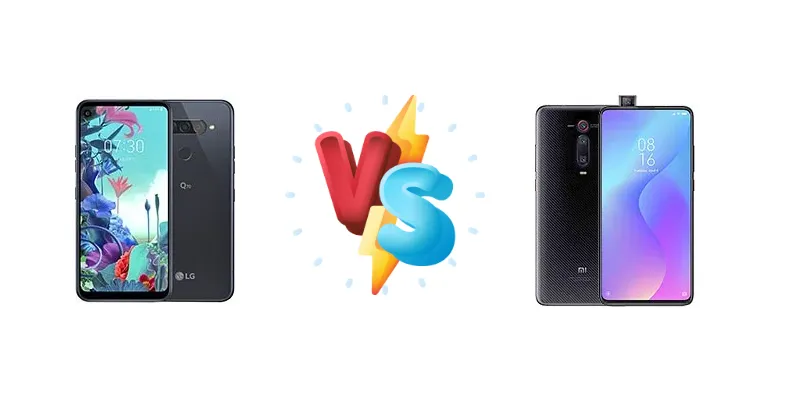
The LG Q70 and Xiaomi Mi 9T Pro represent distinct approaches to the mid-range smartphone market. The Q70, with its Snapdragon 675, aimed for solid all-around performance and reliability. The Mi 9T Pro, however, brought near-flagship power with the Snapdragon 855, but at a slightly higher price point. This comparison dissects the key differences to help you determine which device best suits your needs.
🏆 Quick Verdict
For the average user prioritizing raw performance and future-proofing, the Xiaomi Mi 9T Pro is the clear winner. Its Snapdragon 855 offers a substantial leap in processing power and gaming capabilities. However, the LG Q70 remains a viable option for those on a tighter budget who value a dependable experience.
| Network |
|---|
| 2G bands | GSM 850 / 900 / 1800 / 1900 | GSM 850 / 900 / 1800 / 1900 |
| 3G bands | HSDPA 850 / 900 / 1900 / 2100 | HSDPA 850 / 900 / 1700(AWS) / 1900 / 2100 |
| 4G bands | 2, 3, 4, 5, 7, 12, 13, 20, 66 - Verizon | 1, 2, 3, 4, 5, 7, 8, 20, 28, 38, 40 |
| Speed | HSPA 42.2/5.76 Mbps, LTE (3CA) Cat11 600/75 Mbps | HSPA, LTE |
| Technology | GSM / CDMA / HSPA / EVDO / LTE | GSM / HSPA / LTE |
| | CDMA2000 1xEV-DO | - |
| Launch |
|---|
| Announced | 2019, September 28. Released 2019, October | 2019, August 21. Released 2019, August 21 |
| Status | Discontinued | Discontinued |
| Body |
|---|
| Build | Glass front (Gorilla Glass), glass back, aluminum frame | Glass front (Gorilla Glass 5), glass back (Gorilla Glass 5), aluminum frame |
| Dimensions | 162.1 x 76.8 x 8.3 mm (6.38 x 3.02 x 0.33 in) | 156.7 x 74.3 x 8.8 mm (6.17 x 2.93 x 0.35 in) |
| SIM | · Nano-SIM· Nano-SIM + Nano-SIM | Nano-SIM + Nano-SIM |
| Weight | 198 g (6.98 oz) | 191 g (6.74 oz) |
| | IP68 dust/water resistant (up to 1.5m for 30 min)
MIL-STD-810G compliant*
*does not guarantee ruggedness or use in extreme conditions | - |
| Display |
|---|
| Protection | Corning Gorilla Glass | Corning Gorilla Glass 5 |
| Resolution | 1080 x 2310 pixels (~398 ppi density) | 1080 x 2340 pixels, 19.5:9 ratio (~403 ppi density) |
| Size | 6.4 inches, 101.4 cm2 (~81.4% screen-to-body ratio) | 6.39 inches, 100.2 cm2 (~86.1% screen-to-body ratio) |
| Type | IPS LCD | Super AMOLED, HDR |
| Platform |
|---|
| CPU | Octa-core (2x2.0 GHz Kryo 460 Gold & 6x1.7 GHz Kryo 460 Silver) | Octa-core (1x2.84 GHz Kryo 485 & 3x2.42 GHz Kryo 485 & 4x1.78 GHz Kryo 485) |
| Chipset | Qualcomm SDM675 Snapdragon 675 (11 nm) | Qualcomm SM8150 Snapdragon 855 (7 nm) |
| GPU | Adreno 612 | Adreno 640 |
| OS | Android 9.0 (Pie), upgradable to Android 10, LG UX 9 | Android 9.0 (Pie), upgradable to Android 11, MIUI 12.5 |
| Memory |
|---|
| Card slot | microSDXC (dedicated slot) | No |
| Internal | 64GB 4GB RAM | 64GB 6GB RAM, 128GB 6GB RAM, 256GB 8GB RAM |
| | eMMC 5.1 | UFS 2.1 |
| Main Camera |
|---|
| Dual or Triple | 32 MP, f/1.8, 26mm (wide), 1/2.8", 0.8µm, PDAF
13 MP, f/2.2, 13mm (ultrawide)
Auxiliary lens
or
32 MP, f/1.8, 26mm (wide), 1/2.8", 0.8µm, PDAF
Auxiliary lens | - |
| Features | LED flash, panorama, HDR | Laser AF, Dual-LED flash, HDR, panorama |
| Triple | - | 48 MP, f/1.8, 26mm (wide), 1/2.0", 0.8µm, PDAF
8 MP, f/2.4, 53mm (telephoto), 1/4.0", 1.12µm, PDAF, 2x optical zoom
13 MP, f/2.4, 12mm (ultrawide), 1/3.1", 1.12µm |
| Video | 4K@30fps, 1080p@30fps | 4K@30/60fps, 1080p@30/120/240fps, 1080p@960fps |
| Selfie camera |
|---|
| Features | HDR | HDR |
| Single | 16 MP, f/1.9, 26mm (wide), 1/2.8", 1.12µm | Motorized pop-up 20 MP, f/2.2, (wide), 1/3.4", 0.8µm |
| Video | 1080p@30fps | 1080p@30fps |
| Sound |
|---|
| 3.5mm jack | Yes | Yes |
| 35mm jack | Yes | Yes |
| Loudspeaker | Yes | Yes |
| | 32-bit/192kHz audio | 24-bit/192kHz audio
|
| Comms |
|---|
| Bluetooth | 5.0, A2DP, LE | 5.0, A2DP, LE, aptX HD |
| NFC | Yes | Yes |
| Positioning | GPS, GLONASS | GPS (L1+L5), GLONASS (G1), BDS (B1), GALILEO (E1+E5a) |
| Radio | No | Yes |
| USB | USB Type-C 2.0 | USB Type-C 2.0, OTG |
| WLAN | Wi-Fi 802.11 a/b/g/n/ac, dual-band, Wi-Fi Direct, DLNA | Wi-Fi 802.11 a/b/g/n/ac, dual-band, Wi-Fi Direct |
| Features |
|---|
| Sensors | Fingerprint (rear-mounted), accelerometer, proximity, compass | Fingerprint (under display, optical), accelerometer, gyro, proximity, compass |
| Battery |
|---|
| Charging | 15W wired, QC3 | 27W wired, QC4 |
| Type | Li-Po 4000 mAh, non-removable | Li-Po 4000 mAh, non-removable |
| Misc |
|---|
| Colors | Mirror Black | Carbon black, Red flame, Glacier blue |
| Models | LM-Q730N, LMQ620WA, LM-Q620WA, LM-Q620VAB, LMQ620VAB, LM-Q730 | M1903F11G |
| Price | About 320 EUR | About 150 EUR |
| SAR | - | 1.03 W/kg (head) 0.72 W/kg (body) |
| SAR EU | - | 1.30 W/kg (head) 1.51 W/kg (body) |
| Tests |
|---|
| Audio quality | - |
Noise -93.9dB / Crosstalk -94.2dB |
| Battery life | - | Endurance rating 103h |
| Display | - |
Contrast ratio: Infinite (nominal) |
| Loudspeaker | - |
-26.9 LUFS (Good) |
| Performance | - |
AnTuTu: 368846 (v7), 437823 (v8)
GeekBench: 10684 (v4.4), 2732 (v5.1)
GFXBench: 36fps (ES 3.1 onscreen) |
LG Q70
- More affordable price point
- Reliable Snapdragon 675 performance for everyday tasks
- Decent battery life
- Significantly slower performance compared to the Mi 9T Pro
- Slower charging speed (15W)
- Less future-proof
Xiaomi Mi 9T Pro
- Powerful Snapdragon 855 processor
- Faster 27W charging with QC4
- Superior gaming performance
- Higher price tag
- Potentially more heat generation under heavy load
- May not offer significantly better battery life despite the more powerful chipset
Display Comparison
Both devices feature displays with an 'Infinite' (nominal) contrast ratio, suggesting deep blacks, but lack specific details on panel technology like OLED or IPS. The lack of detailed display specs makes a direct comparison difficult. However, the Mi 9T Pro’s higher processing power could potentially drive higher refresh rate displays if supported by the software, a feature absent in the Q70’s specifications. Bezels are likely comparable given the market segment, but without specific measurements, it's difficult to assess.
Camera Comparison
Without detailed camera specifications beyond the presence of sensors, a thorough comparison is limited. However, the Mi 9T Pro, being a higher-tier device, likely features a more sophisticated image processing pipeline and potentially larger sensor sizes. While both phones likely offer standard features like HDR and scene detection, the 855’s image signal processor (ISP) is more advanced, enabling faster processing and potentially better low-light performance. The absence of OIS information for either device makes it difficult to assess image stabilization capabilities.
Performance
The core difference lies in the chipsets. The Xiaomi Mi 9T Pro’s Snapdragon 855 (7nm) is a significant upgrade over the LG Q70’s Snapdragon 675 (11nm). The 855’s Kryo 485 cores, with a prime core clocked at 2.84 GHz, deliver substantially higher CPU and GPU performance. The 7nm process node also contributes to better thermal efficiency, meaning the Mi 9T Pro is less likely to throttle under sustained load. This translates to smoother gaming, faster app loading times, and a more responsive overall experience. The Q70’s Snapdragon 675 is still capable for everyday tasks, but will struggle with demanding games and applications.
Battery Life
Both phones boast an endurance rating of 103 hours, suggesting similar real-world battery life despite the Mi 9T Pro’s more powerful processor. This is likely due to optimizations in software and battery management. However, the Mi 9T Pro’s 27W fast charging with QC4 support is a significant advantage over the Q70’s 15W charging with QC3. The faster charging allows for a much quicker top-up, reducing downtime. While both offer adequate battery life, the Mi 9T Pro’s charging speed provides a more convenient user experience.
Buying Guide
Buy the LG Q70 if you need a reliable daily driver with good battery life and aren't demanding of the most intensive mobile games or applications. It's ideal for users who prioritize practicality and affordability. Buy the Xiaomi Mi 9T Pro if you prefer a smoother, faster experience, especially for gaming and multitasking. It's the better choice for power users and those who want a phone that will remain responsive for years to come.
Frequently Asked Questions
❓ Will the Mi 9T Pro overheat during extended gaming sessions?
While the Snapdragon 855 is a powerful chip, the Mi 9T Pro incorporates thermal management solutions to mitigate overheating. However, prolonged gaming at maximum settings may still result in some heat buildup. The 7nm process node helps, but it's not a guarantee against throttling.
❓ Is the LG Q70 a good choice for mobile gaming?
The LG Q70 can handle casual mobile games, but it will struggle with graphically demanding titles. The Snapdragon 675 is not designed for high-end gaming, and you may experience frame drops and lag. It's better suited for less intensive games and everyday tasks.
❓ Does the Mi 9T Pro support high refresh rate gaming?
While the Snapdragon 855 is capable of driving high refresh rate displays, the Mi 9T Pro's display specifications don't explicitly state support for anything beyond the standard 60Hz. However, some games may offer higher frame rate options within their settings, which the 855 could handle.
❓ How long does it take to fully charge the LG Q70?
With its 15W charging and QC3 support, the LG Q70 will take approximately 2-3 hours to fully charge from 0% to 100%, depending on usage during charging. It's considerably slower than the Mi 9T Pro's 27W charging.