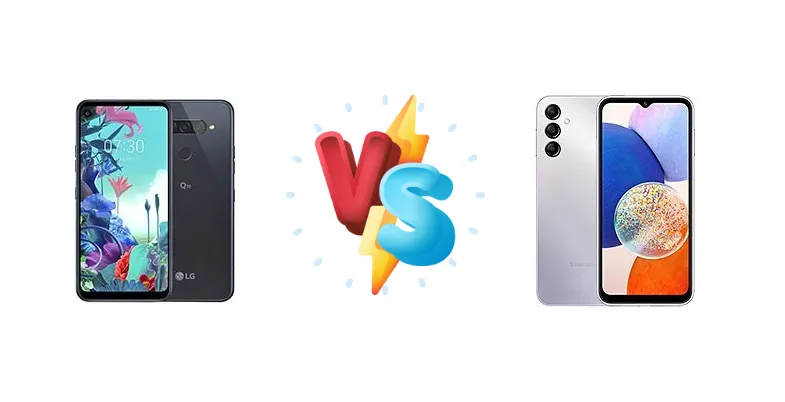
The LG Q70 and Samsung Galaxy A14 5G represent different approaches to the budget smartphone market. The Q70, released in 2019, offers a proven Qualcomm chipset, while the A14 5G, a more recent release, leverages Samsung’s Exynos platform and 5G connectivity. This comparison dissects their strengths and weaknesses to help you choose the right device for your needs.
🏆 Quick Verdict
For most users, the Samsung Galaxy A14 5G is the better choice. Its Exynos 1330 chipset, built on a 5nm process, delivers significantly improved performance and efficiency compared to the LG Q70’s Snapdragon 675. While both offer 15W charging and similar battery endurance ratings, the A14 5G’s modern architecture provides a more future-proof experience.
| Network |
|---|
| 2G bands | GSM 850 / 900 / 1800 / 1900 | GSM 850 / 900 / 1800 / 1900 |
| 3G bands | HSDPA 850 / 900 / 1900 / 2100 | HSDPA 850 / 900 / 1700(AWS) / 1900 / 2100 |
| 4G bands | 2, 3, 4, 5, 7, 12, 13, 20, 66 - Verizon | 1, 2, 3, 4, 5, 7, 8, 12, 17, 20, 26, 28, 38, 40, 41, 66 - International |
| 5G bands | - | 2, 5, 66, 77 Sub6/mmWave - USA |
| Speed | HSPA 42.2/5.76 Mbps, LTE (3CA) Cat11 600/75 Mbps | HSPA, LTE, 5G |
| Technology | GSM / CDMA / HSPA / EVDO / LTE | GSM / HSPA / LTE / 5G |
| | CDMA2000 1xEV-DO | 1, 3, 5, 7, 8, 20, 28, 40, 41, 78 SA/NSA/Sub6 - India |
| Launch |
|---|
| Announced | 2019, September 28. Released 2019, October | 2023, January 04 |
| Status | Discontinued | Available. Released 2023, January 12 |
| Body |
|---|
| Build | Glass front (Gorilla Glass), glass back, aluminum frame | Glass front, plastic back, plastic frame |
| Dimensions | 162.1 x 76.8 x 8.3 mm (6.38 x 3.02 x 0.33 in) | 167.7 x 78 x 9.1 mm (6.60 x 3.07 x 0.36 in) |
| SIM | · Nano-SIM· Nano-SIM + Nano-SIM | · Nano-SIM· Nano-SIM + Nano-SIM |
| Weight | 198 g (6.98 oz) | 202 g (7.13 oz) |
| | IP68 dust/water resistant (up to 1.5m for 30 min)
MIL-STD-810G compliant*
*does not guarantee ruggedness or use in extreme conditions | - |
| Display |
|---|
| Protection | Corning Gorilla Glass | - |
| Resolution | 1080 x 2310 pixels (~398 ppi density) | 1080 x 2408 pixels, 20:9 ratio (~400 ppi density) |
| Size | 6.4 inches, 101.4 cm2 (~81.4% screen-to-body ratio) | 6.6 inches, 104.9 cm2 (~80.2% screen-to-body ratio) |
| Type | IPS LCD | PLS LCD, 90Hz |
| Platform |
|---|
| CPU | Octa-core (2x2.0 GHz Kryo 460 Gold & 6x1.7 GHz Kryo 460 Silver) | Octa-core (2x2.4 GHz Cortex-A78 & 6x2.0 GHz Cortex-A55) - SM-A146BOcta-core (2x2.2 GHz Cortex-A76 & 6x2.0 GHz Cortex-A55) - SM-A146P |
| Chipset | Qualcomm SDM675 Snapdragon 675 (11 nm) | Exynos 1330 (5 nm) - SM-A146BMediatek Dimensity 700 (7 nm) - SM-A146P |
| GPU | Adreno 612 | Mali-G68 MP2 - SM-A146BMali-G57 MC2 - SM-A146P |
| OS | Android 9.0 (Pie), upgradable to Android 10, LG UX 9 | Android 13, upgradable to Android 15, One UI Core 7 |
| Memory |
|---|
| Card slot | microSDXC (dedicated slot) | microSDXC (uses shared SIM slot) - USA onlymicroSDXC (dedicated slot) - International |
| Internal | 64GB 4GB RAM | 64GB 4GB RAM, 128GB 4GB RAM, 128GB 6GB RAM, 128GB 8GB RAM |
| | eMMC 5.1 | - |
| Main Camera |
|---|
| Dual or Triple | 32 MP, f/1.8, 26mm (wide), 1/2.8", 0.8µm, PDAF
13 MP, f/2.2, 13mm (ultrawide)
Auxiliary lens
or
32 MP, f/1.8, 26mm (wide), 1/2.8", 0.8µm, PDAF
Auxiliary lens | - |
| Features | LED flash, panorama, HDR | LED flash, panorama, HDR |
| Single | - | 13 MP, f/2.0, (wide) |
| Triple | - | 50 MP, f/1.8, 26mm (wide), 1/2.76", 0.64µm, PDAF
2 MP (macro)
Auxiliary lens |
| Video | 4K@30fps, 1080p@30fps | 1080p@30fps |
| Selfie camera |
|---|
| Features | HDR | - |
| Single | 16 MP, f/1.9, 26mm (wide), 1/2.8", 1.12µm | 13 MP, f/2.0, 26mm (wide), 1.12µm |
| Video | 1080p@30fps | 1080p@30fps |
| Sound |
|---|
| 3.5mm jack | Yes | Yes |
| 35mm jack | Yes | Yes |
| Loudspeaker | Yes | Yes |
| | 32-bit/192kHz audio | - |
| Comms |
|---|
| Bluetooth | 5.0, A2DP, LE | 5.2, A2DP, LE |
| NFC | Yes | Yes |
| Positioning | GPS, GLONASS | GPS, GLONASS, GALILEO |
| Radio | No | FM radio (Exynos 1330 chipset only), recording |
| USB | USB Type-C 2.0 | USB Type-C 2.0 |
| WLAN | Wi-Fi 802.11 a/b/g/n/ac, dual-band, Wi-Fi Direct, DLNA | Wi-Fi 802.11 a/b/g/n/ac, dual-band, Wi-Fi Direct |
| Features |
|---|
| Sensors | Fingerprint (rear-mounted), accelerometer, proximity, compass | Fingerprint (side-mounted), accelerometer, gyro, proximity, compass, barometer (USA only) |
| Battery |
|---|
| Charging | 15W wired, QC3 | 15W wired |
| Type | Li-Po 4000 mAh, non-removable | Li-Po 5000 mAh |
| Misc |
|---|
| Colors | Mirror Black | Black, Light Green, Dark Red, Silver |
| Models | LM-Q730N, LMQ620WA, LM-Q620WA, LM-Q620VAB, LMQ620VAB, LM-Q730 | SM-A146B, SM-A146B/DS, SM-A146P, SM-A146P/DS, SM-A146U, SM-A146U1, SM-A146U1/DS, SM-A146W, SM-A146P/N, SM-A146P/DSN, SM-S146VL, SM-A146M |
| Price | About 320 EUR | $ 77.63 / C$ 151.00 / £ 97.00 / € 159.79 / ₹ 14,990 |
| SAR | - | 1.00 W/kg (head) 1.00 W/kg (body) |
| SAR EU | - | 0.56 W/kg (head) 1.28 W/kg (body) |
| Tests |
|---|
| Battery life | - |
Endurance rating 130h
|
| Camera | - |
Photo / Video |
| Display | - |
Contrast ratio: 1334:1 (nominal) |
| Loudspeaker | - |
-26.8 LUFS (Good)
|
| Performance | - |
AnTuTu: 307886 (v9)
GeekBench: 1727 (v5.1)
GFXBench: 12fps (ES 3.1 onscreen) |
LG Q70
- Proven Qualcomm Snapdragon 675 chipset
- Potentially lower price point due to age
- Familiar Android experience (depending on software version)
- Older chipset with lower performance
- No 5G connectivity
- Display brightness likely lower than A14 5G
Samsung Galaxy A14 5G
- More powerful Exynos 1330 or Dimensity 700 chipset
- 5G connectivity for faster data speeds
- Brighter display for better outdoor visibility
- Exynos 1330 may exhibit some thermal throttling under heavy load
- Software experience can be bloated with Samsung’s One UI
- 2MP macro camera is largely ineffective
Display Comparison
The Samsung Galaxy A14 5G boasts a brighter display, measured at 519 nits, compared to the LG Q70’s unspecified brightness. Both share a 1334:1 contrast ratio, suggesting similar color reproduction capabilities. However, the A14 5G’s larger screen size and higher peak brightness make it more suitable for outdoor use and media consumption. The Q70’s display technology is not specified, while the A14 5G likely utilizes a standard LCD panel, offering a decent viewing experience for its price point.
Camera Comparison
Both devices offer photo and video capabilities, but detailed camera specifications are limited. The LG Q70’s camera system is not detailed, making a direct comparison difficult. The Samsung Galaxy A14 5G’s camera performance will depend heavily on software processing. Without knowing sensor sizes or aperture values, it’s difficult to assess image quality. The presence of a 2MP macro camera on the A14 5G is unlikely to significantly enhance the photography experience, serving primarily as a marketing feature.
Performance
The core difference lies in the chipsets. The Samsung Galaxy A14 5G utilizes either the Exynos 1330 (5nm) or the MediaTek Dimensity 700 (7nm), depending on the region. The Exynos 1330, with its Cortex-A78 cores clocked at 2.4 GHz, offers a substantial performance uplift over the LG Q70’s Snapdragon 675 (11nm). The 5nm fabrication process of the Exynos 1330 also translates to better power efficiency and reduced thermal throttling during sustained workloads. The Snapdragon 675’s Kryo 460 cores, while capable, are simply outmatched by the newer architecture of the Exynos 1330. The A14 5G’s CPU configuration (2x2.4 GHz Cortex-A78 & 6x2.0 GHz Cortex-A55) provides a more responsive experience for multitasking and demanding applications.
Battery Life
Both the LG Q70 and Samsung Galaxy A14 5G have an endurance rating of 130 hours, suggesting comparable battery life under similar usage conditions. Both support 15W wired charging, meaning charging times will be similar. The Exynos 1330’s improved power efficiency in the A14 5G could potentially offset the lack of faster charging, allowing for slightly longer real-world usage despite similar battery capacities.
Buying Guide
Buy the LG Q70 if you prioritize a familiar Qualcomm chipset and can find it at a significantly discounted price. It’s a viable option for basic tasks and light usage. Buy the Samsung Galaxy A14 5G if you want a more capable device with 5G connectivity, a more efficient processor, and a brighter display, even if it means sacrificing the established Qualcomm ecosystem.
Frequently Asked Questions
❓ Does the Exynos 1330 in the Galaxy A14 5G tend to overheat during prolonged gaming sessions?
While the Exynos 1330 is a capable chip, it's not known for exceptional thermal performance. Expect some throttling during extended gaming, but it shouldn't be severe enough to render games unplayable. The 5nm process helps mitigate heat compared to the Q70's 11nm Snapdragon 675.
❓ Is the 2MP macro camera on the Samsung Galaxy A14 5G actually useful for taking detailed close-up photos?
Generally, 2MP macro cameras on budget phones are more of a marketing gimmick than a genuinely useful feature. The low resolution results in images lacking detail and sharpness. You're better off using the main camera and cropping for close-up shots.
❓ Can the Samsung Galaxy A14 5G reliably maintain 60fps in popular games like PUBG Mobile?
The Galaxy A14 5G should be able to run PUBG Mobile at 60fps on medium settings. However, achieving consistently smooth frame rates may require lowering graphics settings, especially during intense action sequences. The Exynos 1330 provides a noticeable improvement over the Q70's Snapdragon 675 in gaming performance.
❓ How does the software update support compare between the LG Q70 and the Samsung Galaxy A14 5G?
Samsung generally provides better software update support than LG, especially for budget devices. The LG Q70 is likely no longer receiving major Android updates, while the Galaxy A14 5G should receive at least a couple of major Android version updates and several years of security patches.