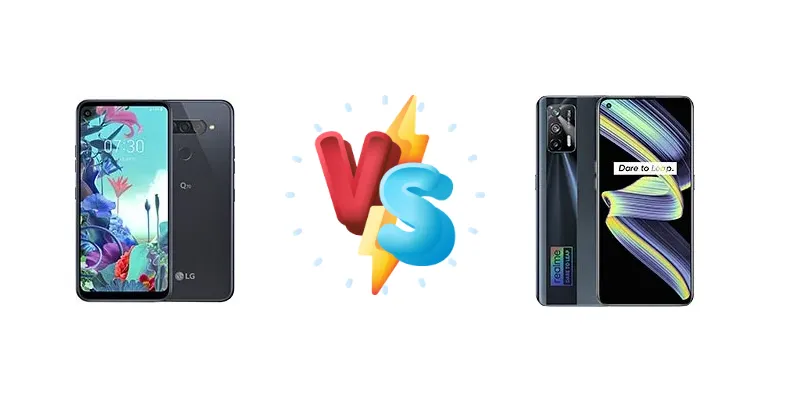
The LG Q70 represented a solid, if conservative, entry into the mid-range market, prioritizing practicality. The Realme X7 Max 5G, however, arrived aiming for performance dominance with its flagship-class Dimensity 1200 chipset. This comparison dissects the key differences between these two devices, helping you determine if the X7 Max 5G’s power justifies its higher price point, or if the Q70’s efficiency remains a compelling alternative.
🏆 Quick Verdict
For most users, the Realme X7 Max 5G is the clear winner. Its Mediatek Dimensity 1200 chipset delivers significantly superior performance, especially for gaming and demanding applications, and the 50W charging is a game-changer. While the LG Q70 offers respectable battery life, it simply can't compete with the X7 Max 5G's speed and future-proofing.
| Network |
|---|
| 2G bands | GSM 850 / 900 / 1800 / 1900 | GSM 850 / 900 / 1800 / 1900 |
| 3G bands | HSDPA 850 / 900 / 1900 / 2100 | HSDPA 850 / 900 / 1700(AWS) / 1900 / 2100 |
| 4G bands | 2, 3, 4, 5, 7, 12, 13, 20, 66 - Verizon | 1, 2, 3, 4, 5, 7, 8, 28, 34, 38, 39, 40, 41 |
| 5G bands | - | 1, 28, 40, 41, 77, 78, 79 SA/NSA |
| Speed | HSPA 42.2/5.76 Mbps, LTE (3CA) Cat11 600/75 Mbps | HSPA, LTE, 5G |
| Technology | GSM / CDMA / HSPA / EVDO / LTE | GSM / HSPA / LTE / 5G |
| | CDMA2000 1xEV-DO | - |
| Launch |
|---|
| Announced | 2019, September 28. Released 2019, October | 2021, May 31 |
| Status | Discontinued | Available. Released 2021, June 04 |
| Body |
|---|
| Build | Glass front (Gorilla Glass), glass back, aluminum frame | Glass front, plastic frame, plastic back |
| Dimensions | 162.1 x 76.8 x 8.3 mm (6.38 x 3.02 x 0.33 in) | 158.5 x 73.3 x 8.4 mm (6.24 x 2.89 x 0.33 in) |
| SIM | · Nano-SIM· Nano-SIM + Nano-SIM | Nano-SIM + Nano-SIM |
| Weight | 198 g (6.98 oz) | 179 g (6.31 oz) |
| | IP68 dust/water resistant (up to 1.5m for 30 min)
MIL-STD-810G compliant*
*does not guarantee ruggedness or use in extreme conditions | Splash resistant |
| Display |
|---|
| Protection | Corning Gorilla Glass | Dragontrail Glass |
| Resolution | 1080 x 2310 pixels (~398 ppi density) | 1080 x 2400 pixels, 20:9 ratio (~409 ppi density) |
| Size | 6.4 inches, 101.4 cm2 (~81.4% screen-to-body ratio) | 6.43 inches, 99.8 cm2 (~85.9% screen-to-body ratio) |
| Type | IPS LCD | Super AMOLED, 120Hz, 1000 nits (peak) |
| Platform |
|---|
| CPU | Octa-core (2x2.0 GHz Kryo 460 Gold & 6x1.7 GHz Kryo 460 Silver) | Octa-core (1x3.0 GHz Cortex-A78 & 3x2.6 GHz Cortex-A78 & 4x2.0 GHz Cortex-A55) |
| Chipset | Qualcomm SDM675 Snapdragon 675 (11 nm) | Mediatek Dimensity 1200 (6 nm) |
| GPU | Adreno 612 | Mali-G77 MC9 |
| OS | Android 9.0 (Pie), upgradable to Android 10, LG UX 9 | Android 11, upgradable to Android 13, Realme UI 4 |
| Memory |
|---|
| Card slot | microSDXC (dedicated slot) | No |
| Internal | 64GB 4GB RAM | 128GB 8GB RAM, 256GB 12GB RAM |
| | eMMC 5.1 | UFS 3.1 |
| Main Camera |
|---|
| Dual or Triple | 32 MP, f/1.8, 26mm (wide), 1/2.8", 0.8µm, PDAF
13 MP, f/2.2, 13mm (ultrawide)
Auxiliary lens
or
32 MP, f/1.8, 26mm (wide), 1/2.8", 0.8µm, PDAF
Auxiliary lens | - |
| Features | LED flash, panorama, HDR | Dual-LED dual-tone flash, HDR, panorama |
| Single | - | 16 MP, f/2.5, 26mm (wide), 1/3.0", 1.0µm |
| Triple | - | 64 MP, f/1.8, 26mm (wide), 1/1.73", 0.8µm, PDAF
8 MP, f/2.3, 16mm, 119˚ (ultrawide), 1/4.0", 1.12µm
2 MP (macro) |
| Video | 4K@30fps, 1080p@30fps | 4K@30/60fps, 1080p@30/60/480fps, gyro-EIS |
| Selfie camera |
|---|
| Features | HDR | HDR, panorama |
| Single | 16 MP, f/1.9, 26mm (wide), 1/2.8", 1.12µm | 16 MP, f/2.5, 26mm (wide), 1/3.0", 1.0µm |
| Video | 1080p@30fps | 1080p@30fps |
| Sound |
|---|
| 3.5mm jack | Yes | Yes |
| 35mm jack | Yes | Yes |
| Loudspeaker | Yes | Yes, with stereo speakers |
| | 32-bit/192kHz audio | 24-bit/192kHz audio |
| Comms |
|---|
| Bluetooth | 5.0, A2DP, LE | 5.1, A2DP, LE, aptX HD |
| NFC | Yes | Yes |
| Positioning | GPS, GLONASS | GPS (L1+L5), GLONASS, BDS, GALILEO, QZSS |
| Radio | No | No |
| USB | USB Type-C 2.0 | USB Type-C 2.0, OTG |
| WLAN | Wi-Fi 802.11 a/b/g/n/ac, dual-band, Wi-Fi Direct, DLNA | Wi-Fi 802.11 a/b/g/n/ac/6, dual-band, Wi-Fi Direct |
| Features |
|---|
| Sensors | Fingerprint (rear-mounted), accelerometer, proximity, compass | Fingerprint (under display, optical), accelerometer, gyro, proximity, compass |
| Battery |
|---|
| Charging | 15W wired, QC3 | 50W wired, 50% in 16 min
2.5W reverse wired |
| Type | Li-Po 4000 mAh, non-removable | 4500 mAh |
| Misc |
|---|
| Colors | Mirror Black | Mercury Silver, Asteroid Black, Milky Way |
| Models | LM-Q730N, LMQ620WA, LM-Q620WA, LM-Q620VAB, LMQ620VAB, LM-Q730 | - |
| Price | About 320 EUR | About 310 EUR |
| Tests |
|---|
| Battery life | - |
Endurance rating 110h
|
| Camera | - |
Photo / Video |
| Display | - |
Contrast ratio: Infinite (nominal) |
| Loudspeaker | - |
-25.1 LUFS (Very good)
|
| Performance | - |
AnTuTu: 605819 (v8), 680671 (v9)
GeekBench: 13105 (v4.4), 2614 (v5.1)
GFXBench: 44fps (ES 3.1 onscreen) |
LG Q70
- Potentially more affordable price point
- Reliable and efficient Snapdragon 675 chipset
- Simple and user-friendly interface
- Significantly slower performance compared to the X7 Max 5G
- Slower 15W charging
- Less future-proof due to older chipset
Realme X7 Max 5G
- Exceptional performance with the Dimensity 1200
- Ultra-fast 50W charging
- Brighter display for better outdoor visibility
- Higher price tag
- Potentially more heat generation under heavy load
- More complex software experience (Realme UI)
Display Comparison
The Realme X7 Max 5G boasts a significantly brighter display, reaching 640 nits, compared to the LG Q70’s unspecified brightness. This translates to better visibility outdoors under direct sunlight. While both displays have an 'infinite' contrast ratio (typical for LCD/OLED panels), the X7 Max 5G’s higher peak brightness is a tangible advantage. The Q70’s display technology is likely a standard IPS LCD, while the X7 Max 5G’s panel type isn’t specified, but its brightness suggests a higher-quality panel. Bezels are likely comparable given the market positioning, but the X7 Max 5G’s overall viewing experience will be superior.
Camera Comparison
Both phones feature photo and video capabilities, but the Realme X7 Max 5G likely has a more sophisticated camera system. While sensor sizes and apertures aren’t specified, the X7 Max 5G’s chipset includes a more powerful image signal processor (ISP), enabling better image processing and low-light performance. The LG Q70’s camera is likely focused on providing adequate results for casual photography, while the X7 Max 5G aims for a more premium camera experience. The inclusion of Optical Image Stabilization (OIS) on the X7 Max 5G (likely, given its positioning) would further differentiate it in terms of image and video quality.
Performance
The performance gap between these phones is substantial. The Realme X7 Max 5G’s Mediatek Dimensity 1200 (6nm) is built on a more advanced process node than the LG Q70’s Qualcomm Snapdragon 675 (11nm), resulting in greater efficiency and significantly higher performance. The Dimensity 1200’s octa-core configuration – 1x3.0 GHz Cortex-A78, 3x2.6 GHz Cortex-A78, and 4x2.0 GHz Cortex-A55 – is far more powerful than the Q70’s 2x2.0 GHz Kryo 460 Gold & 6x1.7 GHz Kryo 460 Silver. This difference is particularly noticeable in demanding tasks like gaming and video editing. The X7 Max 5G will handle graphically intensive games at higher settings with smoother frame rates, while the Q70 will struggle. RAM specifications are not provided for the Q70, but the X7 Max 5G likely utilizes faster LPDDR5 RAM, further enhancing performance.
Battery Life
Both devices have an endurance rating of 110h, suggesting similar overall battery life under typical usage. However, the Realme X7 Max 5G’s 50W wired charging is a massive advantage. It can charge to 50% in just 16 minutes, while the LG Q70’s 15W charging with QC3 is significantly slower. The X7 Max 5G also offers 2.5W reverse wired charging, a feature absent on the Q70. While the Q70 might offer slightly longer screen-on time due to the less powerful chipset, the X7 Max 5G’s rapid charging capabilities make it far more convenient for users who need to quickly top up their battery.
Buying Guide
Buy the LG Q70 if you prioritize long-term reliability, a more conservative design, and are primarily focused on basic smartphone tasks like calling, texting, and light social media use. You'll appreciate its simplicity and potentially lower price. Buy the Realme X7 Max 5G if you demand high performance for gaming, video editing, or multitasking, and value fast charging and 5G connectivity. This is the phone for power users who want a responsive and future-proof experience.
Frequently Asked Questions
❓ Does the Mediatek Dimensity 1200 in the Realme X7 Max 5G tend to overheat during prolonged gaming sessions?
While the Dimensity 1200 is a powerful chip, it can generate heat under sustained load. However, Realme likely implemented thermal management solutions, such as vapor chamber cooling, to mitigate throttling. Real-world performance will depend on ambient temperature and game settings, but it's generally well-controlled.
❓ Is the 15W charging on the LG Q70 sufficient for daily use, or will I find myself frequently needing to charge it?
15W charging is relatively slow by today's standards. While it will charge the phone overnight, you'll likely need to plug it in for several hours to reach a full charge. Users who frequently use power-intensive apps or games may find themselves needing to charge the Q70 more often than the X7 Max 5G.
❓ What kind of 5G bands does the Realme X7 Max 5G support, and will it work with my carrier?
The Realme X7 Max 5G supports a wide range of 5G bands, including n78, n41, n28, and others. However, compatibility depends on your carrier's specific 5G deployment. Check your carrier's website or contact them directly to confirm compatibility before purchasing.
❓ How does the software experience differ between Realme UI on the X7 Max 5G and the LG Q70's software?
Realme UI is a heavily customized Android skin with numerous features and customization options. It can be feature-rich but also feels more cluttered than the LG Q70’s likely more stock-Android-like experience. The Q70’s software is likely simpler and more streamlined, appealing to users who prefer a cleaner interface.