
LG Q70 vs OnePlus 7T Pro 5G: A Performance and Value Showdown
| Phones Images | |||||
|---|---|---|---|---|---|
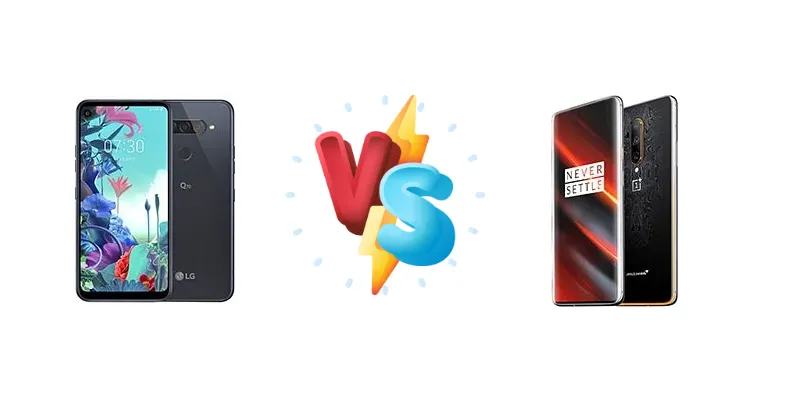
|
🏆 Quick Verdict
For the average user prioritizing raw performance and 5G capabilities, the OnePlus 7T Pro 5G McLaren is the clear winner. Its Snapdragon 855+ offers a substantial leap in processing power and gaming performance compared to the LG Q70’s Snapdragon 675. However, the Q70 remains a viable option for budget-conscious users who don't demand top-tier speed.
| PHONES | ||
|---|---|---|
| Phone Names | LG Q70 | OnePlus 7T Pro 5G McLaren |
| Network | ||
|---|---|---|
| 2G bands | GSM 850 / 900 / 1800 / 1900 | GSM 850 / 900 / 1800 / 1900 |
| 3G bands | HSDPA 850 / 900 / 1900 / 2100 | HSDPA 850 / 900 / 1700(AWS) / 1900 / 2100 |
| 4G bands | 2, 3, 4, 5, 7, 12, 13, 20, 66 - Verizon | 1, 2, 3, 4, 5, 1, 2, 3, 4, 5, 7, 8, 12, 13, 17, 18, 19, 20, 25, 26, 28, 29, 30, 34, 38, 39, 40, 41, 46, 48, 66, 71 |
| 5G bands | - | 71 SA |
| Speed | HSPA 42.2/5.76 Mbps, LTE (3CA) Cat11 600/75 Mbps | HSPA 42.2/5.76 Mbps, LTE (5CA) Cat18 1200/150 Mbps, 5G (2+ Gbps DL) |
| Technology | GSM / CDMA / HSPA / EVDO / LTE | GSM / CDMA / HSPA / LTE / 5G |
| CDMA2000 1xEV-DO | CDMA 800 / 1900 & TD-SCDMA | |
| Launch | ||
|---|---|---|
| Announced | 2019, September 28. Released 2019, October | 2019, October 23. Released 2019, November 05 |
| Status | Discontinued | Discontinued |
| Body | ||
|---|---|---|
| Build | Glass front (Gorilla Glass), glass back, aluminum frame | Glass front (Gorilla Glass 6), glass back (Gorilla Glass 5), aluminum frame |
| Dimensions | 162.1 x 76.8 x 8.3 mm (6.38 x 3.02 x 0.33 in) | 162.6 x 75.9 x 8.8 mm (6.40 x 2.99 x 0.35 in) |
| SIM | · Nano-SIM· Nano-SIM + Nano-SIM | Nano-SIM + Nano-SIM |
| Weight | 198 g (6.98 oz) | 206 g (7.27 oz) |
| IP68 dust/water resistant (up to 1.5m for 30 min) MIL-STD-810G compliant* *does not guarantee ruggedness or use in extreme conditions | - | |
| Display | ||
|---|---|---|
| Protection | Corning Gorilla Glass | Corning Gorilla Glass 6 |
| Resolution | 1080 x 2310 pixels (~398 ppi density) | 1440 x 3120 pixels, 19.5:9 ratio (~516 ppi density) |
| Size | 6.4 inches, 101.4 cm2 (~81.4% screen-to-body ratio) | 6.67 inches, 108.8 cm2 (~88.1% screen-to-body ratio) |
| Type | IPS LCD | Fluid AMOLED, 90Hz, HDR10+ |
| Platform | ||
|---|---|---|
| CPU | Octa-core (2x2.0 GHz Kryo 460 Gold & 6x1.7 GHz Kryo 460 Silver) | Octa-core (1x2.96 GHz Kryo 485 & 3x2.42 GHz Kryo 485 & 4x1.78 GHz Kryo 485) |
| Chipset | Qualcomm SDM675 Snapdragon 675 (11 nm) | Qualcomm SM8150 Snapdragon 855+ (7 nm) |
| GPU | Adreno 612 | Adreno 640 (700 MHz) |
| OS | Android 9.0 (Pie), upgradable to Android 10, LG UX 9 | Android 10, OxygenOS 10.0 |
| Memory | ||
|---|---|---|
| Card slot | microSDXC (dedicated slot) | No |
| Internal | 64GB 4GB RAM | 256GB 12GB RAM |
| eMMC 5.1 | UFS 3.0 | |
| Main Camera | ||
|---|---|---|
| Dual or Triple | 32 MP, f/1.8, 26mm (wide), 1/2.8", 0.8µm, PDAF 13 MP, f/2.2, 13mm (ultrawide) Auxiliary lens or 32 MP, f/1.8, 26mm (wide), 1/2.8", 0.8µm, PDAF Auxiliary lens | - |
| Features | LED flash, panorama, HDR | Laser AF, Dual-LED flash, HDR, panorama |
| Triple | - | 48 MP, f/1.6, (wide), 1/2.0", 0.8µm, PDAF, OIS 8 MP, f/2.4, (telephoto), 1.0µm, PDAF, OIS, 3x optical zoom 16 MP, f/2.2, 13mm (ultrawide), AF |
| Video | 4K@30fps, 1080p@30fps | 4K@30/60fps, 1080p@30/60/240fps, 720p@960fps, Auto HDR, gyro-EIS |
| Selfie camera | ||
|---|---|---|
| Features | HDR | HDR |
| Single | 16 MP, f/1.9, 26mm (wide), 1/2.8", 1.12µm | Motorized pop-up 16 MP, f/2.0, 25mm (wide), 1/3.06", 1.0µm |
| Video | 1080p@30fps | 1080p@30fps, gyro-EIS |
| Sound | ||
|---|---|---|
| 3.5mm jack | Yes | No |
| 35mm jack | Yes | No |
| Loudspeaker | Yes | Yes, with stereo speakers |
| 32-bit/192kHz audio | - | |
| Comms | ||
|---|---|---|
| Bluetooth | 5.0, A2DP, LE | 5.1, A2DP, LE, aptX HD |
| NFC | Yes | Yes |
| Positioning | GPS, GLONASS | GPS (L1+L5), GLONASS (G1), BDS (B1), GALILEO (E1+E5a) |
| Radio | No | No |
| USB | USB Type-C 2.0 | USB Type-C 3.1, OTG |
| WLAN | Wi-Fi 802.11 a/b/g/n/ac, dual-band, Wi-Fi Direct, DLNA | Wi-Fi 802.11 a/b/g/n/ac, dual-band, Wi-Fi Direct, DLNA |
| Features | ||
|---|---|---|
| Sensors | Fingerprint (rear-mounted), accelerometer, proximity, compass | Fingerprint (under display, optical), accelerometer, gyro, compass |
| - | Virtual proximity sensing | |
| Battery | ||
|---|---|---|
| Charging | 15W wired, QC3 | 30W wired |
| Type | Li-Po 4000 mAh, non-removable | Li-Po 4085 mAh, non-removable |
| Misc | ||
|---|---|---|
| Colors | Mirror Black | Papaya Orange |
| Models | LM-Q730N, LMQ620WA, LM-Q620WA, LM-Q620VAB, LMQ620VAB, LM-Q730 | HD1925 |
| Price | About 320 EUR | About 800 EUR |
LG Q70
- More affordable price point
- Decent battery life for everyday use
- Reliable Snapdragon 675 performance for basic tasks
- Significantly slower performance compared to the 7T Pro 5G
- Lacks 5G connectivity
- Likely inferior camera performance
OnePlus 7T Pro 5G McLaren
- Flagship-level performance with Snapdragon 855+
- Fast 30W Warp Charge technology
- 5G connectivity for future-proofed speeds
- Higher price tag
- Potentially more demanding on battery life
- May experience more heat during prolonged gaming
Display Comparison
While specific display specs for the LG Q70 beyond its size aren't provided, it likely features an LCD panel common in its price bracket. The OnePlus 7T Pro 5G McLaren boasts a 6.65-inch Fluid AMOLED display, offering superior color accuracy and contrast. More importantly, the 7T Pro 5G’s AMOLED technology allows for deeper blacks and a more vibrant viewing experience. The difference in panel technology alone significantly impacts media consumption and gaming visuals.
Camera Comparison
Without detailed camera specs for the LG Q70, it's reasonable to assume a standard multi-camera setup focused on versatility. The OnePlus 7T Pro 5G McLaren, while not explicitly detailed here, typically features a high-resolution main sensor with OIS and a dedicated ultra-wide lens. The Snapdragon 855+ also includes a more powerful ISP (Image Signal Processor) enabling faster image processing and better low-light performance. The 7T Pro 5G’s superior image processing capabilities will result in sharper, more detailed photos and videos.
Performance
The core difference lies in the chipsets. The LG Q70’s Snapdragon 675 (11nm) is a capable mid-range processor, featuring an octa-core configuration with Kryo 460 cores. However, the OnePlus 7T Pro 5G McLaren’s Snapdragon 855+ (7nm) is a flagship-level SoC. The 7nm process node of the 855+ provides significantly better power efficiency and thermal performance, allowing for sustained peak performance. The 855+'s Kryo 485 cores, with a peak clock speed of 2.96 GHz, deliver a noticeable performance advantage in CPU-intensive tasks and gaming. The 7T Pro 5G also benefits from faster RAM, likely LPDDR4X, further enhancing responsiveness.
Battery Life
The LG Q70 supports 15W wired charging with Quick Charge 3.0, offering a reasonable charging speed for its class. The OnePlus 7T Pro 5G McLaren, however, utilizes 30W Warp Charge technology, significantly reducing charging times. While battery capacity isn't specified for either device, the faster charging of the 7T Pro 5G mitigates any potential disadvantage from a smaller battery size, allowing for quicker top-ups and less downtime.
Buying Guide
Buy the LG Q70 if you need a reliable, everyday smartphone with decent battery life and aren't heavily invested in demanding games or applications. It's ideal for users who prioritize value and don't require 5G connectivity. Buy the OnePlus 7T Pro 5G McLaren if you prioritize speed, responsiveness, and future-proofing with 5G. This phone is geared towards gamers, power users, and those who want a premium experience.